AI gym routine app
How to Choose an AI Gym Routine App That Actually Fits Your Training
The best AI gym routine app does more than generate random exercises. Learn which features matter for goals, equipment, progression, and consistency.
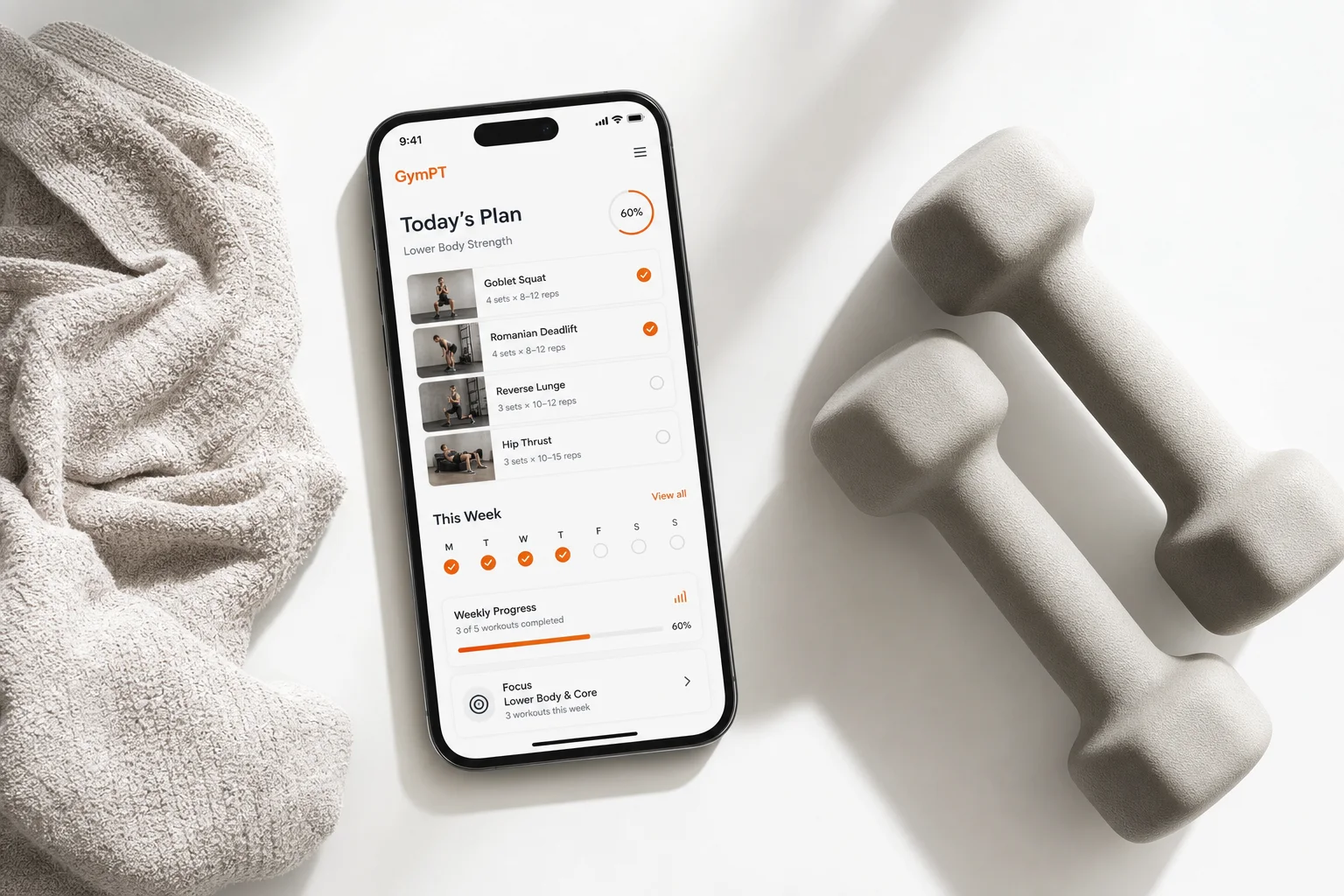
Choosing an AI gym routine app can feel surprisingly difficult. Many apps promise personalized workouts, but personalization can mean anything from selecting a goal to adapting an entire training week around your schedule, equipment, experience, and progress.
The practical difference is important. A useful app should help you make better training decisions repeatedly—not just produce an attractive workout on day one. It should give you a clear plan, explain what to do, record what happened, and adjust when your circumstances change.
This guide explains what to look for, how to evaluate an app before committing to it, and why GymPT is a practical example of a more complete AI training approach.
What should an AI gym routine app do?
At a minimum, an AI gym routine app should turn your input into a realistic weekly routine. That input may include your goal, training level, available days, session length, equipment, and preferred training environment.
However, a genuinely useful app should go beyond exercise selection. It should connect four parts of the training process:
- Planning: creating sessions that match your goal and availability.
- Execution: showing exercises, sets, reps, rest periods, and useful instructions.
- Tracking: recording weights, repetitions, completed sessions, and consistency.
- Adjustment: using your training history and feedback to improve future sessions.
This matters because a routine is not a finished product. It is a starting point that should become more useful as the app learns about your training behavior.
7 features to compare before choosing an AI gym routine app
1. Goal-specific programming
Look for an app that asks what you are trying to achieve instead of treating every user the same. Strength, muscle gain, general fitness, fat loss, and building a consistent routine can require different exercise choices, session structures, and progression strategies.
A good system should also ask about your current experience. A beginner may need fewer exercises, more explanation, and a manageable number of weekly sessions. An experienced lifter may need more control over exercise selection, volume, and progression.
Goal selection should influence the plan without locking you into a rigid template. Your goal may change, or you may temporarily prioritize shorter sessions during a busy period.
2. Equipment-aware workouts
One of the fastest ways to identify a weak app is to see whether it recommends equipment you do not have. A routine built around machines is not useful if you train at home with dumbbells. A barbell-focused plan may not fit a small apartment gym.
An effective app should understand the difference between training at a full gym, using a limited home setup, or working with no equipment. It should also offer sensible exercise substitutions rather than simply removing movements from the plan.
This is especially valuable when equipment availability changes. You may have access to a full gym on weekdays but only dumbbells at home on weekends. An equipment-based system can help preserve the purpose of the session while changing the exercise details.
For ideas on matching movements to the tools you own, read Dumbbell Workout Plan: Match Your Exercises to the Equipment You Have.
3. A realistic weekly schedule
The best plan is one you can repeat. Before choosing an app, check whether it lets you control training frequency, session duration, preferred training days, and recovery time.
More sessions are not automatically better. Research on resistance training suggests that training frequency should be considered alongside total weekly volume and individual preference. In practice, an app should help distribute training in a way that fits your life rather than assuming that everyone can train five or six days per week.
For many people, two to four well-structured sessions are easier to sustain than an ambitious daily plan. A good app should make consistency easier, not create another schedule you feel guilty about missing.
4. Progressive overload without guesswork
Progressive overload means gradually increasing the challenge of training. That may involve adding weight, completing more repetitions, performing an additional set, improving technique, or using a more demanding variation.
An AI gym routine app should make progression visible. Useful features may include:
- Previous performance for each exercise.
- Suggested weights or repetition targets based on your history.
- Simple guidance on when to increase difficulty.
- Notes for effort, form, or exercise substitutions.
- Adjustments when a target is consistently too easy or too difficult.
Progression should not mean adding more work every session regardless of how you feel. A responsible system should recognize that performance varies with sleep, stress, schedule, and recovery.
5. Workout tracking that leads to decisions
Tracking is useful only when it helps you decide what to do next. Recording a workout is better than relying on memory, but a strong app should also show patterns over time.
Look for progress insights such as completed sessions, exercise history, volume trends, personal bests, and consistency. These metrics can answer practical questions: Are you training as often as planned? Are your lifts moving forward? Are you repeatedly skipping a certain session? Is your routine too demanding to maintain?
For a closer look at useful measurements, see Fitness Progress App: How to Track Workouts, Trends, and Consistency.
6. Coaching and explanations
AI can make an app feel personal, but chat alone is not the same as coaching. The app should connect its answers to your plan and training history.
Useful AI coach support might help you understand an exercise, choose an alternative, interpret a missed session, or decide how to approach a busy week. It should explain recommendations clearly instead of presenting unexplained numbers or overly confident claims.
It is also worth checking whether the app communicates its limits. Fitness software can provide general training guidance, but it should not diagnose injuries or replace qualified medical care. If you have pain, a medical condition, or a return-to-training concern, seek appropriate professional advice.
7. Adaptation over time
A static plan can be helpful for a few weeks, but real life rarely stays static. You may miss a session, change your goal, lose access to equipment, or find that an exercise does not suit you.
An adaptive workout plan should respond to those changes while preserving the purpose of your training. That may mean rescheduling a session, replacing an exercise, reducing the workload, or reorganizing the week.
Read Adaptive Workout Plan: Build a Week That Adjusts to Your Goals and Recovery for a deeper explanation of why flexibility matters.
How GymPT approaches personalized training
GymPT is designed as more than a library of premade workouts. It combines AI-generated planning with tools that help you train, track, and review your progress.
You can use GymPT to build routines around your training goal, experience, available equipment, and preferred schedule. The app can then support the complete training loop:
- Create a personalized workout plan.
- Ask the AI coach questions about your routine.
- Use body analysis as one source of training context.
- Adapt exercises to the equipment you have available.
- Track completed workouts and performance.
- Review progress insights to guide future decisions.
The advantage of this connected approach is that planning and tracking do not live in separate places. Your routine can become more relevant as you build a history of completed sessions and performance data.
For a broader discussion of AI coaching strengths and limitations, read Personalized Fitness Coach: What AI Can—and Cannot—Do for Your Training.
A simple test for comparing apps
Before choosing an AI gym routine app, use this five-question test:
- Can it create a plan for my actual goal? Check whether the goal changes the structure of the routine.
- Can it use the equipment I really have? Test a home, dumbbell-only, or limited-gym setup if relevant.
- Can it fit my real schedule? Look for control over days per week and session length.
- Can it show whether I am improving? Review the quality of exercise history and progress insights.
- Can it adapt when something changes? Check how it handles missed sessions, substitutions, and changing goals.
If an app performs well on all five questions, it is more likely to support consistent training than one that only generates attractive routines.
Common mistakes when choosing an AI workout app
- Choosing the app with the longest exercise library: More exercises do not automatically create better programming.
- Confusing novelty with personalization: A different workout every day may feel engaging but can make progression difficult to follow.
- Ignoring tracking: Without a useful history, it is harder to know whether the plan is working.
- Expecting perfect predictions: AI recommendations are inputs for decision-making, not guarantees of results.
- Starting with too much volume: A manageable plan that you complete is usually more useful than an advanced plan you abandon.
Final takeaway
The right AI gym routine app should help you make training simpler, more consistent, and more measurable. Prioritize goal-specific planning, equipment compatibility, realistic scheduling, progressive overload, meaningful tracking, useful coaching, and adaptation.
GymPT brings these elements together in one training experience, from personalized workout creation and AI coach chat to equipment-based planning, workout tracking, body analysis, and progress insights. The goal is not to replace your judgment. It is to give you clearer decisions and a more practical path from today’s workout to your next one.