dumbbell workout plan
Dumbbell Workout Plan: Match Your Exercises to the Equipment You Have
A good dumbbell workout plan should fit the equipment you actually have. Learn how to choose exercises, organize your week, and progress without making training complicated.
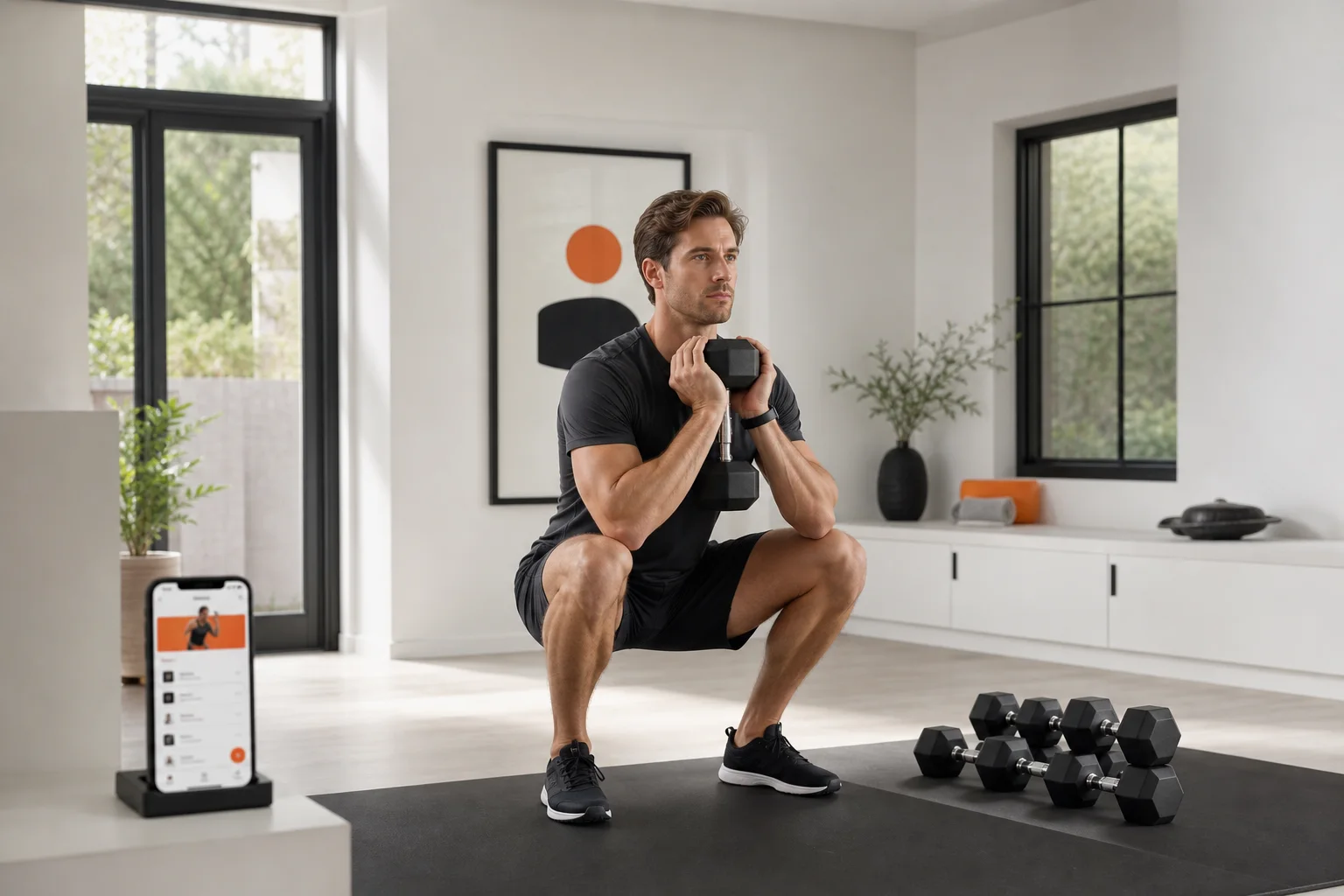
A good dumbbell workout plan does not start with a list of impressive exercises. It starts with a practical question: What equipment can you use consistently?
If you have one pair of light dumbbells, an adjustable set, or several weights at home, your plan should match that reality. When exercises fit your available equipment, workouts are easier to start, easier to track, and less likely to be interrupted by constant substitutions.
This guide shows you how to build a simple dumbbell routine around your equipment, training goal, available time, and experience level. You will also find a sample full-body plan and clear ways to make it harder as you get stronger.
Why your dumbbell workout plan should match your equipment
Equipment affects more than the amount of weight you can lift. It also changes which exercises are practical, how quickly you can move between movements, and how easy it is to progress from week to week.
For example, a pair of light dumbbells may work well for split squats, shoulder raises, rows, and higher-repetition presses. Heavier dumbbells may be better suited to goblet squats, Romanian deadlifts, floor presses, and loaded carries. Adjustable dumbbells give you more flexibility, but they can take longer to change between sets.
The best plan accounts for these details instead of assuming that everyone has a complete home gym. Resistance training can be effective with relatively simple equipment when the exercises are selected well and performed consistently.
- Fixed light dumbbells: Use unilateral exercises, slower tempos, pauses, and higher repetitions.
- One moderate or heavy dumbbell: Build the session around goblet squats, rows, deadlifts, carries, and one-arm presses.
- Two adjustable dumbbells: Use a wider range of bilateral and unilateral strength exercises.
- Dumbbells plus a bench: Add bench presses, supported rows, step-ups, and split squats with more stability.
- Dumbbells plus limited space: Prioritize stationary movements and avoid exercises that require long walking lanes.
This equipment-first approach removes unnecessary friction. You spend less time wondering what to substitute and more time completing quality sets.
How to build a full-body dumbbell workout
A balanced session does not need dozens of exercises. Start by covering the main movement patterns that train your legs, hips, pushing muscles, pulling muscles, and trunk.
1. Choose a squat or knee-dominant exercise
Use a goblet squat, front squat with two dumbbells, reverse lunge, split squat, or step-up. Choose the version that matches your space, balance, and dumbbell load.
If your weights are light, a single-leg variation can make the movement challenging without requiring heavier equipment. If balance is a limitation, start with a goblet squat or reverse lunge before progressing to more demanding variations.
2. Add a hip-dominant exercise
Romanian deadlifts, dumbbell deadlifts, hip thrusts, and suitcase deadlifts train the muscles around your hips and the back of your legs. Keep the dumbbells close to your body and move through a controlled range of motion.
A hip-dominant exercise also gives your workout a different stimulus from squats. This helps create a more complete lower-body session without needing many movements.
3. Include a horizontal or vertical push
For a horizontal push, use a dumbbell floor press or bench press. For a vertical push, try a standing or seated dumbbell shoulder press. The floor press is especially useful when you do not have a bench because it limits the range of motion while still training the chest, shoulders, and triceps.
Use the exercise that lets you maintain good control. If your dumbbells are too heavy to press overhead safely, keep the load for floor presses and use lighter weights for shoulder work.
4. Include a pulling exercise
One-arm rows, two-arm bent-over rows, and chest-supported rows help balance pressing movements. A one-arm row is often the easiest place to start because you can brace one hand on a sturdy surface and focus on moving the elbow toward your ribs.
Keep your torso stable rather than twisting toward the dumbbell. If your lower back becomes the limiting factor, use a supported row or reduce the weight.
5. Finish with a simple trunk or carry movement
Suitcase carries, farmer carries, dead bugs, plank variations, and controlled mountain climbers can all train the trunk. Choose an option that fits your space and does not compromise your technique after the main lifts.
A carry can be particularly practical in a home dumbbell workout because it combines grip, posture, and trunk control without needing a large amount of equipment.
A simple 3-day dumbbell workout plan
This example is designed for general strength and fitness. Perform it on nonconsecutive days, such as Monday, Wednesday, and Friday. Start with a few minutes of easy movement and lighter practice sets before the working sets.
Day 1: Squat and press emphasis
- Goblet squat: 3 sets of 8–12 repetitions
- Dumbbell floor press: 3 sets of 8–12 repetitions
- One-arm dumbbell row: 3 sets of 8–12 repetitions per side
- Romanian deadlift: 2 sets of 8–12 repetitions
- Suitcase carry: 2 rounds per side
Day 2: Unilateral lower body and shoulders
- Reverse lunge: 3 sets of 8–10 repetitions per side
- Standing dumbbell shoulder press: 3 sets of 8–12 repetitions
- Two-arm dumbbell row: 3 sets of 10–12 repetitions
- Dumbbell hip thrust: 2–3 sets of 10–15 repetitions
- Dead bug: 2–3 controlled sets per side
Day 3: Hinge and full-body practice
- Dumbbell deadlift: 3 sets of 6–10 repetitions
- Split squat: 3 sets of 8–10 repetitions per side
- Neutral-grip dumbbell press: 3 sets of 8–12 repetitions
- Chest-supported or supported one-arm row: 3 sets of 8–12 repetitions
- Farmer carry: 2–3 rounds
Rest about one to three minutes between demanding sets. You may need more rest after squats, deadlifts, and split squats, while smaller movements can often use shorter rests. The goal is to begin the next set with enough control to repeat strong technique.
How to adjust the plan for lighter dumbbells
Light dumbbells are not a reason to abandon the plan. They simply require a different progression strategy.
- Increase repetitions: Move toward the upper end of the suggested range while keeping your form consistent.
- Use unilateral exercises: Perform one side at a time with lunges, rows, presses, and deadlifts.
- Add a pause: Pause briefly at the bottom of a squat, near the chest during a press, or at the top of a row.
- Slow the lowering phase: Take two to four seconds to lower the weight without losing control.
- Increase range of motion when appropriate: Use a comfortable, controlled range rather than forcing depth or stretch.
- Add a set gradually: Increase weekly work only when your current volume feels manageable.
These methods can make a familiar weight more demanding, but they should not turn every set into a test of exhaustion. Stop or reduce the difficulty if technique breaks down or you feel sharp pain.
How to progress with adjustable or heavier dumbbells
Progressive overload with dumbbells means gradually asking your body to do more high-quality work. That may mean lifting more weight, completing more repetitions, adding a set, or improving control.
A simple method is to use a repetition range. For example, if an exercise calls for 8–12 repetitions, keep the same weight until you can complete all three sets near 12 repetitions with good technique. Then increase the load slightly and return to the lower end of the range.
You can also track:
- The dumbbell weight used
- Repetitions completed in each set
- Number of sets
- How difficult the final repetitions felt
- Any exercise substitutions caused by your equipment
Tracking prevents guesswork. It also helps you notice progress that is not obvious in the mirror, such as completing the same repetitions with better control or using a heavier dumbbell for the same exercise.
How often should you follow a dumbbell routine?
For many people, two or three full-body sessions per week is a practical starting point. It provides regular practice without requiring a complicated split. The right frequency depends on your schedule, training age, recovery, and total activity.
Adults are generally encouraged to perform muscle-strengthening activity on at least two days each week, covering the major muscle groups. More training is not automatically better if it makes your sessions difficult to recover from or causes you to skip workouts.
If you can train only twice per week, perform two full-body sessions and alternate the first and second workouts from the sample plan. If you can train three times per week, use all three days. If you have more time, consider adding a light mobility or conditioning day rather than repeating hard sessions without a plan.
For another way to organize your week, read the 3 Day Home Workout Plan. If your schedule is tighter, the 2 Day Home Workout Plan can help you prioritize the most important movements.
Make your plan easier to follow with equipment-based training
The most useful workout plan is one you can execute without constant decision-making. Before starting, record the dumbbells you have, the amount of space available, and any movements that feel uncomfortable or impractical. Then choose exercises that fit those constraints.
An app such as GymPT can help organize that process by creating workouts around your available equipment, tracking completed sets, and showing how your training changes over time. Instead of forcing a generic routine into your home setup, you can begin with a plan that is more realistic from the first session.
For a more technology-supported approach, explore the AI Workout Planner With Dumbbells. Once you begin recording your sessions, the Workout App With Progress Tracking guide can help you decide what to measure and when to review your routine.
Final takeaway
Your dumbbell workout plan does not need to imitate a commercial gym. It needs to match the weights, space, time, and movement options you can use consistently.
Build each session around a squat or lunge, a hip hinge, a push, a pull, and a trunk movement. Start with manageable sets, track your work, and progress gradually through more repetitions, better control, additional sets, or heavier dumbbells. When the plan fits your equipment, consistency becomes much easier—and consistency is what turns individual workouts into meaningful training.