3 day home workout plan
3 Day Home Workout Plan: Build Strength in Limited Space
A simple 3 day home workout plan for building strength, improving consistency, and progressing with limited space and equipment.
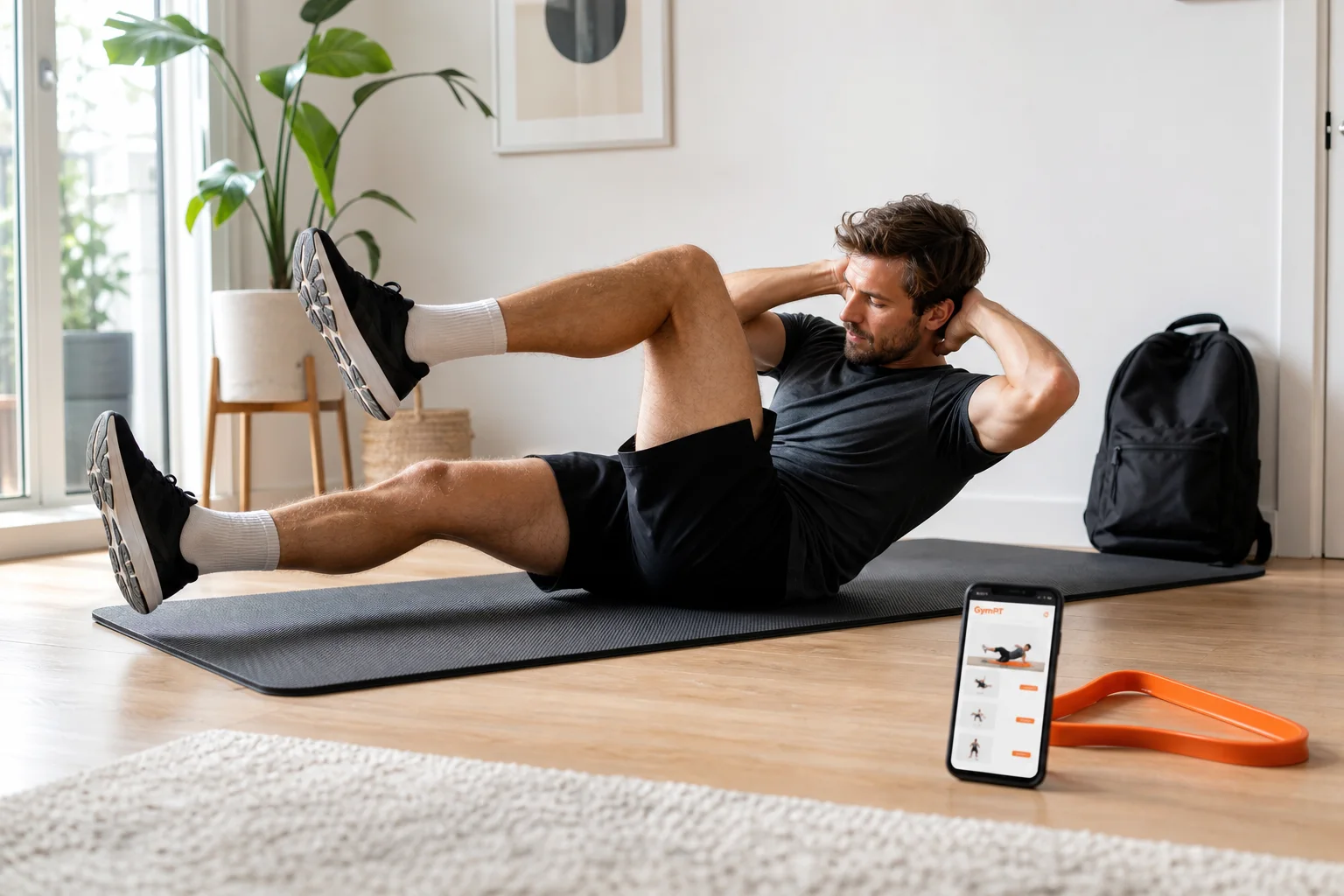
A 3 day home workout plan can build strength, improve fitness, and create a consistent training habit without a gym membership or a large workout space. The key is not having endless exercise variety. It is choosing practical movement patterns, training them regularly, and gradually making the work more challenging.
This plan uses three full-body sessions per week. You can complete it with bodyweight alone, then add a backpack, resistance band, or pair of dumbbells when the exercises become too easy. Each workout should take about 30–45 minutes, including a short warm-up.
How to use this 3 day home workout plan
Schedule the workouts with at least one rest day between sessions. A Monday-Wednesday-Friday schedule works well, but Tuesday-Thursday-Saturday is also effective. The most important factor is choosing days you can repeat consistently.
- Workout 1: Squat, push, pull, and core emphasis
- Workout 2: Hinge, single-leg, upper-body, and core emphasis
- Workout 3: Full-body strength and conditioning emphasis
Before each workout, spend 5–7 minutes preparing your body. Try marching in place, arm circles, hip hinges, bodyweight squats, and easy versions of the first exercise. The warm-up should help you move comfortably without tiring you out.
For most exercises, stop with around 1–3 controlled repetitions left in reserve. You do not need to train to complete exhaustion to make progress. Focus on steady technique, a full comfortable range of motion, and repeatable effort.
Workout 1: Foundational full-body strength
Use this session to practice the basic patterns of a full body home workout. Rest for 60–120 seconds between sets, or longer if you need to maintain good form.
- Bodyweight squat: 3 sets of 8–15 repetitions
- Push-up: 3 sets of 6–15 repetitions
- Backpack row: 3 sets of 8–15 repetitions per side
- Glute bridge: 3 sets of 10–20 repetitions
- Dead bug: 3 sets of 6–10 repetitions per side
Exercise guidance
For the squat, keep your feet stable and lower under control. Use a chair behind you as a target if you are learning the movement. For push-ups, place your hands slightly wider than shoulder width and keep your ribs and hips moving together. If floor push-ups are too difficult, elevate your hands on a sturdy surface.
A backpack row gives you a simple pulling exercise when you do not have a pull-up bar. Fill the backpack with books or other secure items, brace one hand on a chair or your thigh, and pull the bag toward your hip. Keep the load close to your body and avoid twisting.
Workout 2: Hinge, single-leg, and upper-body control
The second session changes the angles and loading demands while still training the whole body. Move slowly enough to feel each repetition and use support when balance is the limiting factor.
- Romanian deadlift with backpack: 3 sets of 8–15 repetitions
- Reverse lunge: 3 sets of 8–12 repetitions per side
- Pike push-up or elevated shoulder press: 3 sets of 6–12 repetitions
- Band pull-apart or prone Y-raise: 3 sets of 10–20 repetitions
- Side plank: 3 sets of 20–40 seconds per side
Exercise guidance
The Romanian deadlift is a hip-hinge movement. Start tall, soften your knees, push your hips back, and keep the backpack close to your legs. Stop when your back position would begin to change. You should feel the back of your legs and hips working, not sharp discomfort in your lower back.
For reverse lunges, step back rather than forward. This often makes it easier to control the movement in a small space. Hold a wall or chair if balance is challenging. If pike push-ups are too demanding, use an elevated surface and keep the range of motion comfortable.
If you do not have a resistance band, prone Y-raises are a useful alternative. Lie face down or hinge forward with a neutral spine, lift your arms into a gentle Y shape, and pause briefly. Keep the movement light and controlled rather than forcing a large range.
Workout 3: Full-body strength and conditioning
This session combines strength exercises with a short conditioning finish. Keep the strength work controlled, then choose a low-impact finisher if jumping is uncomfortable or your space is limited.
- Split squat: 3 sets of 8–12 repetitions per side
- Close-grip or standard push-up: 3 sets of 6–15 repetitions
- Backpack squat or tempo squat: 3 sets of 10–15 repetitions
- Single-arm backpack row: 3 sets of 8–15 repetitions per side
- Plank: 3 sets of 20–45 seconds
Finish with 6–10 minutes of alternating work and recovery. For example, perform 30 seconds of brisk marching, step-ups on a stable low step, or shadow boxing, followed by 30 seconds of easy movement. Repeat for 6–10 rounds.
The finisher should support your training rather than interfere with recovery. You should be able to complete it with controlled breathing and stable movement. If your legs are already fatigued, choose marching or easy step-touches instead of high-impact exercises.
How to progress with limited equipment
Progressive overload at home does not require heavier weights every week. You can increase the challenge in several practical ways:
- Add repetitions: Work toward the top of the recommended range while maintaining form.
- Add a set: Increase from two sets to three, or from three sets to four when recovery is good.
- Slow the movement: Use a three-second lowering phase or pause briefly at the hardest point.
- Choose a harder variation: Move from incline push-ups to floor push-ups, or from squats to split squats.
- Increase load: Add books to a backpack or use a resistance band or dumbbells.
- Improve range of motion: Work through a larger comfortable range without losing control.
- Reduce rest slightly: Use this mainly for muscular endurance and conditioning, not as the first progression for strength.
Use one progression at a time. For example, when you can complete 3 sets of 15 push-ups with consistent technique, try a harder variation or add a small amount of load. Record your exercise, repetitions, sets, and variation so you know what to improve next.
A simple four-week progression
Week 1: Learn the movements
Complete two sets for each exercise if three sets feel excessive. Prioritize technique, a manageable pace, and a routine you can repeat.
Week 2: Build consistency
Move to three sets for the main exercises if you are recovering well. Keep one or two repetitions in reserve on most sets.
Week 3: Add a small challenge
Add a few repetitions, a small backpack load, a pause, or a slightly harder exercise variation. Avoid changing every exercise at once.
Week 4: Review and adjust
Compare your notes with week one. If repetitions and technique improved, continue the plan. If you feel unusually tired or your performance is declining, reduce one set per exercise for several sessions before building again.
A workout tracking habit makes this process much easier. GymPT can help organize sessions, record performance, and provide progress insights so your next adjustment is based on what you actually completed.
How much cardio should you add?
Strength sessions are the foundation of this plan, but general fitness also benefits from regular aerobic movement. Add walking, cycling, dancing, or another enjoyable activity on rest days if it fits your schedule. Start with short sessions and build gradually instead of trying to compensate for missed workouts with exhausting cardio.
Keep at least one easier day each week. Recovery is part of the plan, especially when you are increasing repetitions, adding load, or returning after a long break.
Common mistakes with home workouts
- Doing only pushing exercises: Include rows, band pull-aparts, or other pulling movements to balance your upper-body training.
- Changing the routine every session: Repeat key exercises long enough to measure improvement.
- Rushing every repetition: Slower, controlled repetitions often make simple movements more challenging.
- Ignoring lower-body training: Squats, hinges, lunges, and bridges are practical foundations for home strength training.
- Progressing too quickly: Increase one variable at a time and give your body time to adapt.
- Training through sharp pain: Stop the movement and choose a less demanding variation. If you have an injury, medical condition, or uncertainty about exercise safety, seek qualified professional guidance.
Make the plan fit your goal
This routine is a starting point, not a fixed rule. If your priority is muscle gain, gradually increase challenging sets and use a backpack, bands, or dumbbells to make exercises harder. If your priority is general fitness, keep the strength sessions consistent and add moderate aerobic activity. If you are new to training, use easier variations and focus on building the habit first.
For a broader beginner-friendly structure, read Workout Plan for Beginners at Home. If you want to understand how to adapt training to a specific objective, see AI Workout Plan by Goal.
You can also learn how to use performance data in Workout App With Progress Tracking and explore how equipment changes your exercise choices in Equipment Based Workout Plans.
The takeaway
The best 3 day home workout plan is one you can perform consistently and progress gradually. Train the major movement patterns, use simple exercise variations, track your work, and adjust the challenge when your current version becomes manageable. With limited space and basic equipment, you can still build a structured routine that supports strength, fitness, and long-term consistency.