workout plan for beginners at home
Workout Plan for Beginners at Home: A Simple 4-Week Start
A practical workout plan for beginners at home using bodyweight exercises, simple progressions, and short sessions you can repeat consistently.
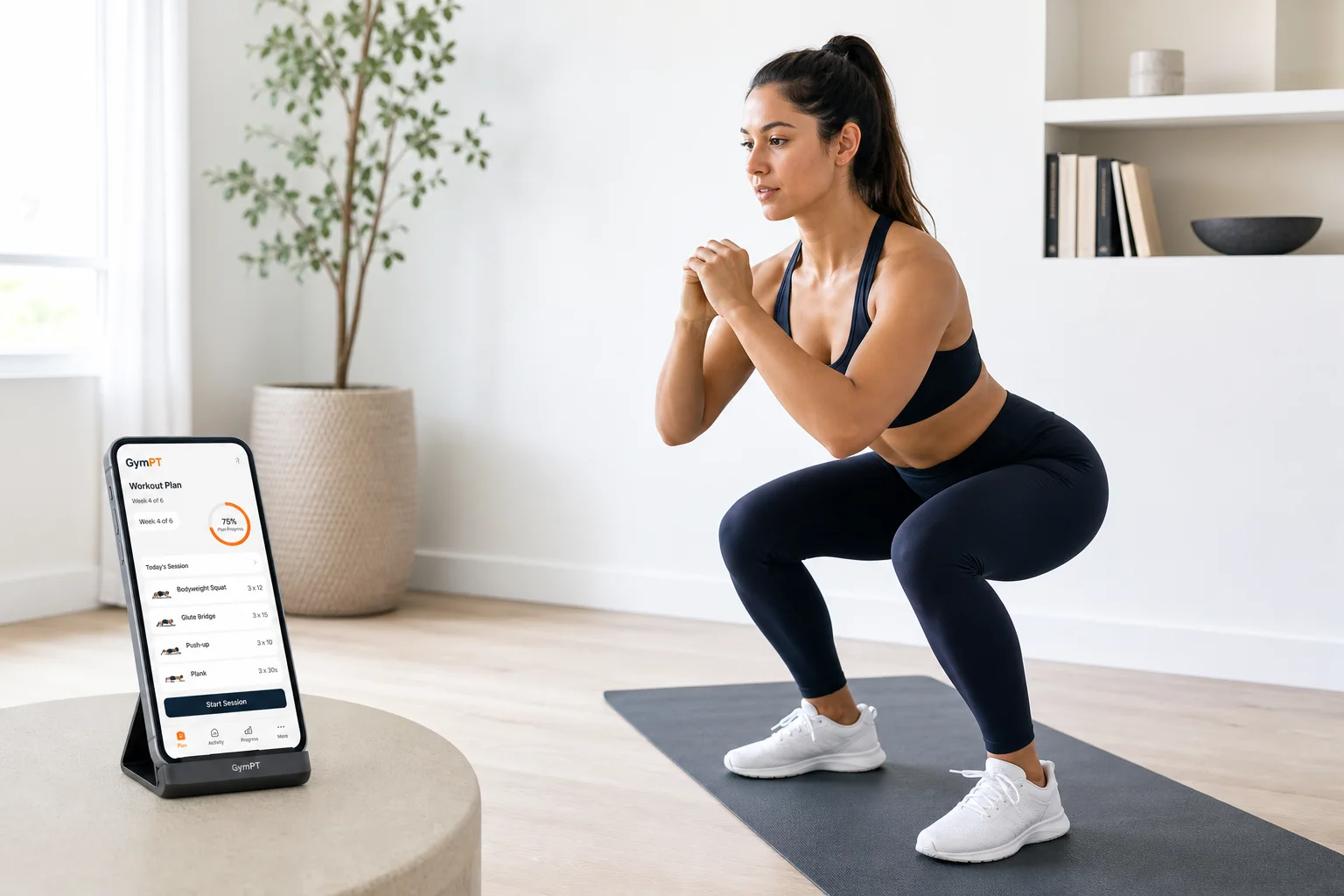
Starting a fitness routine at home does not require a fully equipped gym, a complicated split, or hour-long sessions. A good workout plan for beginners at home should help you practice basic movement patterns, build consistency, and progress gradually with the space and equipment you actually have.
This four-week plan uses bodyweight exercises and optional household resistance. It is designed for beginners who want a clear starting point without feeling overwhelmed. You will train the major muscle groups, add light cardio through walking or simple conditioning, and use small progressions to make each week slightly more challenging.
What makes a beginner home workout effective?
An effective home workout is not defined by how advanced it looks. It works because it is repeatable, balanced, and easy to measure. Your plan should include movements that train your legs, hips, pushing muscles, pulling muscles, core, and general conditioning.
For adults, widely used physical activity guidelines recommend building toward regular aerobic activity throughout the week and muscle-strengthening activity on at least two days. If you are currently inactive, beginning with smaller amounts and increasing gradually is a practical approach.
Home training can support this goal with bodyweight movements, resistance bands, a backpack, or a pair of light dumbbells. You do not need expensive equipment to begin developing strength and movement skill.
Before you start: set up your home training space
Choose an area where you can extend your arms and legs without hitting furniture. A yoga mat is useful but optional. You can also use a sturdy chair for support, a backpack loaded with books for resistance, or a resistance band if you already own one.
- Clear the floor: remove loose rugs, toys, cables, and other trip hazards.
- Check your support: use only a stable chair or countertop for balance exercises.
- Wear comfortable footwear: train barefoot only if the surface is secure and comfortable.
- Keep the first session easy: your initial goal is to learn the movements, not to exhaust yourself.
Use controlled repetitions and stop a movement if you feel sharp pain, loss of control, or unusual symptoms. If you have an injury, a medical condition, or specific exercise restrictions, get individual guidance before starting a new routine.
Workout plan for beginners at home: the weekly schedule
Start with three strength sessions per week, leaving at least one day between them when possible. On the days between workouts, use walking or another comfortable form of light-to-moderate activity. Rest days are part of the plan because recovery helps you return to training with better energy and technique.
- Monday: Strength Workout A
- Tuesday: Easy walk or active recovery
- Wednesday: Strength Workout B
- Thursday: Rest or easy walk
- Friday: Strength Workout A or B
- Saturday: Optional walk, mobility, or gentle conditioning
- Sunday: Rest
Alternate the workouts each week. For example, use Workout A twice in week one, Workout B twice in week two, and continue alternating. If three sessions feel too demanding, complete two sessions consistently before adding a third.
Workout A: squat, push, hinge, and core
Complete a brief warm-up first. March in place, rotate your shoulders, perform slow bodyweight squats, and take several controlled breaths for about five minutes.
- Chair squat: 2 sets of 8 to 12 repetitions. Sit toward a chair with control, lightly touch it, and stand by pressing through your feet.
- Incline push-up: 2 sets of 6 to 12 repetitions. Place your hands on a wall, countertop, or sturdy elevated surface. Keep your body in a straight line as you lower and press away.
- Glute bridge: 2 sets of 10 to 15 repetitions. Lie on your back with your knees bent. Lift your hips while keeping your ribs relaxed, then lower slowly.
- Backpack row: 2 sets of 8 to 12 repetitions per side. Hold a lightly loaded backpack, brace your torso, and pull the load toward your hip without twisting.
- Dead bug: 2 sets of 6 to 10 repetitions per side. Move slowly and keep your lower back comfortable as you extend the opposite arm and leg.
Rest for about 60 to 90 seconds between sets. If you cannot maintain good form, reduce the repetitions or choose an easier variation.
Workout B: lunge, press, hinge, and stability
Use the same five-minute warm-up. Keep the range of motion comfortable, especially during single-leg exercises.
- Supported reverse lunge: 2 sets of 6 to 10 repetitions per side. Hold a wall or chair if needed. Step back, lower under control, and return to standing.
- Elevated shoulder tap: 2 sets of 6 to 10 taps per side. Place your hands on a stable elevated surface and tap the opposite shoulder while limiting hip movement.
- Hip hinge: 2 sets of 8 to 12 repetitions. Push your hips backward while keeping your spine neutral, then stand tall. Add a backpack only when the pattern feels consistent.
- Standing calf raise: 2 sets of 12 to 15 repetitions. Hold a support and rise onto the balls of your feet, pausing briefly at the top.
- Side plank from knees: 2 sets of 15 to 25 seconds per side. Keep your shoulders, hips, and knees aligned while lifting your hips from the floor.
When a movement feels unstable, slow it down before making it harder. Control is a useful form of progression for beginners.
How to progress over four weeks
The most important progression is not doing more at any cost. It is gradually increasing the challenge while keeping technique consistent. Choose one progression at a time rather than changing everything in the same week.
Week 1: learn the movements
Complete two sets of each exercise and stay near the lower end of the repetition range. Focus on breathing, balance, and smooth movement. Finish each set feeling that you could perform a few more controlled repetitions.
Week 2: add practice
Keep the same exercises and aim for one or two additional repetitions where your form remains strong. If you completed two workouts in week one, try a third only if recovery feels manageable.
Week 3: increase the challenge
Use a slightly harder variation for selected exercises. Examples include moving from wall push-ups to countertop push-ups, using a lower support, adding a light backpack, or extending the duration of a plank by five seconds.
Week 4: build consistency
Work toward the top of the repetition ranges or add a third set to one or two exercises. Do not add a third set to every movement automatically. A small, sustainable increase is enough to create a clear training signal without making the routine unnecessarily exhausting.
How hard should a beginner home workout feel?
Use effort and form together. The final repetitions should feel challenging, but you should still be able to maintain the intended position and tempo. A practical beginner target is to finish most sets with roughly two or three good repetitions still available.
This approach gives you room to learn and recover. Training to complete exhaustion is not required for a productive workout, especially when you are still building coordination and tolerance for exercise.
Track the exercise variation, repetitions, sets, and how difficult the set felt. A simple note such as “countertop push-up, 2 sets of 8” gives you useful information for the next session. GymPT can help organize this information into a personalized plan and provide progress insights as your training changes.
Simple cardio and movement on non-strength days
Strength sessions are only one part of an active week. Add comfortable walking, cycling, dancing, or another activity you enjoy on non-strength days. Begin with a duration you can repeat consistently, then add a few minutes as your fitness improves.
You can also use short movement breaks during the day. A brief walk, stair climb, or mobility sequence is easier to maintain than waiting for a perfect uninterrupted workout window.
Common mistakes to avoid
- Starting too hard: soreness and fatigue can make the plan difficult to repeat.
- Changing exercises constantly: keeping a movement for several weeks makes progress easier to see.
- Ignoring pulling movements: include rows or band pulls when possible to balance pressing exercises.
- Rushing repetitions: slower, controlled movement makes technique easier to evaluate.
- Skipping recovery: rest, sleep, and lighter days help you train consistently.
- Measuring only body weight: also track repetitions, exercise variations, energy, and confidence.
How GymPT can personalize your home workout
A useful plan should reflect your available space, equipment, schedule, training level, and goal. GymPT can help create a routine around those details instead of giving you the same generic session every time. You can also use AI coach chat to ask how to modify an exercise, log completed workouts, and review progress insights.
For more guidance, compare this beginner routine with the Home Workout Plan for Any Space. If you want to understand how training changes as your experience grows, read AI Workout Plan by Level. You can also explore how a Workout Plan Generator builds a repeatable training week or learn when an Adaptive Workout Plan may be useful.
Key takeaway
The best beginner home workout plan is one you can repeat. Train the major movement patterns two or three times per week, use simple exercises, progress gradually, and record what you do. With limited space and little equipment, consistency will matter far more than complexity.