home workout plan
Home Workout Plan: A Practical 4-Week Routine for Any Space
This practical home workout plan helps you train your full body with little space, minimal equipment, and a structure designed for consistency.
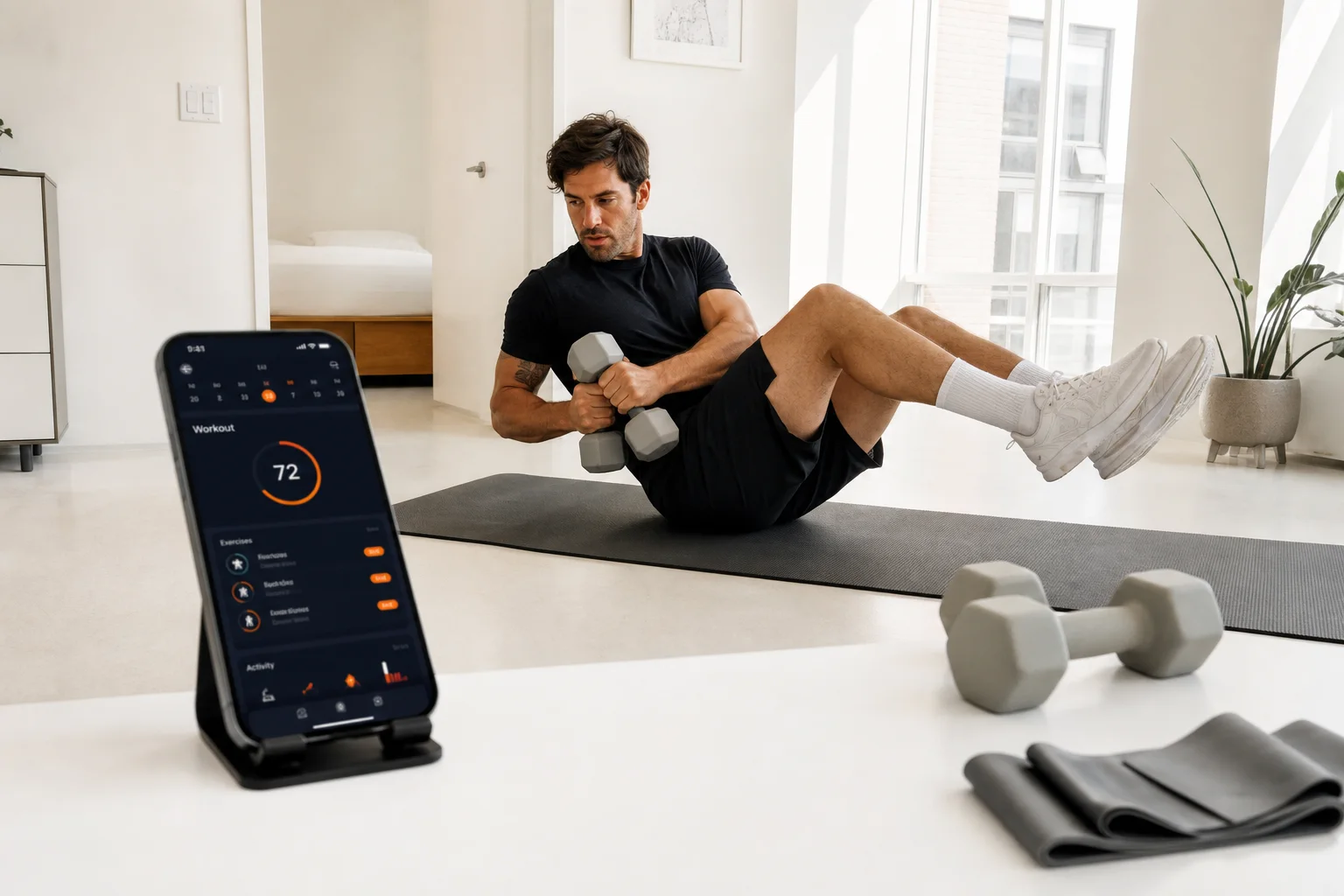
A good home workout plan does not require a dedicated gym room, a rack of equipment, or two hours of free time. It needs a clear structure, exercises you can perform safely, and enough flexibility to fit your actual week.
This four-week plan is built for limited space and limited equipment. It uses bodyweight exercises as the foundation, with optional dumbbells, resistance bands, or a backpack for added resistance. The goal is to train consistently, cover the major movement patterns, and progress gradually without making every session exhausting.
What makes a home workout plan effective?
An effective at-home workout routine should include four elements:
- Strength work: Exercises that challenge your legs, hips, chest, back, shoulders, arms, and core.
- Simple progression: A way to make the exercises gradually harder over time.
- Manageable sessions: Workouts that usually fit into 25 to 40 minutes.
- Recovery and flexibility: Rest days and options for busy or low-energy days.
Current physical activity guidance recommends that adults accumulate at least 150 minutes of moderate-intensity aerobic activity each week, or an equivalent combination of moderate and vigorous activity. It also recommends muscle-strengthening activity on at least two days per week. You do not need to achieve the full target immediately; starting with a realistic amount and building gradually is often more sustainable.
For home training, that means three focused strength sessions plus regular walking, cycling, dancing, or another enjoyable form of movement can create a well-rounded week.
Your 4-week home workout plan
Use the following weekly schedule as a starting point. If you are new to training, complete two sets of each exercise during Week 1. Add a third set when the sessions begin to feel manageable.
Weekly schedule
- Monday: Workout A — squat, push, and core
- Tuesday: Easy walk or light mobility
- Wednesday: Workout B — hinge, pull, and single-leg work
- Thursday: Rest or optional easy cardio
- Friday: Workout C — full-body circuit
- Saturday: Optional walk, stairs, cycling, or recreational activity
- Sunday: Rest
Place the sessions on different days where possible. If your schedule changes, keep the order but move the days. Completing three sessions in a different order is better than abandoning the week because it did not look perfect.
Workout A: Squat, push, and core
- Bodyweight squat: 8–15 repetitions
- Push-up: 6–12 repetitions
- Reverse lunge: 8–12 repetitions per side
- Elevated pike push-up: 6–12 repetitions, or a standing band press
- Dead bug: 8–12 repetitions per side
Rest for approximately 60 to 90 seconds between sets. Use a chair or countertop to make push-ups easier. To make squats harder, hold a backpack close to your chest or slow the lowering phase to three seconds.
Workout B: Hinge, pull, and single-leg work
- Backpack or dumbbell Romanian deadlift: 8–15 repetitions
- One-arm row: 8–15 repetitions per side
- Glute bridge: 10–20 repetitions
- Split squat: 8–12 repetitions per side
- Side plank: 20–40 seconds per side
If you do not have weights or bands, use a slow tempo and pause at the most difficult point of each movement. For example, pause at the top of the glute bridge and lower slowly during the split squat. A backpack filled with books can provide adjustable resistance, but make sure it is secure and comfortable to hold.
Workout C: Full-body home circuit
Complete three to five rounds. Move from one exercise to the next with controlled technique, resting for one to two minutes between rounds.
- Reverse lunge: 8 repetitions per side
- Push-up variation: 6–12 repetitions
- Hip hinge: 12–15 repetitions
- Backpack row or band row: 10–15 repetitions
- Mountain climber: 20–40 total repetitions, or a slow plank shoulder tap
- March in place: 45–60 seconds
The circuit should feel challenging but repeatable. Avoid turning every exercise into a sprint. If your form becomes rushed, reduce the number of repetitions or take a longer rest.
How to progress without a full home gym
Progressive overload does not require constantly buying heavier equipment. You can progress your home strength training in several practical ways:
- Add repetitions: Move from 8 repetitions toward 12 or 15 while keeping good form.
- Add a set: Progress from two sets to three when recovery is comfortable.
- Increase resistance: Add books to a backpack, use a stronger band, or choose heavier dumbbells.
- Slow the tempo: Take three seconds to lower your body instead of dropping quickly.
- Use a harder variation: Move from incline push-ups to floor push-ups, or from a split squat to a rear-foot-elevated variation.
- Improve range of motion: Work through a comfortable, controlled range before choosing a more advanced variation.
- Reduce rest slightly: Use this mainly for conditioning circuits, not as a substitute for strength progression.
Choose one progression method at a time. A simple rule is to stop each set with approximately one to three controlled repetitions still available. This keeps the effort productive without requiring every set to reach complete fatigue.
How to adapt the plan to your equipment
With no equipment
Use bodyweight movements, tempo changes, pauses, and unilateral exercises. Push-ups, squats, lunges, glute bridges, planks, and slow mountain climbers can create a complete beginner bodyweight workout plan when organized across the week.
With resistance bands
Add band rows, presses, pull-aparts, lateral walks, and resisted hinges. Bands are especially useful for balancing pressing exercises with pulling movements, which can be harder to train in a small room.
With dumbbells
Use dumbbells for goblet squats, Romanian deadlifts, rows, floor presses, shoulder presses, and carries. If you have only one dumbbell, unilateral exercises can challenge your core and improve training variety.
With a backpack
A loaded backpack can act as a compact resistance tool for squats, deadlifts, rows, lunges, and floor presses. Keep the load stable, avoid overfilling it, and choose a grip that allows you to control the movement.
Make consistency easier in a small space
The best home workout plan is the one you can repeat. Use these practical habits to remove friction:
- Prepare your training area: Clear a space roughly the length of a yoga mat and check that the floor is stable.
- Set a minimum session: On busy days, commit to the warm-up and one set of each exercise. You can continue if time and energy allow.
- Train at a repeatable time: Linking workouts to an existing routine, such as after work or before your evening shower, reduces decision-making.
- Track the basics: Record exercises, repetitions, resistance, and how difficult the session felt.
- Keep alternatives ready: Have a quiet option for neighbors, a low-impact option for fatigue, and an easier variation for difficult movements.
- Use reminders and feedback: A workout tracker or adaptive plan can help you see patterns and adjust the week instead of relying on memory.
GymPT can help turn these principles into a plan based on your goals, available equipment, schedule, and training history. Its AI coach chat can also help you choose exercise alternatives when space, time, or equipment changes.
Warm-up, recovery, and safety
Before each session, spend five minutes preparing to move. Try marching in place, arm circles, hip hinges, bodyweight squats, and a few easier repetitions of your first exercise. The goal is to raise your temperature and rehearse the movements, not to exhaust yourself.
During training, use a controlled range of motion and stop an exercise if you feel sharp or unusual pain. Normal effort, muscle fatigue, and a temporary increase in breathing are different from pain that feels sudden or concerning. If you have an injury, a health condition, or specific training restrictions, seek qualified professional guidance before changing your exercise routine.
Recovery also includes sleep, nutrition, hydration, and lower-intensity movement. You do not need to feel perfectly recovered to train, but repeated poor recovery is a reason to reduce volume, choose easier variations, or take an additional rest day.
When to adjust your home workout plan
After four weeks, review your notes. Ask:
- Which exercises felt stable and repeatable?
- Did you complete most planned sessions?
- Are you ready for more repetitions, resistance, or a harder variation?
- Did any movement repeatedly cause discomfort or feel impractical in your space?
- Would two longer sessions or four shorter sessions fit your schedule better?
Use the answers to build the next block. You may keep the same exercises and progress them, swap only one or two movements, or change the weekly schedule. Consistency is not about repeating an unchanged routine forever; it is about making sensible adjustments while keeping the habit alive.
If you want more help organizing your week, compare this plan with a workout plan generator, learn how an adaptive workout plan can respond to changing recovery, or explore an AI workout plan by equipment. For a broader view of how technology can support training decisions, read the guide to a personalized fitness coach.
Final takeaway
A productive home training routine can be simple: three strength sessions, regular movement, gradual progression, and enough flexibility to keep going when life gets busy. Start with the version you can complete consistently, track what you do, and make one small improvement at a time.
Your home workout plan does not need to be perfect before you begin. It needs to be clear enough to follow today and adaptable enough to continue next week.