AI workout plan by equipment
AI Workout Plan by Equipment: How to Build a Routine Around What You Have
The best workout plan is not the one with the most equipment. It is the one that matches your goals, available tools, skill level, and ability to progress. Learn how to build an AI workout plan by equipment with GymPT.
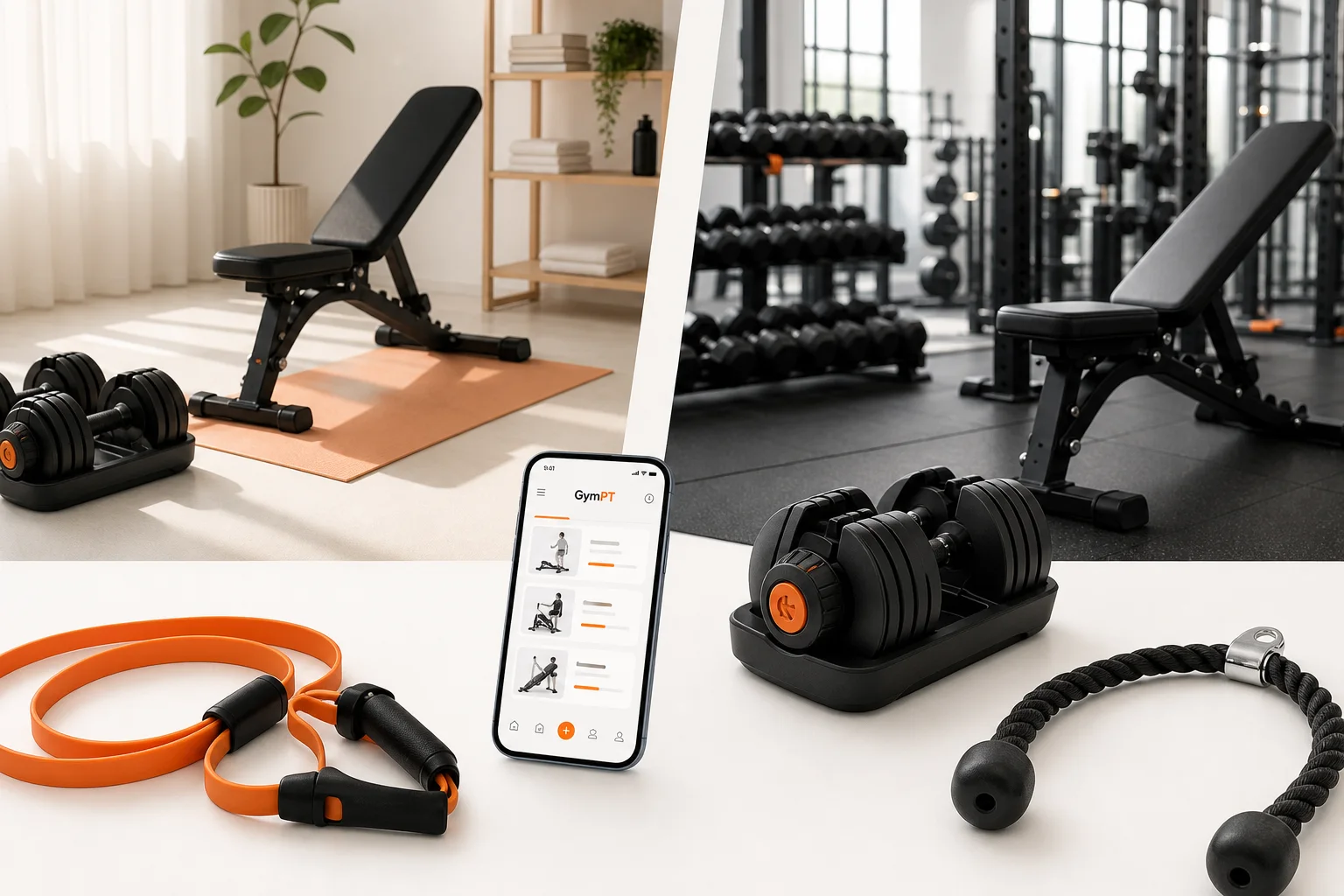
The most effective workout plan is not necessarily the one that uses the most machines, the heaviest barbell, or the largest home gym setup. It is the plan you can perform consistently with the equipment you actually have.
An AI workout plan by equipment helps solve a practical problem: how do you train toward a specific goal when your available equipment changes from day to day? You may have a full gym on Monday, adjustable dumbbells at home on Wednesday, and only a resistance band or your body weight on the weekend.
GymPT helps you build around those real-world constraints. By combining your goals, experience, schedule, available equipment, and progress data, it can create a more practical routine instead of giving you exercises you cannot perform.
Why equipment should shape your workout plan
Equipment affects more than the name of an exercise. It changes how resistance is applied, how stable you feel, how much weight you can use, and how easily you can increase the challenge over time.
For example, a barbell may be useful for practicing a specific strength movement, while a machine can provide more external stability and make it easier to focus on the target muscle. Dumbbells can help address left-to-right differences and allow more freedom of movement. Bands are portable and versatile, but their resistance usually increases as they stretch.
These differences do not mean one equipment category is automatically better than another. Research comparing free weights and machines generally suggests that both can improve strength and muscle size, while strength gains are often specific to the type of equipment used in testing. The better choice is usually the one that fits your goal, comfort, movement skill, and consistency.
That is why a useful equipment-based workout plan should begin with your available tools rather than forcing every person into the same exercise list.
Start with movement patterns, not exercise names
A common mistake is to think, “I need barbell squats,” or “I need a cable machine.” A better approach is to identify the movement pattern or training function you want, then select the most suitable exercise from the equipment you have.
1. Squat or knee-dominant movements
These exercises emphasize bending at the knees and are commonly used to train the quadriceps and lower body. Options may include:
- Bodyweight squats
- Goblet squats with one dumbbell or kettlebell
- Barbell back squats
- Leg presses
- Split squats or reverse lunges
If you are training at home with light dumbbells, unilateral exercises such as split squats can make a moderate load more challenging. In a gym, a leg press or barbell squat may allow you to use heavier resistance, depending on your experience and technique.
2. Hinge or hip-dominant movements
Hinge movements train the hips and posterior chain while requiring you to control the position of your torso. Common choices include:
- Dumbbell or barbell Romanian deadlifts
- Kettlebell deadlifts
- Hip thrusts
- Good mornings
- Band pull-throughs
The best choice depends on what you can load safely and control through a comfortable range of motion. An AI workout planner can suggest substitutions when a barbell is unavailable without abandoning the underlying training goal.
3. Horizontal pushes and pulls
Horizontal pushing includes movements such as push-ups and bench presses. Horizontal pulling includes rows. Together, they create a balanced upper-body foundation.
- Push: push-ups, dumbbell bench press, barbell bench press, chest press machine
- Pull: one-arm dumbbell rows, inverted rows, cable rows, seated row machines
You do not need to match exercises perfectly between equipment types. Instead, look for a similar movement direction, target muscle groups, and level of challenge. For example, a dumbbell row can replace a cable row when the equipment is different, provided you can maintain good control and adjust the load appropriately.
4. Vertical pushes and pulls
Vertical pressing and pulling are useful for training the shoulders, upper back, and arms. Possible options include overhead presses, lat pulldowns, pull-ups, assisted pull-ups, and band pulldowns.
If you cannot perform a full pull-up, an assisted machine, band-assisted version, or pulldown may be a more appropriate starting point. Progression does not require jumping immediately to the hardest version. It requires a repeatable exercise that you can gradually make more demanding.
5. Carrying, bracing, and core training
Core training is not limited to crunches. You can train bracing and trunk control with planks, dead bugs, side planks, loaded carries, cable exercises, and controlled bodyweight movements.
A practical plan should choose core exercises that match your space and equipment. A suitcase carry may work well with one dumbbell, while a plank may be the better option in a small room without equipment.
How to choose the right equipment for your goal
Equipment selection becomes easier when you connect it to your primary goal. The same tool can be useful for different outcomes, but the exercise, load, repetitions, and progression should reflect what you are trying to improve.
For general strength
Choose movements that you can perform with consistent technique and gradually load over time. Barbells, dumbbells, machines, and cables can all be useful. If your goal is to improve a specific lift or sport-related movement, use exercises that resemble the strength you want to express.
For muscle growth
Prioritize exercises that let you train a muscle through a controlled range of motion and accumulate enough challenging work. Machines can be helpful when you want stability and simple setup. Dumbbells and cables may provide flexibility when you need to adjust your position or work around a busy gym.
You do not need to train to complete failure on every set. A sustainable plan should leave room for good technique, recovery, and progression. GymPT can help organize exercises into a manageable weekly structure rather than filling every session with unnecessary movements.
For home workouts
Home training often benefits from exercises that use adjustable resistance, compact equipment, or bodyweight variations. A pair of dumbbells, resistance bands, a bench, or a pull-up bar can support many movement patterns, but your plan should account for the exact equipment and the amount of space available.
For more ideas, see this guide to an AI workout planner without equipment and learn how to build effective sessions when your setup is minimal.
Use substitutions without losing the purpose of the workout
Equipment substitutions work best when they preserve the purpose of the original exercise. When replacing an exercise, compare four factors:
- Movement pattern: Is it still a squat, hinge, push, pull, carry, or rotation-resisting movement?
- Primary muscles: Does it train a similar area of the body?
- Stability demands: Is the new exercise easier or more difficult to control?
- Progression method: Can you increase load, repetitions, range of motion, tempo, or difficulty?
For example, if a program includes a barbell bench press but you only have dumbbells, a dumbbell bench press is a logical substitution. If you have no bench, a floor press or push-up may work instead. The exact exercise changes, but the horizontal pushing objective remains.
GymPT is designed to make this process easier. When your equipment changes, you can use the AI coach chat to ask for an alternative, explain what feels comfortable, and adjust the session instead of abandoning the plan.
Build progression around the equipment you have
A workout plan should not only tell you what to do today. It should also give you a way to make the next session more challenging when appropriate.
With barbells and machines, progression may be as simple as adding a small amount of weight. With dumbbells, you might increase repetitions until you reach the top of your target range, then move to a heavier pair. With bands, progression may involve using a stronger band, increasing range of motion, slowing the lowering phase, or adding repetitions.
When equipment is limited, you can still progress through:
- More repetitions with the same load
- Additional sets when recovery allows
- Slower or more controlled tempo
- Longer pauses at the hardest point
- Greater range of motion
- More demanding unilateral variations
- Shorter rest periods when appropriate
Not every progression method suits every exercise. For strength, heavier loads and specific practice may matter more. For general fitness or muscle growth, several loading and repetition strategies can be effective when the sets are sufficiently challenging and performed consistently.
What to look for in an AI workout planner
Many apps can display a library of exercises. A more useful AI workout planner should help you make decisions around your real training situation.
- Equipment filters: It should understand whether you have machines, free weights, bands, a bench, or no equipment.
- Goal-based programming: Your plan should reflect whether you want strength, muscle, fitness, mobility, or a combination.
- Experience-aware exercise choices: Beginners should not be pushed into complex movements before they are ready.
- Adaptable substitutions: You should be able to replace an exercise when equipment is occupied, unavailable, or uncomfortable.
- Progress tracking: The app should remember completed sessions, loads, repetitions, and other useful training information.
- Coach interaction: You should have a way to ask questions and clarify how to adjust a session.
GymPT combines these functions with personalized plans, AI coach chat, body analysis, equipment-based training, workout tracking, and progress insights. That makes it useful for both a consistent gym setup and a changing home routine.
If you are comparing different tools, this guide to the best workout planner app features can help you decide which capabilities matter most.
How to get better results from your equipment-based plan
Start by being precise about what you have. “Gym equipment” is too broad. List the equipment you can reliably access, including the weight range, number of dumbbells, bench availability, bands, cables, machines, and pull-up options.
Next, be honest about your schedule and experience. A plan that requires six sessions per week will not be useful if you can consistently train only three days. You can use a weekly workout planner approach to organize training around your actual week and protect recovery time.
Finally, track what happens. Record the exercises you completed, the weight or variation used, your repetitions, and how difficult the session felt. Progress insights are more valuable when they are based on your real training history rather than a perfect plan you rarely follow.
The bottom line
An AI workout plan by equipment should make training more realistic, not more complicated. Start with movement patterns, choose exercises that fit your available tools, and use a progression method you can repeat.
Machines, free weights, bands, and bodyweight exercises can all play a role. The right combination depends on your goals, preferences, experience, space, and ability to train consistently. With GymPT, you can create a personalized plan around your equipment, adapt exercises when circumstances change, and use your workout history to make smarter decisions over time.
For a structured gym routine that can still adapt to your situation, explore this gym program maker app guide and see how a flexible plan can fit into your training.