AI fitness app
AI Fitness App Guide: How to Choose the Right One for Your Training
The best AI fitness app should do more than display exercises. Learn which features matter, when an app beats a static PDF plan, and how GymPT supports smarter training.
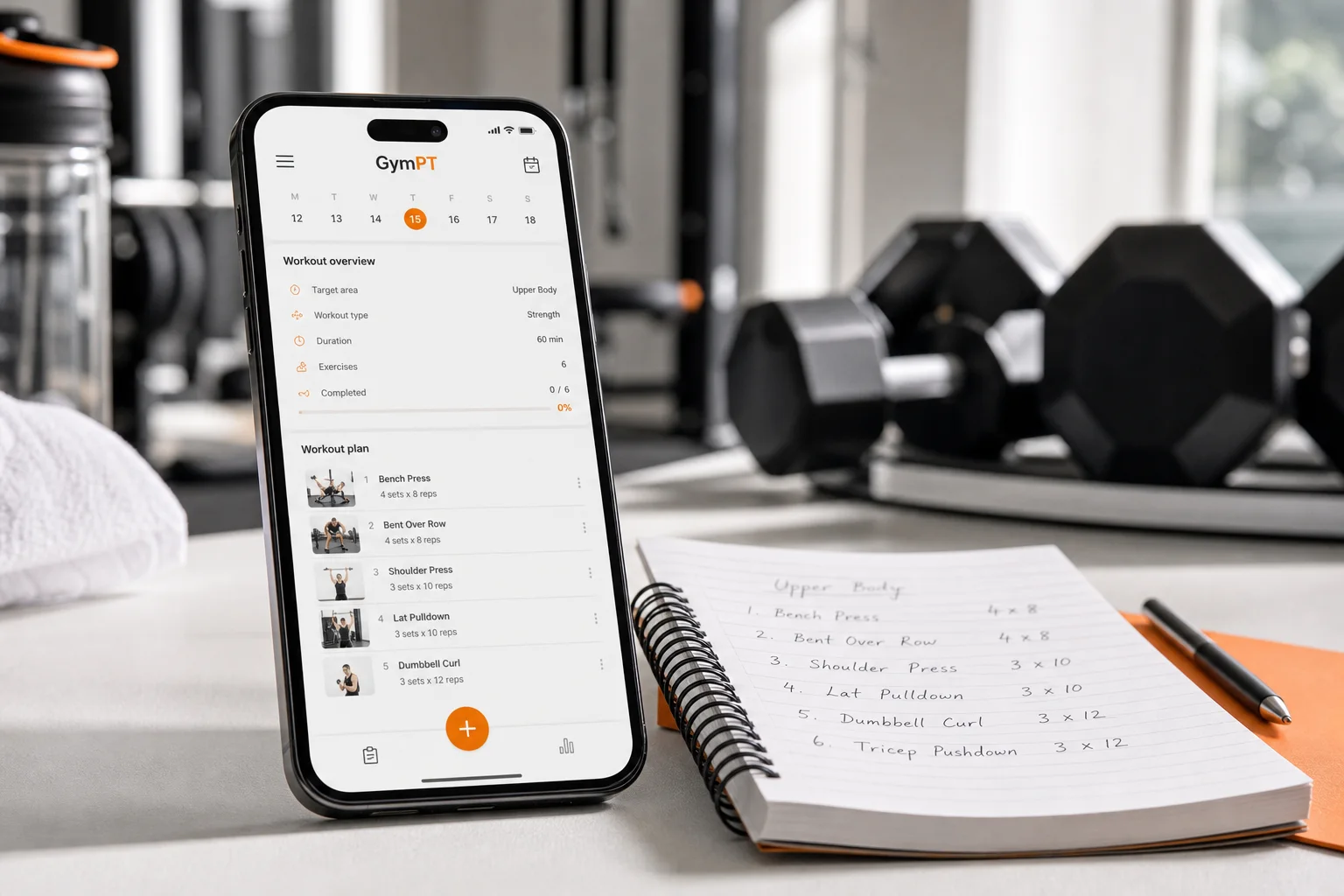
Choosing an AI fitness app can feel harder than choosing a workout itself. Many apps promise personalized training, but the real question is whether the app can help you make better decisions consistently: what to train, which exercises to use, how to adjust the session, and how to measure progress.
A static PDF plan can be useful when your schedule, equipment and recovery stay predictable. However, most people train in less-than-perfect conditions. You may miss a session, arrive at a busy gym, feel more or less recovered than expected, or discover that a particular exercise does not suit you. A good app should help you respond to those changes instead of leaving you with a plan that no longer fits.
What makes an AI fitness app genuinely useful?
Artificial intelligence is not automatically the same as personalization. A useful app should connect your goals and circumstances to practical training decisions. Look for a system that considers several inputs rather than generating a generic list of exercises.
- Your primary goal: strength, muscle development, general fitness, conditioning or a combination.
- Your experience level: beginners often need more exercise guidance and simpler progression than experienced lifters.
- Your available equipment: a home routine, hotel workout and fully equipped gym require different exercise selections.
- Your schedule: the right plan should fit the number of days and approximate session length you can realistically maintain.
- Your training history: recent workouts provide context for exercise selection, volume and progression.
- Your feedback: completed sets, repetitions, loads and perceived difficulty can help inform future sessions.
The goal is not to make training complicated. It is to reduce guesswork while keeping the plan realistic enough to follow.
AI fitness app vs. a static PDF workout plan
A PDF plan gives you a fixed structure. That can be valuable if you want a simple reference and already know how to modify exercises safely. It is also easy to save, print and revisit. The limitation is that a PDF usually cannot respond to what happens after the plan is created.
An AI fitness app can be more useful when your training environment changes. For example, if your gym does not have the planned machine, an adaptive app may offer a suitable alternative. If you miss Monday’s workout, it can help reorganize the week. If a session is consistently too easy or too demanding, recorded training data can support more informed adjustments.
That does not mean an app replaces judgment. You still need to pay attention to technique, discomfort, fatigue and your ability to recover. Think of the app as a planning and feedback tool, not as a medical device or a substitute for professional care when you need it.
For a deeper look at how adaptive planning works, read Personalized Workout Plan: Why Adaptive Training Beats Generic Routines.
7 features to compare before choosing a personalized workout app
1. Goal-based program creation
The app should begin with your objective instead of assuming every user wants the same outcome. A strength-focused plan may emphasize heavier compound movements and longer rest periods, while a general fitness plan may combine resistance training with conditioning and mobility.
Pay attention to whether the app asks useful setup questions. Your goal, training frequency, experience and available equipment should influence the plan from the start.
2. Equipment-aware exercise selection
Equipment flexibility is one of the clearest differences between a practical app and a generic routine. A plan should account for whether you have barbells, dumbbells, cables, machines, resistance bands or no equipment at all.
This matters for consistency. If every session depends on equipment you cannot access, the plan creates friction before the workout even begins. An equipment-based system gives you a better chance of completing the intended movement pattern with the tools available.
GymPT users can also explore Equipment Based Workout Plans: Match Your Training to the Gym You Use for more guidance on building around the equipment you actually have.
3. Clear exercise instructions
A long exercise database is less important than clear, usable instruction. Each movement should communicate the setup, execution, target muscles or purpose, and common points to consider. Beginners should not have to search the internet to understand the basic structure of every exercise.
Good instruction also helps experienced users move efficiently through a session. When the next exercise, target and suggested structure are visible in one place, there are fewer interruptions between sets.
4. Built-in coaching and decision support
Training questions rarely appear only before the workout. You may wonder whether to substitute an exercise, how much rest to take, or what to do when you have less time than planned. An AI coach chat can make an app more useful by giving you a place to ask context-specific questions.
The best coaching experience should be practical rather than overly confident. It should explain the reasoning behind a suggestion, acknowledge when more information is needed, and avoid presenting fitness guidance as medical advice.
5. Workout tracking that captures meaningful details
Tracking is not valuable simply because it produces more numbers. The important details are the ones that help you understand what you did and make the next session more informed. Useful records may include exercises, sets, repetitions, load, session completion and notes about difficulty.
Consistent self-monitoring can make training more visible. Instead of relying on memory, you can identify whether you are repeating the same loads, progressing gradually, or missing certain sessions. Research on technology-supported self-monitoring suggests that feedback and tracking can support physical activity behavior, although results vary and the quality of the overall program still matters.
6. Progress insights instead of isolated statistics
A progress dashboard should help answer simple questions: Am I training consistently? Which movements are improving? Is my weekly workload changing? Am I completing the type of training that matches my goal?
Useful insights should be easy to interpret. A chart that looks impressive but does not change your training decisions adds noise. Look for summaries that turn completed workouts into practical next steps.
7. A plan that fits real life
Adherence is often more important than theoretical perfection. The best AI workout plan is one you can repeat across ordinary weeks, including busy periods, travel and changes in motivation.
Before subscribing, check whether you can adjust the number of training days, session duration and equipment. Also consider whether workouts can be started quickly without navigating through unnecessary screens. Convenience is not a minor feature; it directly affects how easy it is to begin.
How to evaluate an AI workout plan in the first week
You do not need to judge an app by its marketing page alone. Use the first week as a practical test.
- Check the setup: Does the app understand your goal, experience, schedule and equipment?
- Review the weekly structure: Are the training days realistic, and is recovery considered?
- Inspect each workout: Are the exercises understandable and possible with your available equipment?
- Notice the transitions: Can you record a set quickly while training?
- Ask a real question: Test whether the AI coach provides a clear, useful answer rather than a vague motivational message.
- Review the data: After several sessions, does the app show information that helps you decide what to do next?
If the app creates more confusion than clarity, it may not be the right fit, even if it has a large exercise library.
When should you choose an AI fitness app?
An AI fitness app is especially helpful if you:
- Want a plan but do not know how to structure your training week.
- Need workouts that change based on your equipment or available time.
- Prefer guidance during the session instead of reading a long program in advance.
- Struggle to track progression consistently.
- Want to combine planning, coaching, workout logging and progress review in one place.
- Train in more than one location, such as at home and in a gym.
A static PDF may still be enough if you have a stable routine, understand exercise substitutions, and enjoy managing your own progression. The choice depends on how much support and flexibility you need.
How GymPT fits into the decision
GymPT is designed for people who want more than a fixed list of exercises. It creates personalized workout plans based on your goals and training context, supports equipment-based training, and gives you access to AI coach chat when questions come up.
You can also use GymPT to analyze body-related data, track completed workouts and review progress insights over time. These features work together: the plan gives you structure, tracking records what actually happened, and insights help make future training decisions more informed.
If you are comparing different types of training schedules, you may also find Weekly Workout Planner: Build a Training Week That Adapts to You useful. For people who are beginning from scratch, Beginner Gym Workout Plan: A Simple 3-Day Routine That Builds Confidence offers a practical starting point.
The bottom line
The best AI fitness app is not the one with the most features. It is the one that turns your goal, schedule, equipment and training feedback into actions you can follow.
Look for personalization that affects the actual workout, equipment-aware alternatives, clear exercise guidance, useful coaching, simple tracking and progress insights. If those features help you train more consistently and make better adjustments, an app can offer meaningful advantages over a static PDF plan.
Start with the level of support you genuinely need. A well-designed app should make training feel clearer, more flexible and easier to continue—not more complicated.