personalized workout plan
Personalized Workout Plan: Why Adaptive Training Beats Generic Routines
A personalized workout plan does more than list exercises. It adjusts training around your goals, experience, equipment, schedule, performance, and recovery so your routine stays practical and productive.
A personalized workout plan should do more than tell you which exercises to perform on Monday, Wednesday, and Friday. It should help you train toward a specific goal while accounting for your experience, available equipment, schedule, preferences, and day-to-day readiness.
That is the key difference between a generic routine and adaptive planning. A generic plan can be a useful starting point, but it assumes that everyone has the same needs and responds to training in the same way. A personalized fitness program starts with your situation and changes as your situation changes.
What is a personalized workout plan?
A personalized workout plan is a structured training routine designed around an individual rather than an imaginary “average” user. It typically considers several inputs:
- Your primary goal: strength, muscle growth, general fitness, fat loss support, mobility, or improved consistency.
- Your training experience: beginner, returning exerciser, intermediate, or advanced.
- Your schedule: how many days you can realistically train and how long each session can last.
- Your equipment: a full gym, adjustable dumbbells, resistance bands, machines, or bodyweight only.
- Your preferences: exercises and training styles you enjoy or are more likely to follow.
- Your performance and recovery: what you completed, how challenging it felt, and how prepared you are for the next session.
The plan should then translate those details into sensible exercise selection, training frequency, sets, repetitions, rest periods, and progression rules. Personalization is not simply adding your name to a prewritten template. It is making the training decisions relevant to you.
Generic workout plans vs. adaptive workout plans
Generic plans are popular because they are easy to understand. A beginner may find it helpful to see a simple three-day routine, while an experienced lifter may want a familiar push-pull-legs structure. The problem begins when the template is treated as a permanent prescription instead of a flexible framework.
Where generic plans fall short
- They may prescribe more training days than you can maintain.
- They may include equipment you do not have.
- They may be too easy, too difficult, or poorly matched to your experience.
- They often use fixed progressions even when your performance changes.
- They may not account for missed sessions, travel, poor sleep, or accumulated fatigue.
- They can make you feel that you have failed when the plan—not your effort—was unrealistic.
An adaptive workout plan keeps the structure but adjusts the details. If you have less time, it can prioritize the most important movements. If a machine is unavailable, it can offer a suitable alternative. If your last session felt unusually hard, it can avoid forcing an arbitrary increase in load.
This does not mean changing everything randomly. Effective adaptation still follows training principles: gradual progression, adequate recovery, repeated practice of key movement patterns, and enough work to support your goal.
Why personalization matters for better training decisions
Resistance training creates a stimulus, but progress depends on how well that stimulus matches your current capacity and how consistently you can repeat it. The best plan is rarely the most complicated plan. It is the one that provides an appropriate challenge and remains usable week after week.
1. It matches your actual goal
Different goals require different priorities. A strength-focused routine may emphasize heavier sets, longer rest periods, and repeated practice of major lifts. A muscle-building routine may distribute more weekly volume across target muscle groups. A general fitness plan may combine resistance training, conditioning, and mobility in a time-efficient format.
A personalized workout plan helps prevent conflicting priorities. Instead of trying to maximize everything at once, it gives your sessions a clear purpose.
2. It fits your real schedule
A theoretically perfect five-day plan is not useful if you can consistently train only three days. Frequency should reflect your lifestyle, not your ideal week. A flexible plan can also provide shorter-session options when time is limited, allowing you to preserve momentum rather than skip training entirely.
For example, a three-day full-body routine may be more productive for a busy beginner than a six-day split that is frequently interrupted. If your schedule changes, a plan should help you reorganize the week without making the entire program feel wasted.
3. It respects your equipment
Exercise selection should be practical. A home routine built around barbells is not personalized if you own only bands and a pair of dumbbells. Likewise, a gym routine should not depend on one specific station when several effective alternatives are available.
Equipment-based planning allows the same broad movement goal to be trained in different ways. A horizontal pushing pattern, for instance, might use a bench press, dumbbell press, machine press, or push-up variation depending on your setup and experience.
For more ideas, see AI Workout Plan by Equipment: How to Build a Routine Around What You Have.
How adaptive planning uses your training feedback
Personalization should continue after the first plan is created. Your completed workouts provide useful information about what to do next.
Useful feedback includes:
- Whether you completed the planned sets and repetitions.
- The load used and how it compared with previous sessions.
- Your perceived effort or repetitions left in reserve.
- Whether technique stayed controlled throughout the set.
- How long recovery took before you felt ready to train again.
- Whether a movement caused discomfort or simply felt unsuitable.
This information can guide small adjustments. A plan might increase repetitions before adding weight, reduce volume during a demanding week, or suggest an alternative exercise when a movement is not a good fit.
Research on autoregulated resistance training supports the general idea of adjusting training according to performance and perceived readiness instead of relying only on fixed percentages. These methods are not a license to avoid challenging work; they are tools for keeping the challenge appropriate when daily performance fluctuates.
Use effort as a practical guide
You do not need laboratory equipment to make useful adjustments. A simple effort rating can help. If a set feels like you could have completed several more good repetitions, the load may be too light for the intended purpose. If your form breaks down or you reach failure much earlier than expected, the load or volume may be too high for that day.
For many exercises, leaving a small number of quality repetitions in reserve is a practical way to manage effort. The exact target depends on your goal, exercise, experience, and safety considerations. The important point is to record the feedback and use it consistently.
What a strong personalized workout plan should include
Whether you build your routine manually or use an AI workout planner, look for these components:
A clear starting point
The plan should explain why you are starting with particular exercises, sets, and repetitions. Beginners generally benefit from manageable volume and clear technique instructions. More experienced users may need more specific progression targets.
A realistic weekly structure
Your routine should show when to train, when to recover, and how sessions fit together. It should also make sense if you miss one workout. A resilient plan is easier to follow than one that collapses after a scheduling problem.
Progression rules
“Work harder over time” is not enough. Progression might mean adding a small amount of weight, completing an additional repetition, improving technique, increasing range of motion, or reducing rest when appropriate. The method should match your goal and exercise.
Exercise alternatives
Good personalization includes substitutions. An alternative should train a similar movement or muscle function while respecting your equipment and skill level. This keeps your routine moving when a station is occupied or a particular exercise does not suit you.
Tracking and review
Without a training log, it is difficult to tell whether you are progressing. Record the exercises, loads, repetitions, effort, and notes that matter. Review the information regularly instead of reacting emotionally to one difficult workout.
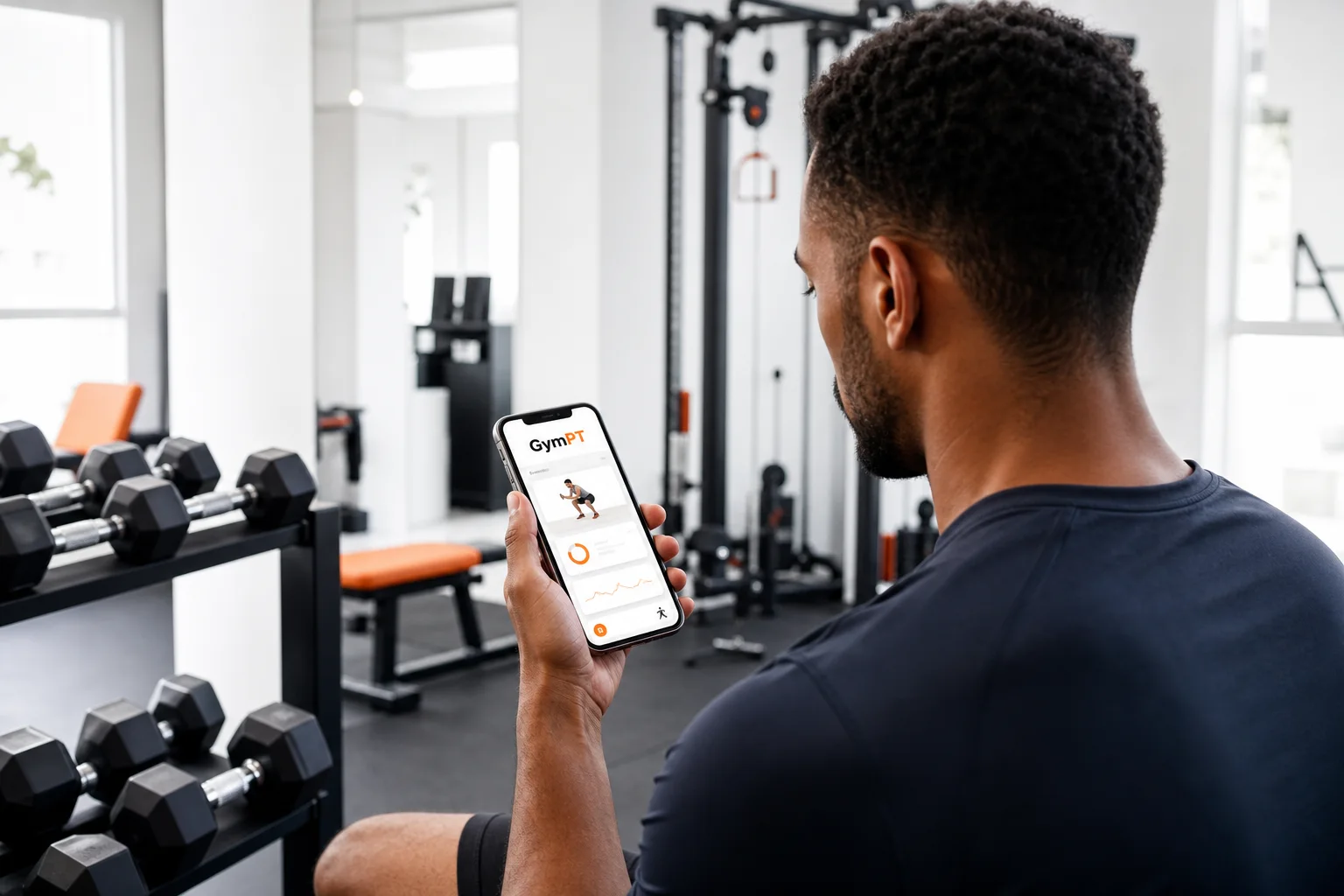
GymPT combines plan creation with workout tracking, AI coach chat, equipment-based training, body analysis, and progress insights so your routine can become more responsive over time. The app is designed to support training decisions, not replace good judgment or professional medical advice.
How to create your own personalized workout plan
- Define one primary goal. Choose the outcome that matters most for the next training phase.
- Set your minimum realistic frequency. Start with the number of sessions you can maintain during a normal week.
- List your available equipment. Include what you can reliably access, not what you might occasionally borrow.
- Select foundational movements. Build sessions around pushing, pulling, squatting, hinging, carrying, and core work as appropriate.
- Choose a manageable amount of work. Begin conservatively so you can learn technique and recover between sessions.
- Define how progression will work. Decide when to add repetitions, load, sets, or a more difficult variation.
- Log every session. Note performance and effort, not just whether you showed up.
- Review after several weeks. Adjust based on trends in performance, recovery, consistency, and enjoyment.
For a ready-made weekly structure, read Weekly Workout Planner: Build a Training Week That Adapts to You. If you are deciding between different training frequencies, compare the 3 Day Gym Workout Plan and 4 Day Gym Workout Plan approaches.
Common mistakes to avoid
- Changing the plan too often: adaptation should respond to useful feedback, not boredom after every workout.
- Adding volume before building consistency: more sets do not compensate for missed sessions.
- Ignoring recovery signals: persistent fatigue, declining performance, and poor technique may indicate that your current workload needs review.
- Confusing variety with progress: constantly rotating exercises can make improvement harder to measure.
- Using personalization to avoid effort: a flexible plan should still challenge you appropriately.
The practical takeaway
A personalized workout plan is valuable because it connects training theory with your actual life. It considers your goal, schedule, equipment, experience, preferences, and feedback. More importantly, it can change when those factors change.
Start with a routine that is simple enough to follow, specific enough to measure, and flexible enough to survive a busy week. Then use your workout history and effort feedback to make small, deliberate adjustments. That is how a generic list of exercises becomes a training system built around you.