workout app with AI coach
How to Choose a Workout App With AI Coach That Actually Helps You Train
A workout app with AI coach should do more than generate random exercises. Here is how to evaluate personalization, coaching, tracking, equipment support, and progress insights before choosing one.
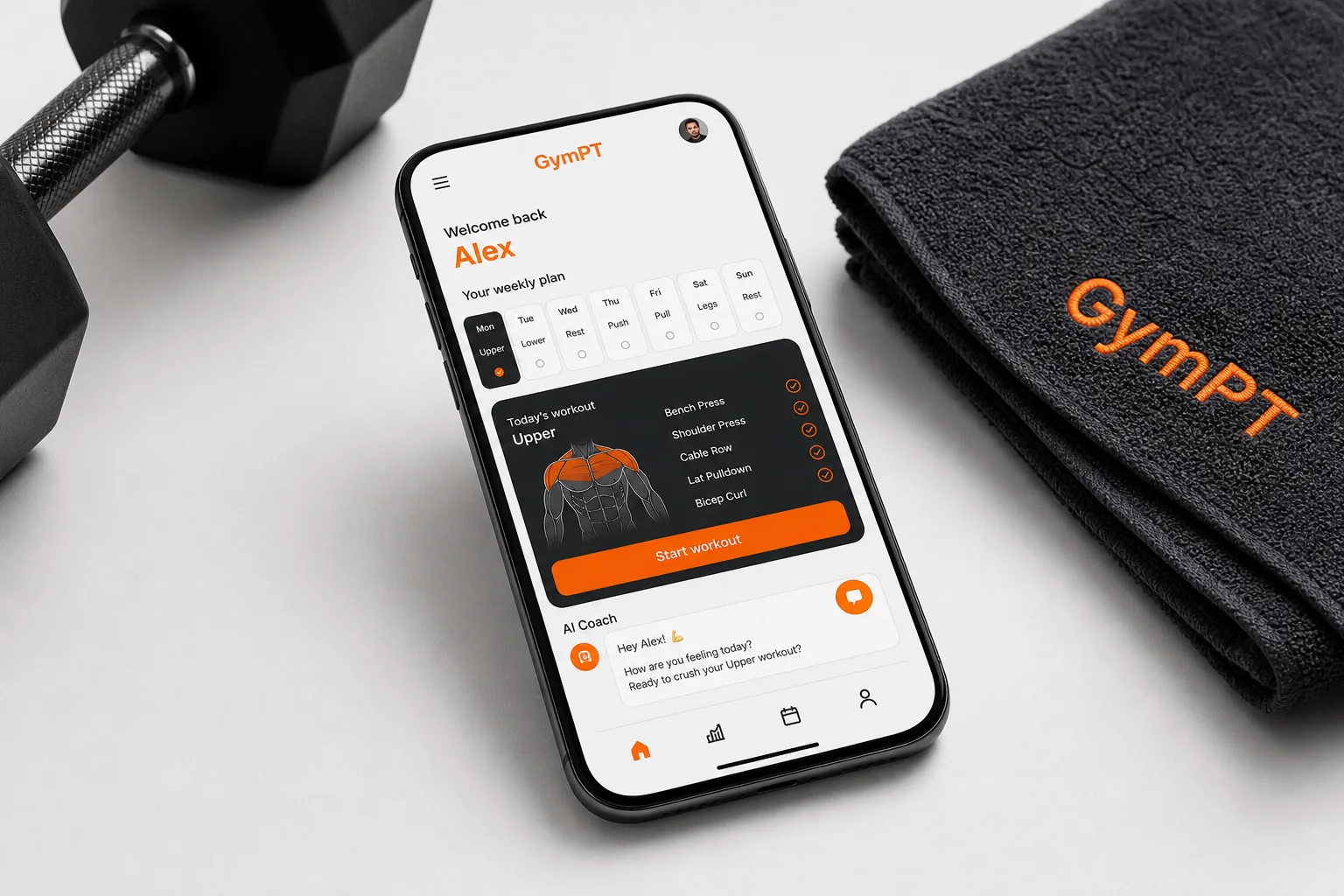
Choosing a workout app with AI coach can feel complicated. Many apps promise personalized plans, smart recommendations, and instant coaching, but the real question is simpler: will the app help you follow a sensible program, make adjustments, and keep training consistently?
The best AI fitness coach app is not necessarily the one with the most features. It is the one that understands your goals, schedule, experience, available equipment, and changing performance. It should make training easier to start and easier to improve without pretending to replace professional judgment.
What should a workout app with AI coach actually do?
An AI coach should support the decisions that normally make training difficult. That includes choosing exercises, organizing your week, selecting realistic training volume, and deciding when to progress or modify a workout.
For a healthy adult beginning or continuing resistance training, current guidance emphasizes training the major muscle groups regularly, building gradually, and selecting a routine that fits the person’s schedule and preferences. In practice, this means a useful app should adapt the plan to your life rather than forcing you into a rigid template.
Look for an app that can help you:
- Define a clear goal, such as strength, muscle gain, general fitness, or improved consistency.
- Choose a realistic number of weekly training days.
- Use the equipment you actually have access to.
- Adjust exercises when a movement is uncomfortable, unavailable, or unsuitable for your setup.
- Track sets, repetitions, load, duration, and completed workouts.
- Use your training history to guide future recommendations.
- Ask questions through an AI coach chat instead of searching for disconnected advice.
If an app only produces a one-time routine, it is closer to a workout generator than a coach. Coaching becomes more valuable when the plan evolves as your habits and performance change.
7 features to compare before choosing an AI fitness coach app
1. Real personalization, not just a goal selection
Many apps ask whether you want to lose weight, build muscle, or get stronger, then show nearly identical workouts to everyone. A more useful personalized workout app considers several inputs at once.
- Your training experience and confidence level.
- How many days you can consistently train.
- Session length and preferred training environment.
- Available equipment, from bodyweight and resistance bands to a full gym.
- Exercises you enjoy, dislike, or need to replace.
- Your current performance and recent training history.
Personalization should also be practical. A plan that looks ideal on paper but takes 90 minutes when you only have 30 is not personalized enough to be useful.
GymPT uses your goals, schedule, equipment, and training information to create a plan that is intended to fit your circumstances. That gives you a better starting point than selecting a generic split and hoping it works.
2. An AI workout planner that explains decisions
Good coaching is not only about telling you what to do. It also helps you understand why a workout is structured a certain way.
For example, an app might organize full-body sessions for someone who can train twice per week, or use an upper-lower structure for someone who has four reliable training days. Neither format is automatically best for everyone. The right choice depends on weekly availability, recovery, preferences, and the amount of work that can be completed with good technique.
Research on resistance training supports a flexible approach: different combinations of load, sets, and frequency can improve strength and muscle growth, while the most effective prescription depends on the goal. For hypertrophy, multiple sets and sufficient weekly volume are important; for strength, heavier loading may be especially useful. An AI coach should help translate those principles into a manageable routine instead of overwhelming you with technical details.
3. Equipment-based training
A plan is only actionable if you can perform it. Before choosing an app, check whether it supports your actual training environment.
A useful system should be able to distinguish between:
- Home workouts with little or no equipment.
- Adjustable dumbbells, kettlebells, bands, or a bench.
- Machines and cables in a commercial gym.
- Mixed training, such as home sessions during the week and gym sessions on weekends.
Equipment-aware programming also improves substitutions. If a cable machine is occupied, for example, the app should help you find a movement that trains a similar pattern with the equipment available. This reduces friction and makes it less likely that a disrupted session becomes a missed week.
4. Coach chat that is useful between workouts
An AI coach chat can be valuable when it answers specific training questions in context. You might ask how to adjust a session after missing a workout, whether to repeat a weight, or what alternative exercise to use when equipment is unavailable.
The quality of the chat depends on whether it knows your plan and history. Generic answers are easy to find. Context-aware answers are more useful because they can relate the suggestion to your goals, recent sessions, and available equipment.
Still, treat AI coaching as fitness guidance rather than medical advice. An app should not diagnose injuries, promise guaranteed transformations, or encourage you to train through sharp or unusual pain. A responsible approach is to stop an exercise that causes concerning symptoms and seek appropriate qualified help when needed.
5. Progress tracking that changes future decisions
Workout tracking is more than recording numbers for motivation. It creates the feedback loop that allows a plan to become more intelligent.
At minimum, your app should make it easy to record:
- Exercise selection.
- Weight or resistance.
- Repetitions and sets.
- Workout completion.
- Session duration or notes.
The app should then help you interpret the information. If you complete the target repetitions comfortably for several sessions, progression may be appropriate. If performance repeatedly drops, the plan may need less volume, a lighter load, more recovery, or a better exercise choice.
For a deeper look at building this feedback loop, read Workout Progress Tracking: How to Log Training and See Real Results.
6. Body analysis used responsibly
Some AI fitness apps include body analysis through photos, measurements, or movement information. This can help users understand changes over time, but it should be handled carefully.
Useful body analysis focuses on practical training context, such as proportions, movement observations, or progress trends. It should not encourage obsessive checking, make medical judgments, or present an image-based estimate as a precise measurement.
Consider whether the feature gives you an actionable next step. If it simply produces a score without explaining how to train differently, it may add novelty without adding much value.
7. Progress insights that reward consistency
Progress is not limited to a heavier one-repetition maximum. A good app can show improvements in completed sessions, exercise performance, total training volume, consistency, and personal bests.
This matters because progress is often uneven. You may increase repetitions before increasing weight, improve technique before adding load, or maintain performance during a busy period. Seeing these trends can keep your expectations realistic and help you judge the plan using more than a single metric.
How to test an AI workout planner before committing
Before choosing a subscription, run a simple quality check. Give the app realistic information rather than selecting the easiest options. Include your true schedule, equipment, experience, and preferred session length.
- Enter a specific goal. “Build muscle while training three days per week” is more useful than “get fit.”
- Check the first week. Are the workouts achievable with your equipment and time?
- Look for balance. Does the plan include major movement patterns and sensible recovery?
- Test substitutions. Can you replace an exercise without rebuilding the entire plan?
- Ask the coach a practical question. See whether the response uses your actual plan and context.
- Complete and log a workout. Notice whether tracking is quick enough to use consistently.
- Review the next recommendation. Does your completed workout influence what comes next?
This process helps separate a genuinely adaptive app from a library of static routines.
Where GymPT fits
GymPT is designed for people who want more structure than a list of exercises but more flexibility than a fixed program. It combines personalized workout planning, AI coach chat, equipment-based training, body analysis, workout tracking, and progress insights in one training experience.
That combination is useful because the parts support one another. Your equipment affects exercise selection. Your completed workouts inform future progression. Your questions can be answered in the context of your plan. Your progress history gives you a clearer view of whether the routine is working.
If you are still deciding what type of plan fits your schedule, start with How to Choose a Custom Fitness Plan App That Actually Fits Your Life. You can also compare the principles of a personalized gym app before deciding which features matter most to you.
What an AI coach cannot replace
Technology can reduce planning friction, but it does not remove the need for judgment. You still need to perform exercises with appropriate control, respect your recovery, and adjust when something does not feel right.
An AI coach also cannot guarantee results. Outcomes are influenced by training consistency, nutrition, sleep, stress, starting point, and individual response. The most useful promise an app can make is not instant transformation. It is helping you make better training decisions repeatedly.
For beginners, that usually means starting with manageable sessions and learning the basics before adding complexity. Our guide to an AI gym plan for beginners covers how to use personalization without rushing the process.
The bottom line
The best workout app with AI coach should help you move from intention to consistent action. Look for meaningful personalization, equipment-aware plans, useful coach chat, fast tracking, responsible analysis, and progress insights that influence future workouts.
GymPT brings those features together so you can spend less time searching for routines and more time following a plan that fits your real life. The goal is not to make training complicated. It is to make the next useful workout easier to understand, complete, and improve.