smart workout app
Smart Workout App vs. Static Plan: What Should You Choose?
A static workout plan can provide structure, but a smart workout app can adjust training around your goals, equipment, schedule, and progress. Here is how to choose the right option.
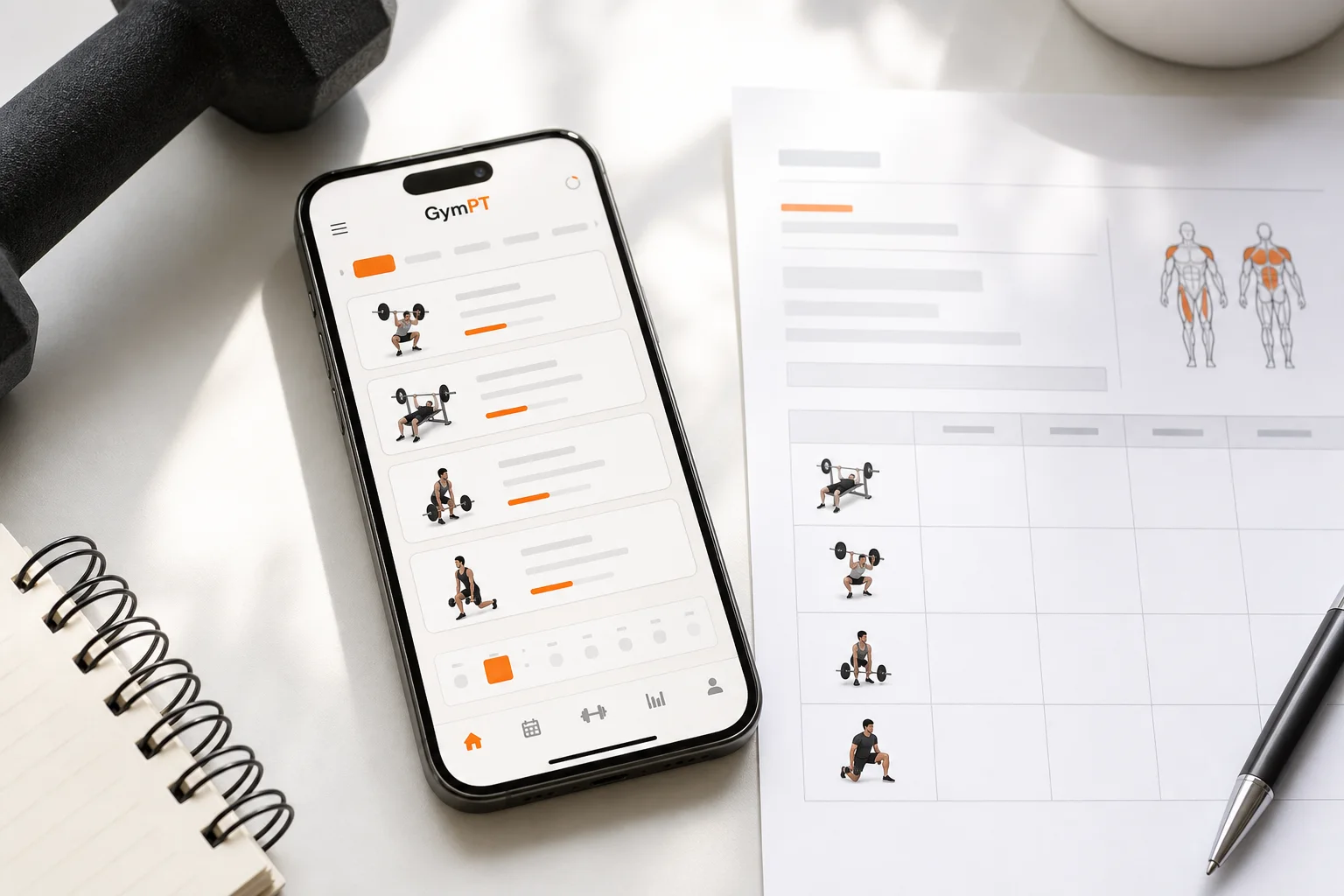
A workout plan is only useful if you can follow it consistently, use the equipment available to you, and make sensible adjustments when your schedule or performance changes. That is where the difference between a static PDF and a smart workout app becomes important.
A PDF can be a good starting point. It may show you which exercises to perform, how many sets to complete, and how to organize your week. But it cannot see that your gym is busy, remember that your shoulder felt uncomfortable during a movement, or adjust tomorrow’s session because you slept poorly and missed today’s workout.
A smart app is designed to turn a plan into an ongoing training system. Instead of giving you a routine once and leaving you to manage every decision, it can combine personalization, coaching, tracking, and progress feedback in one place.
What makes a smart workout app different?
The word “smart” should mean more than a polished interface or a large exercise library. A genuinely useful fitness app should help you make better training decisions with less guesswork.
For most people, that means the app should connect several pieces of information:
- Your goal: strength, muscle development, general fitness, fat loss, or improved consistency.
- Your availability: how many days you can realistically train and how long each session can last.
- Your training environment: a full gym, a small home setup, or limited equipment.
- Your experience: whether you need beginner-friendly instructions or more advanced programming.
- Your performance: the weights, repetitions, sets, and effort you record over time.
- Your feedback: whether a movement feels effective, too easy, too difficult, or unsuitable for you.
The more effectively an app uses these inputs, the more it behaves like a training assistant rather than a digital filing cabinet.
When a PDF workout plan is enough
A static plan is not automatically bad. It may be the right choice if you already understand exercise technique, have predictable access to equipment, and are comfortable making small programming decisions yourself.
A PDF can work well when:
- You want a simple routine with minimal technology.
- Your schedule and gym setup rarely change.
- You know how to substitute exercises safely.
- You can track progression in a notebook or spreadsheet.
- You understand when to add weight, repetitions, or recovery time.
For example, an experienced lifter following a familiar three-day routine may not need an app to tell them how to organize every session. The plan provides structure, while the lifter supplies the judgment.
The limitation is that a PDF usually stops at instruction. It tells you what the original writer intended, but it does not actively respond to what happens during your training. If you miss a session, change gyms, plateau on an exercise, or have less time than expected, you must solve the problem yourself.
When a smart workout app is more useful
A smart workout app becomes more valuable when your real life does not match a fixed template. This is especially true for beginners, people returning to training, busy professionals, and anyone who wants a clearer record of progress.
1. Your schedule changes from week to week
A four-day plan may look ideal on paper, but it becomes frustrating if work, travel, or family responsibilities regularly disrupt your week. An adaptive workout app can help you reorganize sessions instead of forcing you to restart the entire routine after one missed day.
That flexibility matters because the best training frequency is often the one you can maintain. Evidence on resistance training suggests that frequency alone is not the whole story; when total training volume is similar, distributing sessions differently may produce comparable strength outcomes. In practical terms, a plan should fit your week rather than compete with it.
2. You train with different equipment
A plan built around barbells and cable machines is less useful if you train at home with dumbbells and resistance bands. A smart app should use your available equipment when building sessions and offer practical alternatives when something is unavailable.
That does not mean every substitution is identical. A good replacement should match the main training purpose of the original movement, such as a horizontal push, knee-dominant leg exercise, or vertical pull. This is one reason an equipment-based workout plan can be more practical than copying a routine designed for someone else’s gym.
3. You are unsure how to progress
Many people complete the same workout for weeks without knowing whether to increase the load, add repetitions, change an exercise, or take more recovery time. A smart app can make progression easier to understand by using your logged performance as context.
Progression does not need to mean adding weight every session. It may involve completing more repetitions with the same load, improving control, adding a set, or maintaining performance while managing fatigue. The important point is that your next step should be connected to what you actually did previously.
4. You need coaching between sessions
Exercise demonstrations are helpful, but many training questions appear after the workout starts: “Should I reduce the load today?” “What can I do instead of this machine?” or “How should I organize the rest of the week?”
AI coach chat can provide an accessible way to ask those questions in context. It should support your decision-making, not replace professional medical or clinical advice. If you have an injury, a diagnosed condition, or persistent pain, seek guidance from a qualified health professional before modifying exercise around it.
Five features worth comparing before you choose
1. Personalization beyond your stated goal
Nearly every fitness product asks whether you want to build muscle or lose fat. That is only the first layer of personalization. Look for an app that also considers your experience, training days, session length, available equipment, and preferred exercises.
A useful personalized workout planner should produce a routine that is realistic from the first week. A theoretically perfect plan that you cannot complete is less useful than a slightly simpler plan that you can repeat and progress.
2. Clear exercise instructions
Instructions should explain setup, movement, target muscles, common mistakes, and how to choose an appropriate starting load. Beginners should be able to understand what to do without searching across several unrelated videos.
Look for clear language rather than exaggerated promises. The app should help you train with better awareness, not suggest that one exercise is universally best for everyone.
3. Equipment-aware alternatives
Exercise substitutions are essential for real-world training. A smart app should let you remove an unavailable exercise and receive an alternative that suits your equipment and experience level.
This feature is particularly useful when a gym is crowded. Instead of waiting ten minutes for one machine, you can keep the session moving with a sensible alternative.
4. Workout tracking that leads to insight
Logging sets and repetitions is useful only when the information helps you act. A strong workout tracking app should make it easy to review completed sessions, identify trends, and see whether you are gradually improving.
Useful tracking may include:
- Load and repetition history for each exercise.
- Completed versus planned sessions.
- Training frequency across recent weeks.
- Personal records or meaningful performance improvements.
- Notes about effort, exercise comfort, or equipment limitations.
Do not judge an app by the number of charts it displays. The best insights are simple enough to influence your next workout.
5. Adjustments based on feedback
Training should not be rigid when your capacity changes. A useful app can help you adapt session difficulty, exercise selection, or weekly structure based on your completed work and feedback.
This does not mean changing everything constantly. Effective programming still needs enough repetition to measure progress. The goal is controlled flexibility: keep the important structure, while adjusting details that no longer fit.
How to test whether an app is genuinely smart
Before committing to a new platform, use a simple test. Enter a realistic goal, your actual schedule, and the equipment you truly have—not the equipment you hope to use someday.
- Review the first week. Are the sessions achievable in your available time?
- Check exercise selection. Does the plan include movements you can perform confidently?
- Test a substitution. Remove one exercise and see whether the alternative makes sense.
- Log a workout. Notice whether recording sets and effort is quick or distracting.
- Ask a practical question. See whether the coaching feature gives a clear, relevant answer.
- Return after a missed session. Check whether the app helps you continue rather than making you start over.
If the app produces a generic routine regardless of your answers, its intelligence may be mostly cosmetic. If it changes the plan in useful, understandable ways, it is more likely to support your training in practice.
Smart does not mean complicated
A smart workout app should reduce friction, not add another project to your day. You should not need to study complicated metrics before every session or constantly rebuild your routine.
The most useful system usually has a straightforward flow:
- Choose or confirm your goal.
- Complete the planned workout.
- Record what happened.
- Review the result.
- Follow the next appropriate progression.
Consistency is also easier when the app supports achievable training habits. General activity guidance recommends muscle-strengthening work for major muscle groups on at least two days per week, but your best starting point may be less ambitious if you are new to exercise. Build a routine you can sustain, then increase the challenge gradually.
How GymPT fits the smart-app approach
GymPT is designed for people who want more than a fixed list of exercises. It combines personalized workout plans with AI coach chat, body analysis, equipment-based training, workout tracking, and progress insights.
You can use those features as a connected workflow: define what you want to achieve, build sessions around your available equipment, ask questions when you need help, record your performance, and use the resulting information to make future workouts more relevant.
If you are comparing different options, our AI fitness app guide explains the broader features to look for. For users focused on strength, the AI strength training app guide covers how intelligent planning can support more consistent progression.
Final decision: choose the tool that helps you act
The best workout solution is not necessarily the one with the most exercises, the most advanced terminology, or the most attractive dashboard. It is the one that helps you complete appropriate sessions, track meaningful information, and make better decisions over time.
Choose a static plan if you already have the knowledge and consistency to manage adjustments yourself. Choose a smart workout app if you want your plan to respond to your schedule, equipment, performance, and questions.
For many people, the practical advantage is simple: a smart app turns training from a document you read into a process you can follow, evaluate, and improve.
Once you have a routine, you can also explore a weekly workout planner approach to organize your training around the week you actually have.