hypertrophy workout plan
Hypertrophy Workout Plan: A Practical 4-Day Muscle-Gain Routine
A useful hypertrophy workout plan does not need complicated techniques. Learn how to organize four weekly sessions around effective volume, manageable effort, progressive overload, and recovery.
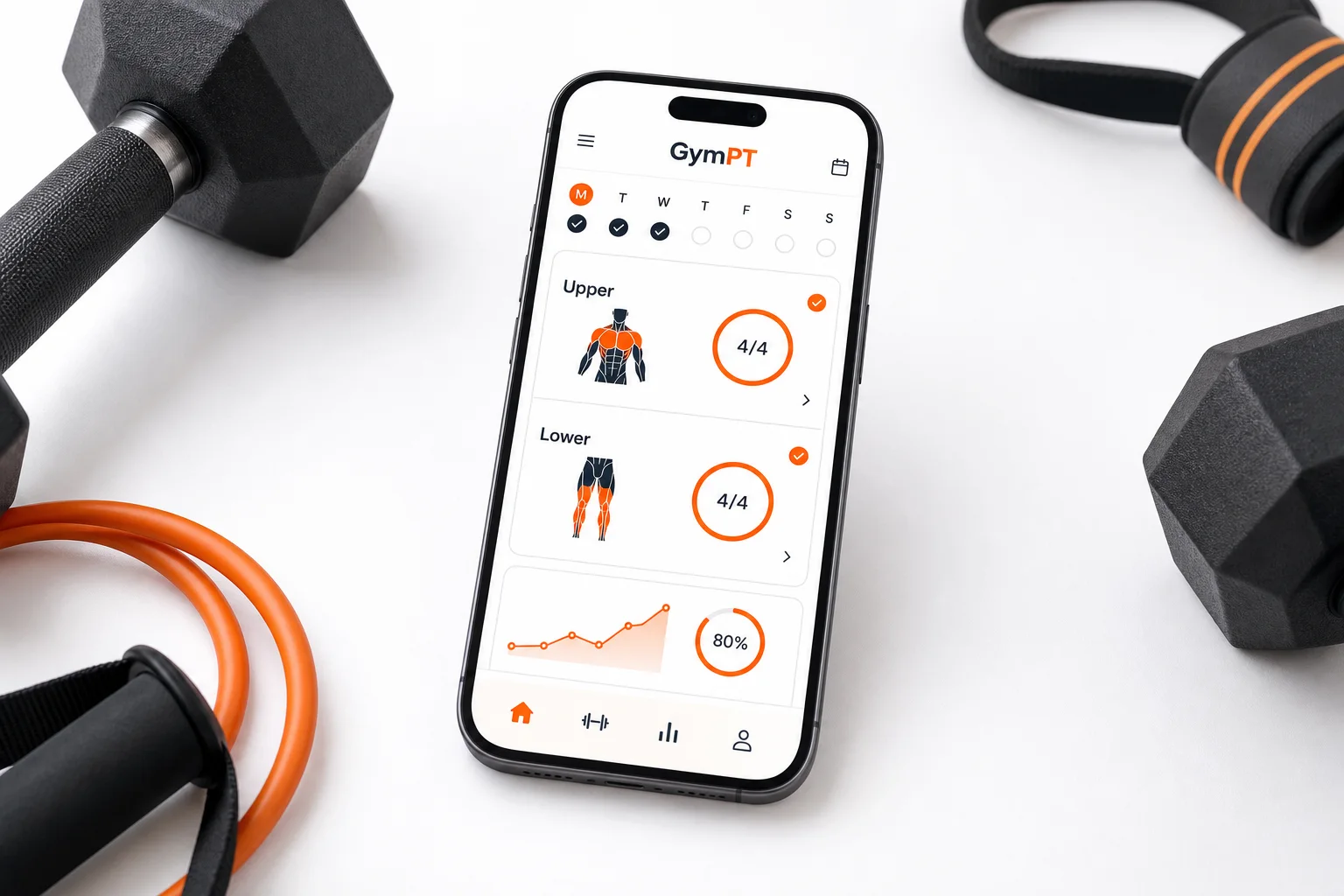
A well-designed hypertrophy workout plan gives each major muscle group enough challenging work to grow while leaving you recovered enough to train productively again. The goal is not to make every workout exhausting or fill your week with advanced techniques. It is to repeat high-quality training, gradually improve performance, and stay consistent long enough for adaptations to accumulate.
This four-day routine uses a practical upper/lower structure. Most muscles are trained twice per week, weekly sets are distributed instead of crammed into one session, and effort is controlled with repetitions in reserve. You can use barbells, dumbbells, machines, cables, or suitable home alternatives. The best exercise is usually the one you can perform safely, load progressively, and recover from.
What makes a hypertrophy workout plan effective?
Muscle growth is influenced by several training variables, but four deserve the most attention:
- Effective weekly volume: enough challenging sets to stimulate progress without creating more fatigue than you can manage.
- Appropriate effort: sets should usually finish close enough to failure that the target muscle is meaningfully challenged.
- Progressive overload: over time, you add repetitions, load, sets, or improved execution when your current workload becomes easier.
- Consistency and recovery: a repeatable plan performed for months is more useful than a perfect plan followed for one week.
Current guidance supports a simple approach: train the major muscle groups regularly, build gradually, and prioritize a routine that fits your schedule. A weekly target around 10 challenging sets per muscle group is a reasonable starting point for many people, but it is not a universal requirement. Beginners may grow with less, while experienced lifters may need more for certain muscle groups.
For a broader look at choosing a sustainable weekly structure, see this adaptive workout plan guide.
How to use this 4-day hypertrophy workout plan
Train on four non-consecutive or semi-consecutive days, such as Monday, Tuesday, Thursday, and Friday. The exact days are flexible. Try to avoid placing demanding lower-body sessions back to back.
- Monday: Upper body A
- Tuesday: Lower body A
- Wednesday: Rest or light activity
- Thursday: Upper body B
- Friday: Lower body B
- Saturday and Sunday: Rest, light activity, or optional mobility work
For most exercises, use a controlled repetition range rather than chasing one exact number. A practical default is 6–12 repetitions for compound lifts and 10–20 repetitions for many isolation movements. Muscle growth can occur across a broad range of loads when sets are sufficiently challenging, so choose loads that let you maintain stable technique.
Day 1: Upper body A
Chest, back, shoulders, and arms
- Barbell bench press or machine chest press: 3 sets of 6–10 repetitions
- Chest-supported row: 3 sets of 8–12 repetitions
- Incline dumbbell press: 2 sets of 8–12 repetitions
- Lat pulldown or assisted pull-up: 2 sets of 8–12 repetitions
- Cable or dumbbell lateral raise: 3 sets of 12–20 repetitions
- Triceps pressdown: 2 sets of 10–15 repetitions
- Dumbbell curl: 2 sets of 10–15 repetitions
Rest about two to three minutes on demanding presses and rows, and roughly one to two minutes on isolation movements. If your repetitions slow dramatically or your technique changes, extend the rest period before the next set.
Day 2: Lower body A
Quadriceps, hamstrings, glutes, and calves
- Back squat, hack squat, or leg press: 3 sets of 6–10 repetitions
- Romanian deadlift: 3 sets of 8–12 repetitions
- Walking lunge or split squat: 2 sets of 8–12 repetitions per side
- Leg curl: 2 sets of 10–15 repetitions
- Leg extension: 2 sets of 10–15 repetitions
- Standing calf raise: 3 sets of 10–15 repetitions
- Optional abdominal exercise: 2–3 sets of 10–20 repetitions
Use a range of motion that you can control without losing position. For lower-body exercises, fatigue can build quickly, so do not treat every set as a test of maximum effort. Strong, repeatable sets are easier to progress and recover from.
Day 3: Upper body B
Change the emphasis without changing the goal
- Overhead press or machine shoulder press: 3 sets of 6–10 repetitions
- Pull-up, pulldown, or single-arm pulldown: 3 sets of 8–12 repetitions
- Dumbbell bench press or push-up variation: 2 sets of 8–15 repetitions
- Seated cable row: 2 sets of 8–12 repetitions
- Rear-delt fly: 3 sets of 12–20 repetitions
- Overhead triceps extension: 2 sets of 10–15 repetitions
- Incline dumbbell curl or cable curl: 2 sets of 10–15 repetitions
This second upper-body session uses slightly different angles and exercises while keeping the overall movement patterns familiar. You do not need to change exercises every week. Keeping movements stable for several weeks makes it easier to compare performance and identify genuine progress.
Day 4: Lower body B
Build muscle with a different lower-body emphasis
- Front squat, goblet squat, or leg press: 3 sets of 8–12 repetitions
- Hip thrust or glute bridge: 3 sets of 8–12 repetitions
- Bulgarian split squat or reverse lunge: 2 sets of 8–12 repetitions per side
- Seated leg curl: 3 sets of 10–15 repetitions
- Leg extension: 2 sets of 12–20 repetitions
- Seated calf raise: 3 sets of 10–20 repetitions
- Optional abdominal exercise: 2–3 sets of 10–20 repetitions
If your lower-body recovery is poor, start with one fewer set per exercise or remove the optional work. More volume is not automatically better if it reduces performance in the following week.
How close to failure should you train?
Use repetitions in reserve, or RIR, to regulate effort. RIR is your estimate of how many technically good repetitions you could still complete at the end of a set.
- 3 RIR: challenging, but clearly not near your limit.
- 2 RIR: hard and productive for most compound exercises.
- 1 RIR: very challenging, with approximately one good repetition left.
- 0 RIR: momentary failure or no additional technically sound repetition.
For this hypertrophy training split, begin most compound sets around 2–3 RIR and most isolation sets around 1–2 RIR. Occasionally reaching failure on a safe isolation movement can be useful, but it is not necessary on every set. Research does not consistently show that taking every set to momentary failure produces better muscle growth, and excessive failure training can make fatigue harder to manage.
How to progress the plan
Use double progression to make the routine measurable:
- Choose a load that lets you reach the lower end of the repetition range with the planned RIR.
- Keep the load steady while gradually adding repetitions across sessions.
- When you reach the top of the range on every set with stable technique, increase the load slightly.
- Return to the lower end of the range and repeat the process.
For example, if an exercise is programmed for 3 sets of 8–12 repetitions, you might perform 10, 9, and 8 repetitions one week. Over several sessions, the goal could become 12, 12, and 12 with similar effort. At that point, add a small amount of weight and rebuild your repetitions.
Track more than the weight on the bar. Record repetitions, RIR, exercise variations, rest periods, and notes about technique or discomfort. A fitness progress app can make these trends easier to review than relying on memory.
How much weekly volume should you use?
The routine above provides a moderate starting volume. Depending on exercise overlap, many major muscle groups receive approximately 8–14 challenging sets per week. Count direct work first, then consider indirect work from compound exercises. For example, pressing contributes to triceps volume, while rows and pulldowns contribute to biceps volume.
After four to six consistent weeks, review your results:
- If performance is improving and recovery is good, keep the volume steady.
- If progress has stalled but you are sleeping and eating adequately, add one set to a lagging muscle group.
- If soreness, motivation, or performance worsens for several sessions, reduce volume temporarily.
- If a muscle is progressing with fewer sets, do not add work simply because a template suggests it.
Volume should be individualized. A higher number of sets can help in some cases, but the benefit tends to depend on exercise quality, effort, recovery, and your training history.
Recovery habits that support muscle gain
A muscle-building routine works best when your lifestyle supports it. Aim for a regular sleep schedule, eat enough total food to support your goal, and include a reliable source of protein in your meals. You do not need a perfect diet, but inconsistent eating can make training progress harder to interpret.
Also consider your total weekly stress. A demanding work schedule, poor sleep, or additional sports can reduce the amount of gym volume you can productively recover from. GymPT can help organize training around your available equipment, schedule, and current performance instead of forcing every person into the same template.
If you train at home, you can adapt this structure with adjustable dumbbells, resistance bands, bodyweight exercises, or limited equipment. This dumbbell workout plan guide explains how to match exercises to the equipment available.
Common mistakes to avoid
- Changing exercises too often: frequent variation makes progression difficult to measure.
- Adding sets before improving execution: better range of motion and control may provide a stronger stimulus without more volume.
- Training every set to failure: hard training is useful, but constant failure can interfere with recovery.
- Ignoring small performance improvements: one extra repetition or cleaner technique can be meaningful progress.
- Copying advanced volume: experienced lifters may tolerate workloads that are unnecessary for newer trainees.
- Skipping deloads when needed: a short reduction in volume can help restore performance when fatigue accumulates.
For a more personalized approach, compare this template with an AI fitness coach for muscle gain workflow that can adjust training around your goals, equipment, and logged progress.
Bottom line
The best hypertrophy workout plan is one that gives you enough challenging work, uses manageable effort, and can be repeated consistently. Start with this four-day upper/lower structure, keep most sets within about 1–3 repetitions of failure, progress gradually, and adjust volume based on your performance and recovery.
You do not need advanced methods, constant exercise changes, or exhausting workouts to build muscle. A clear plan, accurate tracking, and months of steady execution will usually matter more than the latest training trick.