fitness app with body analysis
Fitness App With Body Analysis: How to Turn Body Data Into Smarter Training
A fitness app with body analysis can help you understand your starting point, choose more suitable training, and monitor progress beyond the scale. Learn what to look for and how to use body data responsibly.
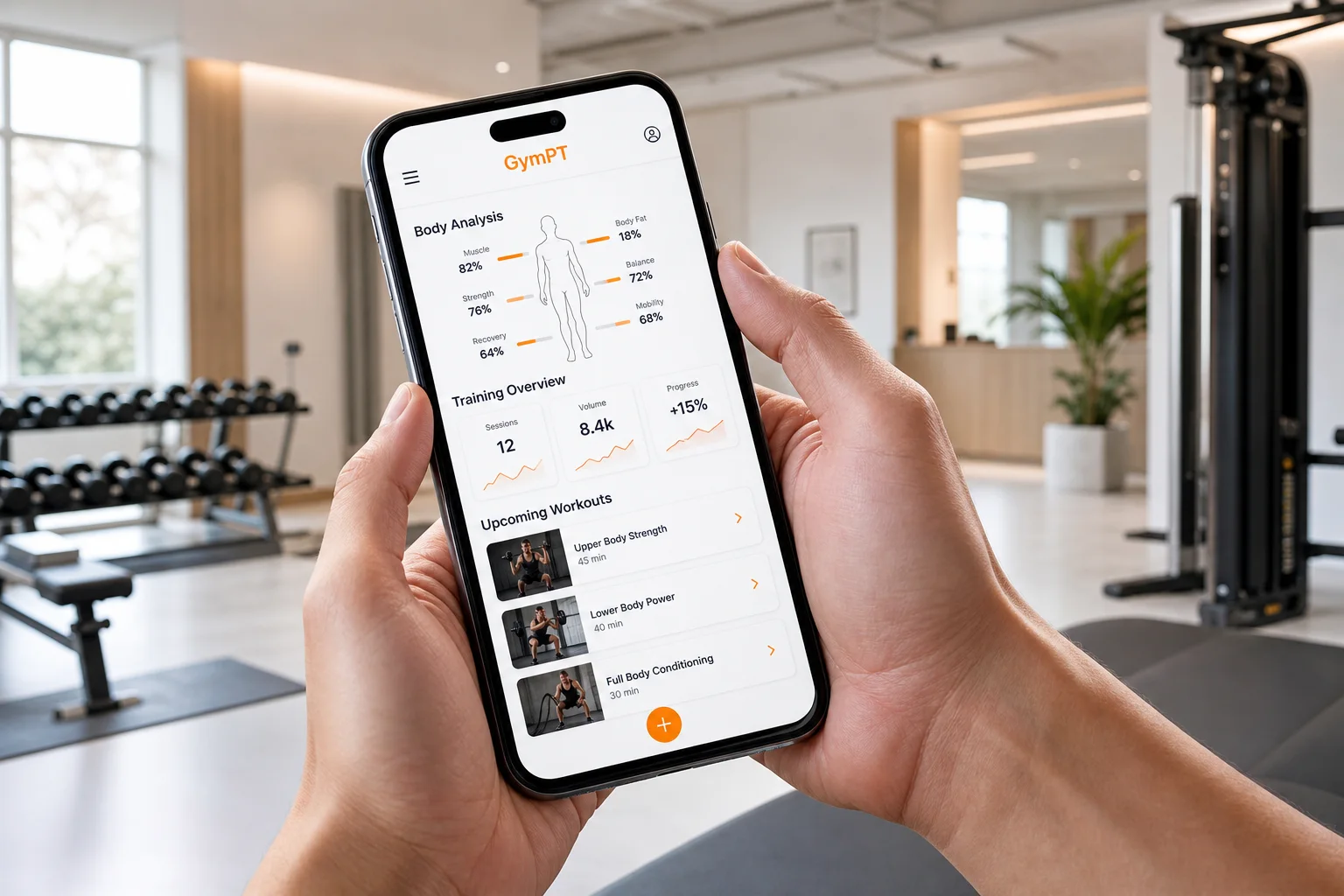
A fitness app with body analysis can do more than record your weight or count completed workouts. Used properly, it can help you understand your starting point, connect your goals to realistic training choices, and notice progress that a scale may miss.
The important distinction is that body analysis should support training decisions, not act as a diagnosis. Measurements are estimates, and they can change with hydration, food intake, measurement conditions, and the method used. The most useful approach is to combine body data with your goals, workout performance, recovery, and consistency.
GymPT brings these pieces together with AI coaching, personalized workout plans, equipment-based training, workout tracking, and progress insights. Here is how to use body analysis as practical guidance instead of getting stuck on a single number.
What does body analysis mean in a fitness app?
In a training app, body analysis usually refers to a structured snapshot of information such as height, weight, body measurements, estimated body composition, training experience, and personal goals. Depending on the app and the information you provide, the result may help organize your training priorities.
For example, the same body weight can appear in very different training situations. One person may be trying to build strength, another may want to improve general fitness, and another may be returning to exercise after a long break. A useful app should not treat these people as interchangeable.
Body analysis can provide context for questions such as:
- Should your plan emphasize strength, muscle development, conditioning, mobility, or a combination?
- How many training days are realistic for your schedule?
- Would a full-body plan or a split routine better match your availability?
- Should exercise selection account for your available equipment or current training experience?
- Which measurements and performance markers are worth tracking over time?
This is where body analysis becomes useful: not as a verdict about your body, but as one input in a more personalized training process.
Why body analysis should not rely on one number
Many people begin with body weight or body mass index because those figures are easy to collect. However, weight-based measurements do not directly describe how much of your body is muscle, fat, water, bone, or other lean tissue. They also do not explain how you move, how strong you are, or how well you recover.
That is why responsible body composition tracking looks at trends and multiple signals rather than promising perfect precision. Useful inputs may include:
- Body weight measured under reasonably consistent conditions
- Waist or other circumference measurements, when appropriate
- Estimated body fat or lean mass trends
- Strength, repetitions, walking capacity, or conditioning performance
- Workout consistency and completed training volume
- Sleep, energy, soreness, and perceived recovery
These measurements are not equally reliable, and they should not be treated as interchangeable. For instance, a consumer body fat estimate can move up or down because of hydration or the time of day. A tape measurement can also vary if you change the measurement location or technique.
The practical solution is consistency. Use the same method, follow similar conditions, and assess progress over several weeks rather than reacting to a single reading.
How a fitness app with body analysis can improve workout choices
1. It can help define a more relevant starting point
A generic program assumes that everyone starts with the same ability, schedule, and priorities. Body analysis gives an app additional context so your first plan can be more appropriate. A beginner may need simpler movement patterns and manageable training volume, while an experienced lifter may need progression, exercise variety, and more specific loading targets.
This does not mean an app can perfectly understand every individual from a few measurements. It means the plan can begin with better questions and clearer assumptions.
2. It can connect goals to training structure
Your goal should influence the structure of your week. Someone focused on strength may benefit from repeated practice of key movement patterns and adequate recovery between demanding sessions. Someone focused on general fitness may need a balanced combination of resistance training and cardiovascular work. Someone prioritizing muscle development may need enough weekly training volume, exercise coverage, and progression.
Body analysis can help provide context, but your goal remains the main decision-maker. A good personalized workout plan should explain what you are training for and give you a realistic way to train consistently.
3. It can make progress tracking more complete
Progress is not limited to a lower scale reading. You may be progressing when you perform more repetitions with good form, use a heavier load, complete workouts more consistently, recover more comfortably, or improve your range of motion.
A fitness app can make these changes easier to see by keeping body data and training history in one place. This is especially helpful when body measurements stay relatively stable but your performance improves.
4. It can support adjustments when your routine is not working
If your plan feels too difficult, your schedule changes, or your available equipment is different from what you expected, the app should help you adapt. Body analysis is only one part of that process. Workout completion, feedback, recovery, and performance trends may be just as important when deciding whether to change frequency, exercise selection, volume, or intensity.
What to look for when choosing an AI fitness app
If you are comparing apps, do not choose based only on the presence of a body scan or a visually impressive dashboard. Look for a system that turns information into practical, adjustable training guidance.
Personalization beyond the profile screen
The app should use your goals, experience, schedule, equipment, and preferences to shape the plan. A profile that collects many details but produces the same routine for everyone is not truly personalized.
Clear explanations
You should be able to understand why a workout was selected and what to do when an exercise is unavailable. Clear coaching is more useful than unexplained scores or overly precise predictions.
Equipment-aware programming
Your plan should reflect the equipment you actually have. A home user with dumbbells, bands, or no equipment should not receive a routine built around machines they cannot access. GymPT can organize training around the tools available to you, making the plan easier to follow in real life.
Progress tracking that includes performance
Look for workout history, completed sets, repetitions, loads, and progression insights alongside body measurements. Training performance often provides important context for interpreting changes in body composition.
Responsible language
Be cautious with any app that presents estimates as medical facts, promises guaranteed transformations, or implies that one body measurement determines your health. A fitness app should provide guidance and education, not diagnosis.
How to use body analysis without becoming obsessed with data
More data does not automatically create better decisions. The goal is to collect enough information to guide your training while avoiding unnecessary day-to-day reactions.
- Set one primary training objective. Choose a main focus such as building strength, improving conditioning, developing muscle, or establishing consistency.
- Record a baseline. Note your current measurements, recent training experience, available equipment, and realistic weekly schedule.
- Use consistent measurement conditions. If you track weight or body measurements, use a similar time and method whenever possible.
- Review trends at sensible intervals. Weekly or monthly reviews are usually more informative than reacting to every fluctuation.
- Pair body data with performance data. Ask whether your strength, work capacity, technique, or workout consistency is changing too.
- Adjust one major variable at a time. Changing training volume, exercise selection, nutrition, and schedule simultaneously makes it difficult to know what helped.
If a measurement causes anxiety or leads you to make extreme training decisions, remove it from your routine and focus on performance, consistency, energy, and other markers that support your goals.
Body analysis is most useful when it leads to action
The value of body analysis is not the number itself. The value is what the number helps you do next. It may encourage a more realistic starting plan, show that your routine needs adjustment, or help you recognize progress that is not visible in the mirror.
GymPT uses body analysis as part of a broader coaching experience. You can combine your profile and goals with AI coach chat, equipment-based workouts, workout tracking, and progress insights. That makes it easier to move from information to action: choose a suitable routine, complete it, review your results, and adapt as your training develops.
For a deeper look at how data can shape your routine, read Body Analysis Fitness App: How to Use Your Data for Smarter Training. You may also find the personalized workout plan guide useful when comparing different training approaches.
Frequently asked questions
Is body analysis accurate in a fitness app?
It depends on the measurement method and how consistently you use it. App-based estimates can be useful for observing broad trends, but they are not perfectly precise. Treat them as guidance and combine them with performance, recovery, and consistency data.
Can body analysis create my complete workout plan?
It can contribute to a plan, but it should not be the only input. Goals, experience, schedule, equipment, preferences, and feedback also matter. The best plan is one you can perform safely and consistently.
Should I track body fat every day?
Usually, daily body fat readings are unnecessary and may create confusion because short-term fluctuations can be influenced by measurement conditions. A consistent, less frequent review is often more useful.
Is GymPT a medical assessment tool?
No. GymPT provides fitness guidance, workout planning, coaching support, and progress insights. Body analysis should not be used to diagnose a condition or replace advice from a qualified healthcare professional.
Bottom line: choose a fitness app with body analysis that helps you make better training decisions—not one that simply gives you more numbers. When body data is combined with personalized programming, equipment awareness, coaching, and workout history, it can become a practical part of a sustainable fitness routine.