fitness app that creates workouts
Fitness App That Creates Workouts: What to Look For Before You Choose One
A fitness app that creates workouts should do more than assemble random exercises. Here’s how to evaluate personalization, progression, equipment support, coaching, and tracking—with GymPT as a practical example.
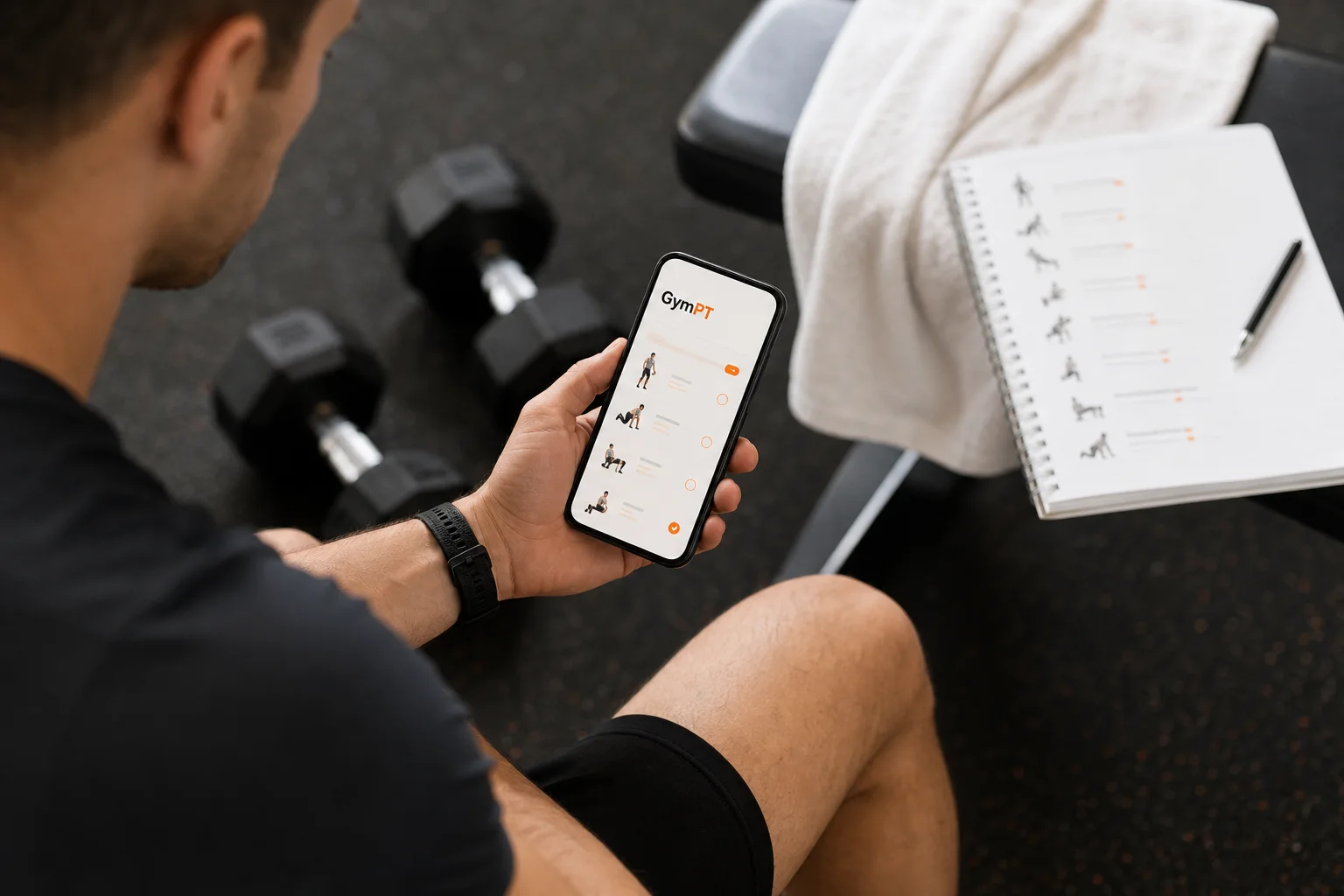
Finding a fitness app that creates workouts is easy. Finding one that creates workouts you can actually follow, repeat, and progress with is much harder.
Many apps can generate a routine from a goal such as muscle gain, fat loss, or general fitness. The better question is whether the app understands your training schedule, experience, available equipment, current ability, and preferences—and then adjusts the plan when real life changes.
This guide explains what to look for in an AI workout planner or workout generator app. It also shows how GymPT can fit into that process with personalized plans, AI coach chat, body analysis, equipment-based training, workout tracking, and progress insights.
What should a fitness app that creates workouts actually do?
A useful workout app should reduce decision fatigue without taking away your control. It should turn broad goals into clear sessions and help you understand why those sessions make sense.
At minimum, look for these capabilities:
- Goal-based planning: The app should distinguish between goals such as strength, muscle growth, general fitness, conditioning, or improving consistency.
- Schedule-aware programming: A three-day routine should not simply be a shortened five-day plan. It should be structured around the time you can realistically train.
- Equipment matching: Exercises should reflect whether you train at a full gym, at home with adjustable dumbbells, or with bodyweight only.
- Progressive training: The app should provide a sensible way to increase challenge over time through repetitions, load, sets, exercise variation, or improved execution.
- Workout logging: You should be able to record completed sets, repetitions, load, effort, and notes without slowing down the session.
- Adaptation: The plan should respond when you miss a workout, have less time, change equipment, or find an exercise unsuitable.
These features matter because consistency usually beats complexity. Current resistance-training guidance emphasizes choosing a plan that fits your goals, preferences, schedule, and resources. A sophisticated plan is not useful if it is too difficult to follow.
How to evaluate a personalized workout app
1. Check how much information the app uses
A generic routine can be generated from one question. A personalized plan requires more context.
Before choosing an app, see whether it asks about:
- Your primary goal and training priorities
- Experience level and recent training history
- Available days and preferred session length
- Home or gym equipment
- Exercise preferences and movements you want to avoid
- Your current ability, body metrics, or relevant limitations
The more relevant information the app uses, the more likely the output is to feel practical rather than random. GymPT uses your goals, available equipment, training preferences, and body information to create a starting point that is more specific to your situation.
That does not mean every recommendation will be perfect. You should still be able to review exercises, ask questions, and replace movements that do not feel appropriate. Personalization should support your judgment, not replace it.
2. Look for a plan, not just a list of exercises
A workout generator app may give you ten exercises, but a training plan should explain how those exercises fit together.
Useful programming considers exercise order, weekly frequency, muscle-group balance, recovery, and progression. For example, a plan for someone training two days per week may rely on full-body sessions. Someone training four days may benefit from an upper-lower structure or another split that distributes workload across the week.
Evaluate whether the app shows the bigger picture:
- What you are training today
- How today’s workout relates to the rest of the week
- How the plan changes as you gain experience
- What to do if you miss or reschedule a session
GymPT is designed to create complete workout plans rather than isolated exercise suggestions. This makes it easier to follow a weekly structure and see how individual sessions contribute to a longer-term goal.
If you are comparing different planning styles, our guide to choosing a custom fitness plan app can help you assess whether an app is genuinely tailored to your routine.
3. Verify that progression is built in
Repeating the same workout forever is not the same as following a progressive plan. Your app should help you apply an appropriate training stimulus while allowing enough recovery.
Progression can take several forms:
- Adding a small amount of weight while maintaining good technique
- Performing more repetitions within a target range
- Adding a set when your recovery and schedule allow it
- Using a more challenging exercise variation
- Improving control, range of motion, or consistency
Not every workout needs to become harder immediately. A practical app should account for performance trends rather than forcing increases every session. If your repetitions, load, or perceived effort are logged, the app has a better foundation for making useful adjustments.
One recent evaluation of exercise-prescription apps found that many tools handled basic workout structure but offered limited individualized adjustment and progression logic. That is an important distinction when comparing apps: generating a plan is only the first step; helping you progress through it is where much of the value lies.
Why equipment-based recommendations matter
The best exercise on paper is not helpful if you cannot perform it with the equipment available to you.
A gym-based plan may include barbells, cable stations, machines, and benches. A home plan may need to work with dumbbells, resistance bands, a pull-up bar, or no equipment at all. A useful app should account for these differences instead of giving you a routine that requires constant substitutions.
Equipment-based programming can also make your plan more flexible. If a cable station is occupied, you may need an alternative that trains a similar movement pattern. If you travel, you may need a shorter bodyweight session. The app should make these changes easy to manage.
GymPT supports equipment-based training so you can create workouts around the tools you actually have. That helps reduce friction between reading a recommendation and completing the session.
Does an AI coach make the app better?
AI coach chat can be valuable when it answers practical training questions in context. Instead of searching through unrelated articles, you can ask why an exercise is included, how to modify a movement, or how to organize a missed session.
Look for an AI coach that can help with questions such as:
- “What can I substitute for this exercise with my available equipment?”
- “How should I adjust this workout if I only have 25 minutes?”
- “What does this exercise train?”
- “How can I approach the next session after a poor performance?”
- “How do I structure my week around three training days?”
Good coaching should be clear, cautious, and connected to your plan. It should not promise instant results or make medical diagnoses. If you have pain, a diagnosed condition, or a significant health concern, consult a qualified healthcare professional rather than relying on an app.
For a closer look at this feature, read our guide on how to choose a workout app with an AI coach that provides useful support instead of generic encouragement.
Tracking is what turns generated workouts into training
A plan becomes more useful when you can learn from what you actually did. Tracking helps you compare sessions, notice patterns, and make better decisions about future workouts.
At a minimum, record:
- Exercises completed
- Sets and repetitions
- Weight or resistance used
- Session duration
- Difficulty or effort
- Notes about technique, energy, and substitutions
Progress insights should go beyond a simple streak. Useful feedback might show that your load has increased gradually, that one movement has plateaued, or that you consistently perform better with longer recovery between sessions.
GymPT combines workout tracking with progress insights so your next plan can be informed by your training history. This creates a feedback loop: the app generates a plan, you complete and log it, and the record helps guide future decisions.
Our article on workout progress tracking explains how to log training in a way that makes progress easier to interpret.
Questions to ask before choosing a workout generator app
Use this checklist when comparing apps:
- Can it create a full weekly plan? A collection of exercises is not the same as structured programming.
- Can I set my own schedule? The app should fit your available training days and session length.
- Does it use my equipment? Check whether the app supports substitutions and home-based options.
- Can I adjust exercises? You should have control when a movement is uncomfortable, unavailable, or unsuitable.
- Does it explain progression? Look for guidance on how training changes over time.
- Can I track completed work? Logging should be fast enough to use during every session.
- Does it provide useful feedback? Progress insights should help you make decisions, not just display decorative statistics.
- Can I ask questions in context? An AI coach is most helpful when it understands your plan and training history.
How GymPT fits the checklist
GymPT is a practical example of a fitness app that creates workouts around the user rather than presenting one fixed routine to everyone.
You can use GymPT to:
- Create personalized workout plans based on your goals and availability
- Build sessions around the equipment you have
- Use AI coach chat for training questions and adjustments
- Use body analysis to provide more relevant starting context
- Track workouts and review progress insights over time
The goal is not to make training complicated. It is to make the next appropriate workout easier to understand and complete.
Final takeaway
When searching for a fitness app that creates workouts, do not judge it only by how quickly it produces a routine. Judge it by whether the plan fits your life, uses your equipment, explains progression, adapts when circumstances change, and helps you learn from your training history.
The right app should make consistency easier while keeping you involved in the decisions. GymPT brings those functions together in one training experience, giving you a personalized starting plan, on-demand coaching, workout tracking, and progress insights that can support your next step.
If you are new to structured training, our guide to an AI gym plan for beginners is a useful place to continue.