5 day home workout plan
5 Day Home Workout Plan: Build Strength in Small Spaces
A practical 5 day home workout plan for building strength, improving conditioning, and staying consistent with limited space and simple equipment.
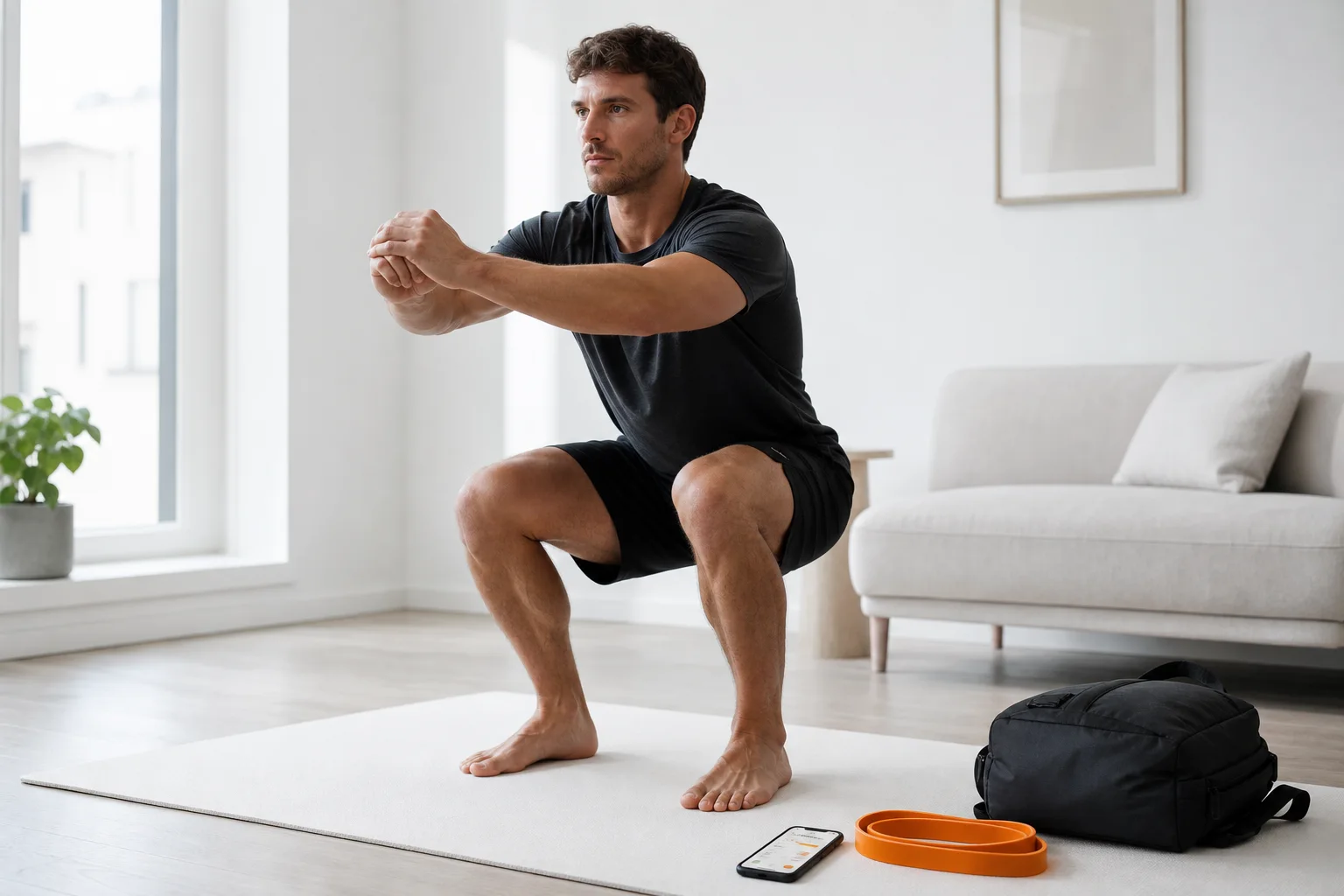
A 5 day home workout plan can help you build strength, improve conditioning, and create a reliable training habit without needing a large room or a fully equipped gym. The key is not collecting endless exercises. It is organizing the week so you train all major movement patterns, recover between demanding sessions, and gradually make the workouts harder.
This plan uses bodyweight exercises first, with optional substitutions for resistance bands, a backpack, or dumbbells. You need enough floor space to lie down, a stable chair or sofa, and roughly 25 to 45 minutes per session. If five training days feels like too much at first, complete the first three sessions and add the remaining days gradually.
How this 5 day home workout plan works
The week combines four strength-focused sessions with one conditioning and core day. Each major muscle group is trained more than once, while the schedule avoids placing the hardest lower-body sessions next to each other.
- Day 1: Lower body strength and stability
- Day 2: Upper body push and pull
- Day 3: Conditioning and core
- Day 4: Lower body volume and single-leg work
- Day 5: Full-body strength and movement quality
- Days 6 and 7: Rest, walking, mobility, or optional easy activity
For most exercises, stop with approximately one to three controlled repetitions left in reserve. You do not need to train to complete exhaustion to make progress. Good technique, repeatable effort, and gradual overload are more useful than turning every session into a test.
Before each workout: warm up for 5 minutes
Start with easy movements that raise your body temperature and prepare the joints you will use. Try marching in place, arm circles, hip hinges, bodyweight squats, and alternating reverse lunges. Perform each movement slowly at first, then increase the pace slightly.
Your warm-up should make you feel ready, not tired. If a movement causes sharp pain, replace it with a comfortable alternative. During the workout, use a range of motion you can control and keep the area around you clear of furniture, pets, and loose rugs.
Day 1: Lower body strength
Focus on controlled squatting, hinging, and glute work. Rest for 60 to 120 seconds between sets, depending on how challenging the exercise feels.
- Bodyweight squat: 3 sets of 8 to 15 reps
- Glute bridge: 3 sets of 10 to 20 reps
- Reverse lunge: 3 sets of 8 to 12 reps per side
- Backpack Romanian deadlift: 3 sets of 10 to 15 reps
- Standing calf raise: 2 to 3 sets of 12 to 20 reps
- Dead bug: 2 to 3 sets of 8 to 12 reps per side
Limited-equipment options: Hold a loaded backpack for squats and Romanian deadlifts. If lunges are uncomfortable, use a chair or wall for balance, or perform sit-to-stand repetitions from a stable chair.
Day 2: Upper body push and pull
Home training often includes plenty of pushing but not enough pulling. If you have a resistance band or dumbbells, use them for rows. Without equipment, focus on push-up variations and upper-back exercises that can be performed safely on the floor.
- Push-up: 3 sets of 6 to 15 reps
- One-arm backpack or dumbbell row: 3 sets of 8 to 15 reps per side
- Pike push-up: 2 to 3 sets of 6 to 12 reps
- Band pull-apart or prone Y-T raise: 2 to 3 sets of 10 to 20 reps
- Close-grip push-up or floor press: 2 to 3 sets of 8 to 15 reps
- Side plank: 2 sets of 20 to 40 seconds per side
Choose a push-up variation that lets you keep your ribs controlled and your body in one line. Elevate your hands on a sturdy surface to make the exercise easier. To progress, lower the surface, slow the lowering phase, or add repetitions before moving to a harder variation.
Do not use an unstable table or a chair for exercises that place your full bodyweight on it. For rows, keep the backpack closed and use a load you can control without twisting.
Day 3: Conditioning and core
This session improves work capacity without requiring jumping or a large training area. Complete the circuit for three to five rounds. Work for 30 seconds, rest for 30 seconds, and take one to two minutes between rounds.
- Marching in place or low-impact step-ups
- Squat to reach
- Mountain climber from an elevated surface or floor
- Bear plank shoulder tap
- Alternating reverse lunge
- Bird dog
Keep the intensity moderate enough that your movement stays coordinated. If you prefer intervals, use 20 seconds of work and 40 seconds of rest for the first week. You can later increase work time, add a round, or reduce rest slightly.
This workout can contribute to your weekly aerobic activity, but it does not need to be maximal. Brisk walking, cycling, dancing, or other enjoyable activities on rest days can also help you build a balanced routine.
Day 4: Lower body volume and single-leg work
The second lower-body session uses different angles and higher repetition ranges. Move slowly and prioritize balance, knee control, and a stable trunk.
- Split squat: 3 sets of 8 to 12 reps per side
- Single-leg glute bridge: 3 sets of 8 to 15 reps per side
- Step-up or supported sit-to-stand: 3 sets of 8 to 12 reps per side
- Hamstring walkout: 2 to 3 sets of 6 to 12 reps
- Wall sit: 2 to 3 sets of 20 to 45 seconds
- Plank: 2 to 3 sets of 20 to 45 seconds
Use a low, stable step for step-ups. If you do not have one, perform a controlled reverse lunge instead. For hamstring walkouts, keep your hips lifted only as high as you can maintain without cramping or losing control.
Day 5: Full-body strength
Finish the week with a full-body workout that reinforces the main patterns: squat, hinge, push, pull, carry, and brace. Complete three rounds, resting as needed.
- Tempo squat: 10 to 15 reps, using a three-second lowering phase
- Incline or standard push-up: 8 to 15 reps
- Backpack row or resistance-band row: 10 to 15 reps
- Hip hinge or backpack deadlift: 10 to 15 reps
- Loaded carry: 30 to 60 seconds, walking carefully around the room
- Hollow-body hold or dead bug: 20 to 40 seconds or 8 to 12 reps per side
If space is extremely limited, replace the loaded carry with a suitcase hold: stand tall while holding one weight or backpack on one side, then switch sides after each set. Keep your shoulders level and avoid leaning.
How to progress when you train at home
Progressive overload does not always mean adding heavier weights. At home, you can increase the challenge in several simple ways:
- Add repetitions: Work toward the top of the recommended range while maintaining form.
- Add a set: Move from two sets to three when recovery is good.
- Use a harder variation: Progress from wall push-ups to incline push-ups, then to floor push-ups.
- Slow the tempo: Add a controlled pause or longer lowering phase.
- Increase resistance: Add books or water bottles to a backpack, or use a stronger band.
- Improve range of motion: Move through a comfortable, controlled range rather than forcing depth.
- Reduce rest carefully: Use this mainly for conditioning, not as a replacement for strength progression.
Use one progression at a time. For example, when you can complete all three sets of push-ups at the top of the range with clean form, try a more difficult variation or add a small amount of resistance. Record the exercise, sets, repetitions, and how challenging the set felt. That simple log makes progress easier to see.
GymPT can support this process by adapting workouts to your available equipment, tracking completed sessions, and showing progress insights over time. If you want a broader explanation of how adaptive training works, read how to choose an adaptive fitness program app. For practical logging strategies, see this guide to workout progress tracking.
How to make the plan fit your level
For beginners
Start with two sets per exercise, use easier variations, and keep two or three repetitions in reserve. You can also train on Monday, Tuesday, Thursday, and Saturday instead of completing five consecutive days. Consistency matters more than using the most advanced version of the plan.
For intermediate trainees
Use three sets for most movements and add resistance where possible. Choose variations that make the final few repetitions challenging without breaking technique. If your home setup includes bands or adjustable dumbbells, use them for rows, hinges, presses, and loaded carries.
For people with very limited space
Choose stationary exercises such as squats, lunges, glute bridges, push-ups, rows, planks, and marching intervals. You can train every major muscle group without running, jumping, or moving across a room.
Recovery and weekly adjustments
Five training days does not mean five maximal efforts. Keep Day 3 moderate and use rest days for easy walking or mobility. Sleep, food, hydration, and stress all affect how well you recover. If soreness or fatigue continues to build, reduce one set from each exercise or take an additional rest day.
Adults are generally encouraged to combine regular aerobic activity with muscle-strengthening work for all major muscle groups on at least two days each week. This plan gives you a structured strength base, while walking or other enjoyable cardio can help you build toward your broader weekly activity target.
Start with the version you can repeat
The best home workout plan is one that fits your space, schedule, equipment, and current ability. Begin with manageable variations, record your sessions, and progress gradually. You do not need complicated programming or expensive equipment to train effectively at home.
When you are ready to personalize the routine further, GymPT can create equipment-based workouts, provide AI coach chat for training questions, and use your workout history to help guide future sessions. You can also compare this approach with a practical AI fitness app for home workouts or learn what to look for in a custom fitness plan app.
Fitness guidance should be adapted to your experience and circumstances. Stop an exercise if you feel sharp or unusual pain, and seek qualified professional advice if you have an injury, medical condition, or specific training concern.