30 minute gym workout plan
30 Minute Gym Workout Plan: Build a Routine You Can Repeat
A 30-minute gym workout plan can be effective when it prioritizes the right exercises, manageable volume, and consistent progression. Use this guide to build a routine that fits your level and schedule.
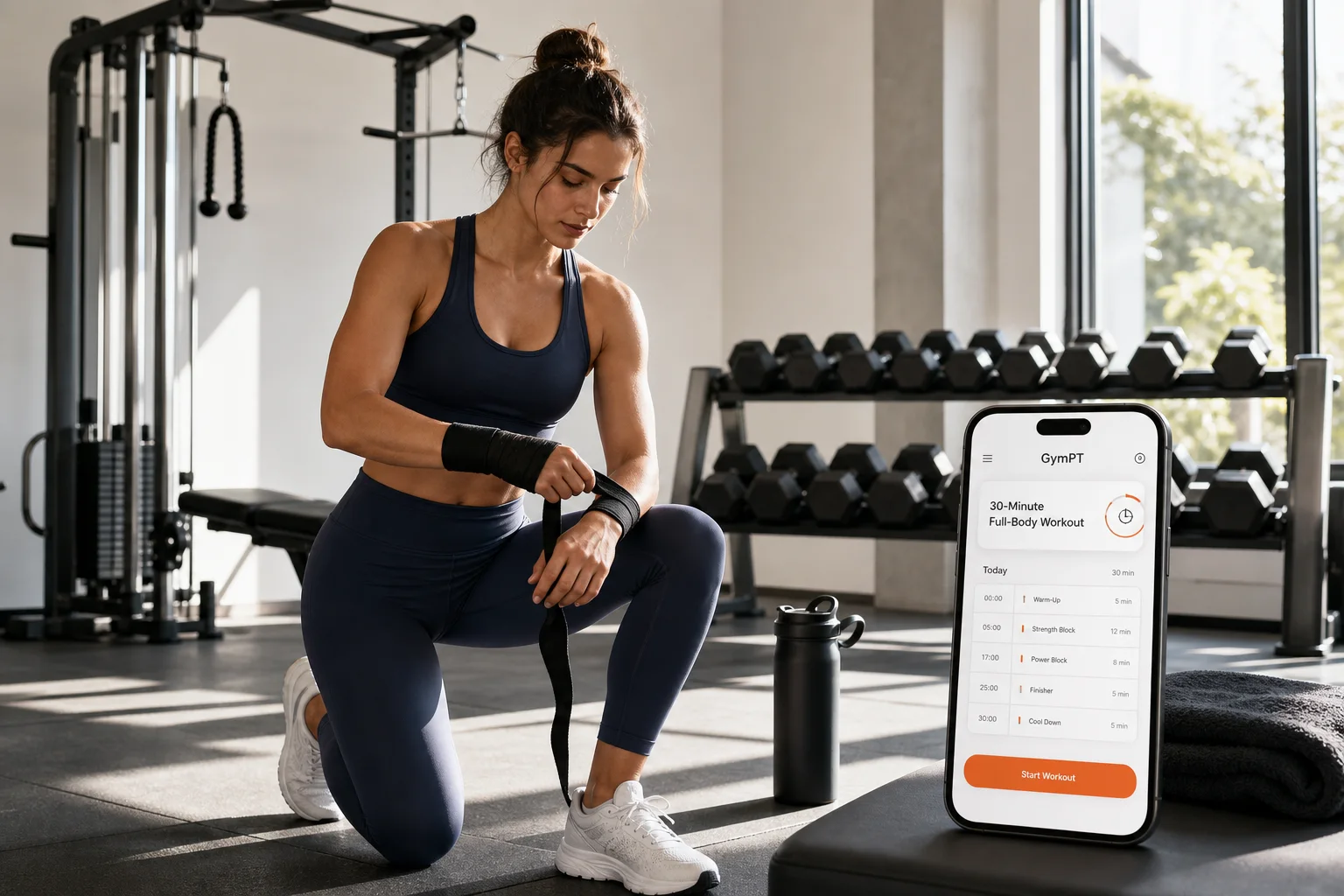
A good workout plan does not need to fill an entire evening. With the right exercise order and realistic effort, a 30 minute gym workout plan can train your major muscle groups, support strength, and make consistency easier.
The key is not trying to squeeze a long workout into half an hour. Instead, choose a focused structure: a short warm-up, a few high-value exercises, efficient rest periods, and a clear progression rule. This guide shows how to build that structure for different training levels, how often to train, and how to recover between sessions.
What makes a 30 minute gym workout plan effective?
Thirty minutes is enough when each part of the session has a purpose. For most people, the best approach is a full-body workout built around movement patterns rather than a long list of isolated exercises.
- One lower-body movement: squat, leg press, split squat, or Romanian deadlift.
- One pushing movement: chest press, bench press, shoulder press, or push-up variation.
- One pulling movement: seated row, lat pulldown, or supported dumbbell row.
- One optional accessory: a core, shoulder, arm, or calf exercise.
This gives you broad coverage without wasting time switching between too many stations. It also makes the plan easier to repeat two or three times per week.
For general fitness, a short resistance workout can contribute to your weekly activity target, but it does not have to do everything. You can add walking, cycling, or other cardio on separate days if you want more aerobic activity.
The 30-minute workout structure
Use this format as the foundation for your 30 minute full body workout:
- Minutes 0–5: Warm-up. Move lightly on a treadmill, bike, or rowing machine, then perform a few easy repetitions of your first exercise.
- Minutes 5–17: Main lower-body and push exercises. Complete two exercises with controlled technique.
- Minutes 17–27: Main pull exercise and optional accessory. Use paired exercises if the gym is busy and the equipment is available.
- Minutes 27–30: Cooldown and notes. Record your weights, repetitions, and how difficult the session felt.
Most working sets should stop with good form still available. You do not need to take every set to failure, especially when you are learning technique or returning after time away from training.
Beginner 30 minute gym workout plan
If you are new to resistance training, start with two non-consecutive sessions per week. For example, train on Monday and Thursday, leaving at least one recovery day between sessions.
Beginner session
- Leg press or goblet squat: 2 sets of 8–12 repetitions
- Machine chest press: 2 sets of 8–12 repetitions
- Lat pulldown: 2 sets of 8–12 repetitions
- Plank: 2 sets of 20–40 seconds
Rest around 60–90 seconds between sets. Choose a load that lets you complete the target repetitions without rushing or changing your posture. If you are unfamiliar with an exercise, use the first session to practice the movement with a light load.
For beginners, the goal is not to feel destroyed after every workout. The goal is to finish with enough energy to recover and return for the next session. This is one reason a simple beginner gym workout plan often works better than an ambitious five-day split.
Intermediate 30 minute gym workout plan
After several weeks of consistent training, you can increase the challenge by using three weekly full-body sessions or alternating two workouts. Keep the exercises familiar and gradually add repetitions or weight.
Intermediate session
- Squat, hack squat, or leg press: 3 sets of 6–10 repetitions
- Bench press or chest press: 3 sets of 6–10 repetitions
- Seated cable row or chest-supported row: 3 sets of 8–12 repetitions
- Romanian deadlift or leg curl: 2 sets of 8–12 repetitions
To stay within 30 minutes, keep your setup organized and avoid unnecessary phone breaks. You can also pair the chest press with the row, resting briefly after both exercises. Do not pair movements if the equipment is far apart or if doing so makes your technique less controlled.
A practical weekly schedule is Monday, Wednesday, and Friday. If three sessions are not realistic, two well-executed workouts are still useful. A schedule you can repeat is more valuable than a theoretically perfect plan that constantly gets skipped.
Advanced option: make 30 minutes more focused
Experienced lifters can use a short session to maintain progress, emphasize a priority muscle group, or train during a busy week. The main difference is not necessarily more exercises; it is better exercise selection and more deliberate effort.
Advanced short session
- Primary lift: 3 sets of 4–8 repetitions
- Secondary compound movement: 3 sets of 6–10 repetitions
- Opposing upper-body pair: 2–3 sets of 8–12 repetitions each
For example, you could perform leg press, incline dumbbell press, and then alternate a cable row with a lateral raise. Keep the first exercise as the priority and allow enough rest to maintain performance. If the first lift requires longer recovery, reduce accessory volume rather than rushing the main work.
How often should you use a 30 minute workout?
Your ideal frequency depends on training history, recovery, and the rest of your weekly activity.
- New to training: 2 full-body sessions per week.
- Consistent beginner or intermediate: 3 full-body sessions per week.
- Experienced trainee: 3–5 short sessions, using different emphasis days if needed.
Training the same muscles on consecutive days is not automatically wrong, but it can make performance and recovery harder. When in doubt, alternate training and recovery days. You can also use an upper-body session after a lower-body session if your schedule requires back-to-back gym visits.
For a simple weekly structure, try:
- Monday: full-body workout
- Tuesday: walking, mobility, or rest
- Wednesday: full-body workout
- Thursday: light cardio or rest
- Friday: full-body workout
- Weekend: optional easy activity and recovery
Use the guide on how many days beginners should train if you are still deciding how to fit resistance training into your week.
How to progress when every workout is only 30 minutes
Progression does not require adding exercises every week. Use one variable at a time so you can tell what is working.
- Add repetitions: If your target is 8–12 repetitions, keep the same weight until you can complete 12 repetitions with consistent form.
- Add a small amount of weight: Once you reach the top of the range for all sets, increase the load slightly and return to the lower end of the range.
- Improve execution: Use a controlled lowering phase, a stable position, and a full comfortable range of motion.
- Add a set only when needed: If your progress has stalled and recovery is good, add one set to a priority exercise rather than expanding the entire session.
Track the load, repetitions, and effort for each exercise. If the same weight feels easier over time, that is progress even before you add more weight. A workout tracker can make this process easier by keeping your recent performance visible.
Recovery rules for short gym workouts
A 30-minute session is only one part of the plan. Recovery helps determine whether you can perform well at your next workout.
- Leave recovery between hard sessions: Avoid turning every day into a maximum-effort workout.
- Sleep consistently: Poor sleep can make normal training feel unusually difficult.
- Eat regular meals: Include enough overall food and protein to support your training goals.
- Use lighter days when necessary: Reduce weight or sets if fatigue is accumulating.
- Pay attention to persistent pain: Stop an exercise that causes sharp or unusual pain and seek appropriate professional advice.
Recovery is not a reason to avoid effort. It is how you make effort repeatable. If your performance drops for several sessions, your plan may need less volume, more rest, or a temporary reduction in load.
How to personalize your plan for the equipment you have
The exercise names matter less than the movement pattern and your ability to perform the exercise safely. A leg press can replace a squat, a machine chest press can replace a barbell bench press, and a cable row can replace a dumbbell row.
If your gym is crowded, prepare one alternative for each movement pattern before you start. This prevents a five-minute wait from taking over the workout. A plan that adapts to available equipment is easier to follow than one that depends on a single machine.
GymPT can help you build an equipment-aware routine instead of forcing you to search for substitutions during the session. For more ideas, see this guide to a workout plan with limited equipment and learn how an equipment-scan workout app can support faster planning.
Make your 30-minute plan sustainable
The best quick gym workout is the one you can repeat for months. Start with a manageable number of exercises, use a consistent weekly schedule, and record enough information to make your next decision clear.
When your goals or equipment change, adjust the plan rather than abandoning it. You can also compare app features in this guide to choosing a mobile personal trainer app that fits your training style.
With a focused warm-up, a few compound movements, sensible recovery, and gradual progression, 30 minutes can be a productive training window—not a rushed version of a longer workout.