workout plan with limited equipment
Workout Plan With Limited Equipment: How to Build, Adapt, and Progress
A limited equipment setup does not have to limit your results. Learn how to match exercises to your available tools, organize a balanced routine, and keep progressing over time.
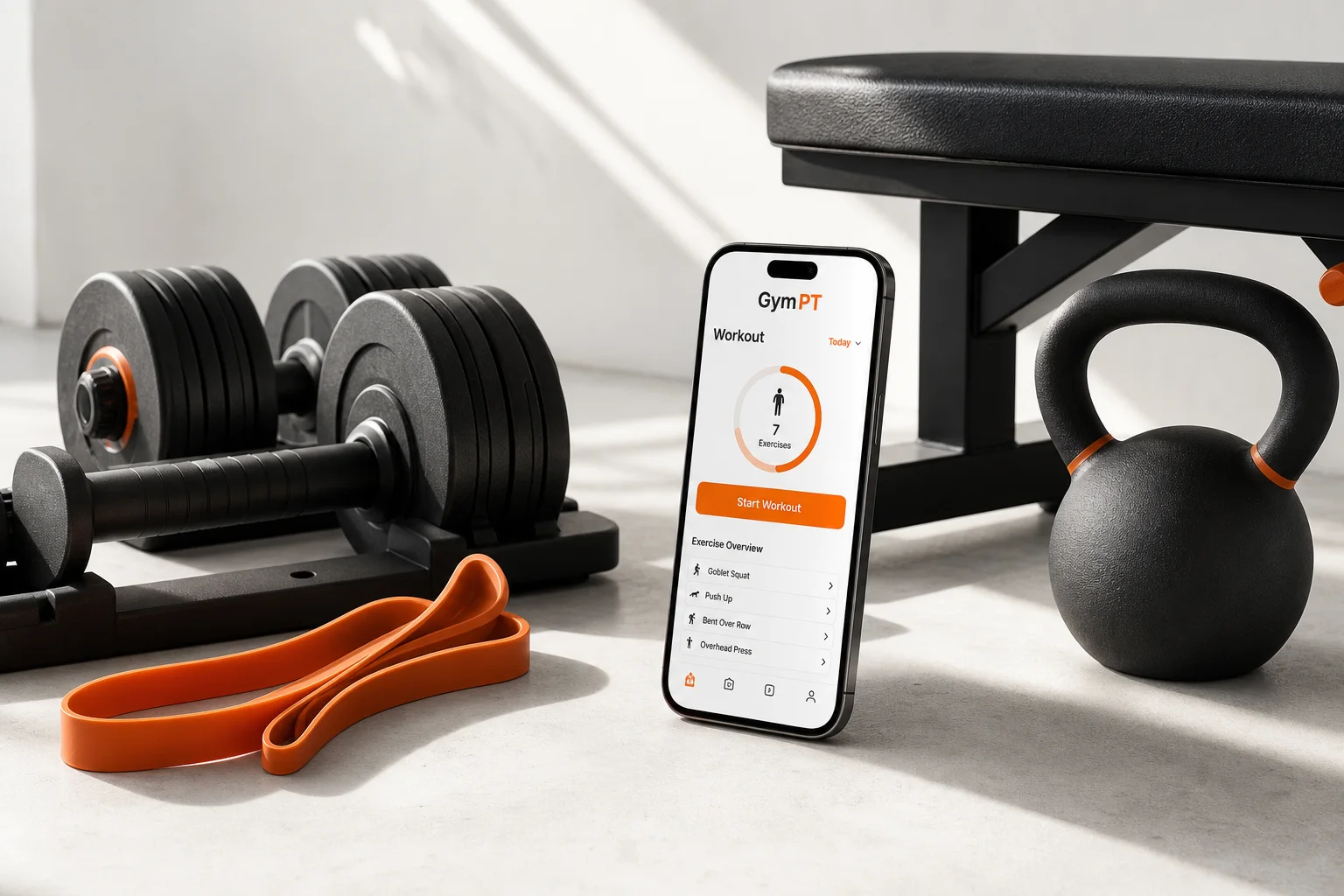
A workout plan with limited equipment can still build strength, muscle, work capacity, and consistency. The key is not collecting every possible tool. It is choosing movements that match what you have, training each major movement pattern, and progressing when an exercise becomes easier.
Whether your setup includes one pair of dumbbells, resistance bands, a kettlebell, a pull-up bar, or just a bench, you can create a structured routine around it. GymPT can help by adapting exercise choices to your equipment and tracking the variables that matter from week to week.
What makes a limited equipment workout plan effective?
An effective routine does not depend on a specific machine or a large weight selection. It depends on a few fundamentals:
- Coverage: You train the major movement patterns, including squatting, hinging, pushing, pulling, lunging, carrying, and core bracing.
- Appropriate effort: Your working sets are challenging enough to stimulate adaptation without turning every set into a test of exhaustion.
- Progressive overload: You gradually increase repetitions, resistance, sets, range of motion, control, or exercise difficulty.
- Consistency: You repeat the plan long enough to evaluate whether it is working.
- Recovery: You leave enough time between demanding sessions for performance to recover.
Current resistance-training evidence suggests that different loads can support muscle growth when sets are performed with sufficient effort, while heavier loads tend to be more useful for maximizing strength. This is good news for home training: a lighter dumbbell or band can still be useful when you increase repetitions, slow the lowering phase, or choose a more demanding variation.
Start with the equipment you actually have
Before selecting exercises, make a simple equipment inventory. Include both the tool and its practical limitations.
Dumbbells
Dumbbells are versatile for presses, rows, squats, lunges, hinges, carries, and isolation exercises. If the weights are light, use single-limb movements, longer ranges of motion, controlled tempo, or higher repetitions to make each set more challenging.
Resistance bands
Bands work well for rows, presses, pulldowns, lateral raises, curls, triceps work, and lower-body exercises. Their resistance usually increases as they stretch, so pay attention to the hardest part of the movement and use a smooth tempo rather than allowing the band to snap back.
Kettlebell
A kettlebell can cover squats, deadlifts, swings, presses, rows, carries, and loaded core work. A single kettlebell is especially useful for unilateral training, where one side works at a time and the exercise feels more demanding without requiring a heavier load.
Bench, chair, or stable elevated surface
A stable surface expands your options for incline push-ups, split squats, step-ups, hip thrusts, supported rows, and elevated core exercises. Check that the surface does not slide or tip before loading it or using it for balance.
Pull-up bar
A pull-up bar adds vertical pulling, hanging, and grip-focused exercises. If full pull-ups are not yet appropriate, you can begin with controlled hangs, scapular movements, band-assisted repetitions, or slow lowering phases.
If you want more ideas for adapting a routine to a changing home or gym setup, see this guide to an AI workout plan for limited equipment.
Build your routine around movement patterns
Equipment lists are useful, but movement patterns provide a better planning framework. They help you avoid building a routine that contains many pressing exercises but no pulling or hip-dominant work.
- Squat: Goblet squat, split squat, front-foot-elevated split squat, or tempo bodyweight squat.
- Hinge: Dumbbell Romanian deadlift, kettlebell deadlift, single-leg Romanian deadlift, or hip thrust.
- Horizontal push: Push-up, dumbbell floor press, dumbbell bench press, or band chest press.
- Horizontal pull: One-arm dumbbell row, band row, or supported row.
- Vertical push: Dumbbell overhead press, half-kneeling press, or band overhead press.
- Vertical pull: Pull-up, assisted pull-up, band pulldown, or pullover variation.
- Lunge and single-leg work: Reverse lunge, step-up, split squat, or lateral lunge.
- Core and carries: Dead bug, side plank, suitcase carry, front-rack carry, or plank variation.
You do not need one exercise from every category in every session. Across the week, aim to include a balanced mix that trains the upper body, lower body, trunk, and grip.
A practical three-day workout plan with limited equipment
The following example works with dumbbells or kettlebells and can be modified with bands or bodyweight alternatives. Begin with a load that allows controlled technique and leaves roughly one to three good repetitions in reserve on most working sets.
Day 1: Full-body strength emphasis
- Goblet squat: 3 sets of 8–12 repetitions
- One-arm dumbbell row: 3 sets of 8–12 repetitions per side
- Dumbbell floor press: 3 sets of 8–12 repetitions
- Romanian deadlift: 3 sets of 8–12 repetitions
- Side plank: 2–3 sets per side
Day 2: Rest or light activity
Use this day for walking, mobility work, or complete rest. Avoid turning recovery into another demanding workout if your performance is still reduced from Day 1.
Day 3: Unilateral and upper-body emphasis
- Reverse lunge: 3 sets of 8–12 repetitions per side
- Push-up or band chest press: 3 sets of 8–15 repetitions
- Supported dumbbell row: 3 sets of 10–15 repetitions
- Single-leg hip thrust: 3 sets of 8–15 repetitions per side
- Dumbbell overhead press: 2–3 sets of 8–12 repetitions
- Dead bug: 2–3 controlled sets per side
Day 4: Rest
Day 5: Full-body volume emphasis
- Step-up or split squat: 3 sets of 10–15 repetitions per side
- Kettlebell deadlift or dumbbell sumo deadlift: 3 sets of 10–15 repetitions
- Incline push-up or dumbbell press: 3 sets of 10–15 repetitions
- Band pulldown or dumbbell pullover: 3 sets of 10–15 repetitions
- Suitcase carry: 3 carries per side
This is a template, not a fixed prescription. If you train only twice per week, perform two full-body sessions. If you train four days, you can repeat the structure with small exercise changes while keeping the same movement patterns.
How to progress when you cannot add more weight
Limited equipment becomes a problem mainly when there is no progression strategy. Use the following options in order of practicality:
- Add repetitions: If your target is 8–12 repetitions and you complete 12 with good form, increase the challenge next time.
- Add a set: Move from two sets to three, provided your recovery and technique remain strong.
- Improve range of motion: Use a deeper squat, a longer split-squat range, or a fuller push-up position when appropriate.
- Slow the eccentric phase: Lower for three or four seconds, then lift with control. This can make a light load much more demanding.
- Pause at the hardest position: Brief pauses can reduce momentum and improve control.
- Use a harder variation: Progress from a standard squat to a split squat, or from a two-arm press to a single-arm press.
- Reduce rest slightly: This can increase training density, especially for accessory work, but do not sacrifice technique.
Not every progression method is equally useful for every goal. For strength, gradually increasing resistance is often the clearest approach. For muscle gain, a wider range of loads and repetition targets can work when sets are sufficiently challenging. For general fitness, improved control, work capacity, and consistency may be the most meaningful measures.
Use effort without training to failure every time
When equipment is light, it is tempting to perform every set until you cannot complete another repetition. That is not always necessary. Research comparing failure and non-failure training does not show that momentary failure is required for strength or muscle growth in healthy adults.
A practical approach is to finish most sets with one to three controlled repetitions still available. You may occasionally work closer to failure on safer isolation exercises, such as band curls or lateral raises, but demanding movements such as split squats and overhead presses usually benefit from maintaining technique and control.
GymPT can make this easier by recording repetitions, resistance, and perceived effort. Instead of guessing whether a session was productive, you can compare performance over time and adjust the plan when progress stalls.
How GymPT adapts training to your setup
A good equipment-based training plan should change when your circumstances change. Maybe you travel with bands, buy a heavier pair of dumbbells, move from home to a commercial gym, or have less time than usual. GymPT is designed to help you keep the training structure while changing the exercises around your available options.
- Equipment-based exercise selection: Choose movements that match the tools you have instead of skipping the session.
- AI coach chat: Ask how to substitute an exercise, reduce difficulty, or make a movement more challenging.
- Workout tracking: Save sets, repetitions, resistance, and completed sessions so progression is visible.
- Progress insights: Review trends and identify whether the issue is exercise difficulty, recovery, consistency, or volume.
- Body and goal context: Use your training preferences and goals to make the plan more personal and practical.
If you are comparing digital coaching options, this overview of fitness program builder app features explains which capabilities make a plan easier to follow. You can also explore how a workout app with equipment scan may simplify exercise selection when your setup changes.
Common mistakes with limited equipment training
- Changing exercises too often: Keep key movements for several weeks so you can measure progress.
- Only training what is easy: Include pulling, posterior-chain, single-leg, and core movements even when they require more planning.
- Using poor-quality substitutes: A substitution should match the original movement pattern and training goal, not merely use the same body part.
- Ignoring setup safety: Check bands, benches, chairs, and pull-up bars before every session.
- Measuring only soreness: Soreness is not a reliable scorecard. Track performance, control, repetitions, and consistency.
- Trying to compensate with endless volume: More work is not automatically better. Add training gradually and monitor recovery.
Make your equipment work harder by making your plan clearer
A limited equipment setup can support a complete training routine when you organize it around movement patterns and use a deliberate progression system. Start with exercises you can perform safely, select realistic repetition targets, and record enough detail to know whether you are improving.
The best plan is not the one with the most exercises. It is the one you can repeat, progress, and adapt. With GymPT, you can build a routine around your actual equipment, ask for substitutions when needed, and use workout data to make the next session more informed.
For a broader weekly structure, read this practical guide to a 4-day workout plan for strength.