AI workout plan for limited equipment
AI Workout Plan for Limited Equipment: How to Train Effectively With What You Have
Limited equipment does not mean limited progress. Learn how to build a flexible AI workout plan around dumbbells, bands, machines, or bodyweight training with GymPT.
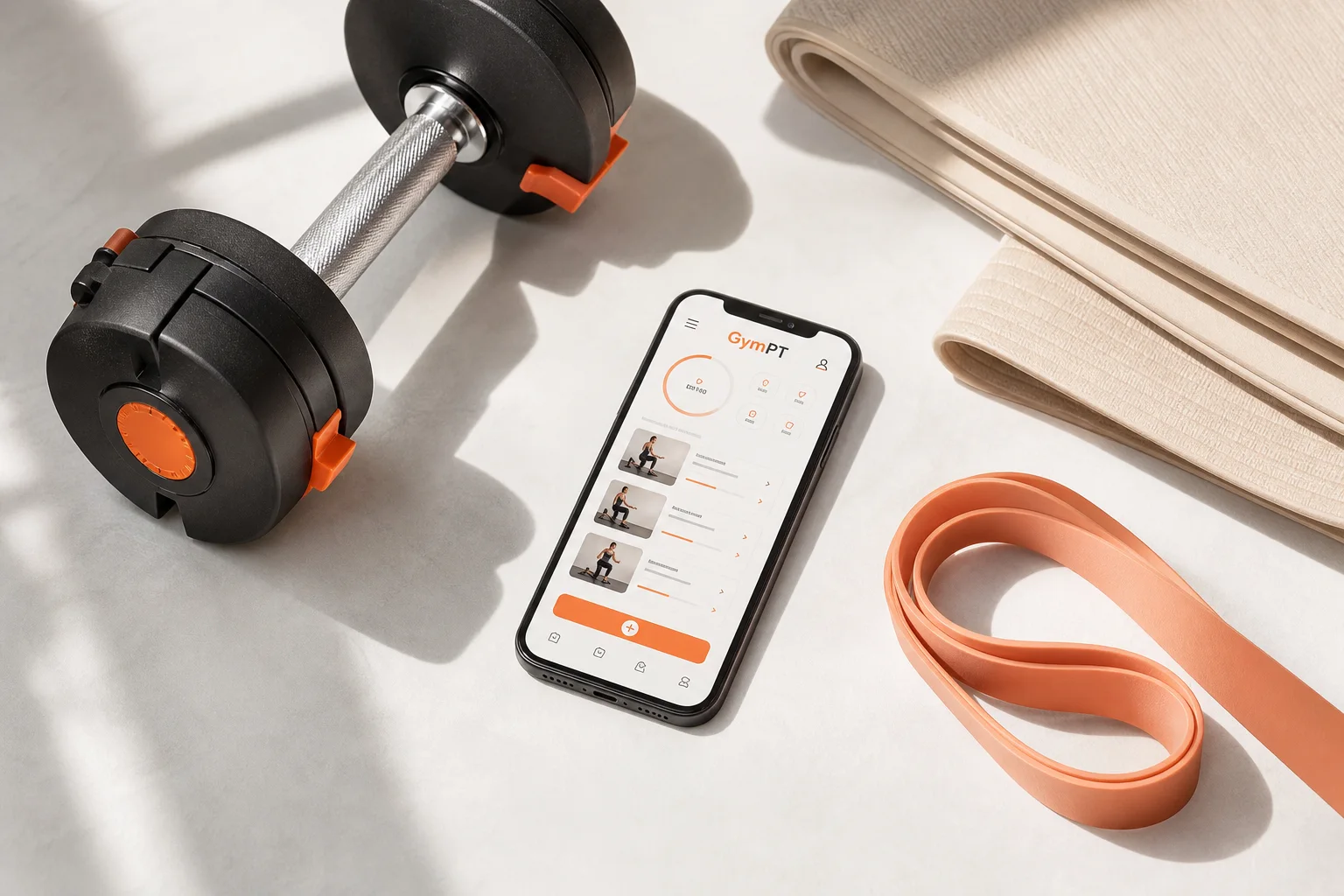
The best workout plan is not the one with the most equipment. It is the one you can perform consistently, progress over time, and adapt when your training environment changes. That is why an AI workout plan for limited equipment can be more useful than a fixed routine built around exercises you cannot perform.
Whether you have a pair of dumbbells, resistance bands, a bench, a pull-up bar, one adjustable kettlebell, or only your bodyweight, GymPT can help you organize effective training around what is actually available. Instead of forcing a standard gym program into your home setup, the plan can match exercises to your equipment, goals, schedule, and current training level.
Why limited equipment does not limit your results
Resistance training can work across a broad range of loads and exercise variations. Heavier training is especially useful when your primary goal is maximal strength, but lighter loads can also support muscle growth when the set is sufficiently challenging and the overall program is consistent.
This matters when equipment is limited. You may not be able to add another plate or use a heavier machine, but you can still increase the challenge by changing the exercise angle, range of motion, tempo, repetitions, sets, rest periods, or unilateral difficulty.
For example, a pair of moderate dumbbells can be used for goblet squats, split squats, Romanian deadlifts, rows, presses, and carries. A resistance band can provide pulling, pressing, shoulder, and lower-body exercises. Bodyweight training can be progressed through leverage, pauses, single-limb variations, and increased control.
The goal is not to imitate a fully equipped commercial gym. The goal is to create a clear progression system with the tools you have.
How to choose exercises around your available equipment
A practical limited equipment workout plan should begin with movement patterns rather than a list of specific exercises. This makes substitutions easier and helps you train the major muscle groups without depending on one particular machine or weight.
1. Start with the main movement patterns
- Squat: bodyweight squat, goblet squat, split squat, front-foot elevated split squat, or tempo squat.
- Hinge: Romanian deadlift, single-leg deadlift, hip thrust, glute bridge, or banded good morning.
- Horizontal push: push-up, dumbbell floor press, bench press, or band chest press.
- Horizontal pull: one-arm dumbbell row, band row, inverted row, or chest-supported row.
- Vertical push: dumbbell shoulder press, single-arm press, pike push-up, or band overhead press.
- Vertical pull: pull-up, assisted pull-up, band pulldown, or a high-anchor band row.
- Loaded carry and core: suitcase carry, farmer carry, plank, dead bug, side plank, or controlled mountain climber.
You do not need every variation in one session. A well-designed plan usually selects one or two exercises from each relevant pattern and distributes them across the week.
2. Match the exercise to the equipment, not the other way around
When equipment is limited, substitutions should preserve the training purpose of the original exercise. If a barbell back squat is unavailable, a goblet squat or split squat can still train the lower body. If a cable row is unavailable, a dumbbell row or resistance-band row can provide a similar pulling emphasis.
GymPT can make this process easier by using your equipment list as a planning input. You can indicate whether you have dumbbells, bands, a bench, a pull-up bar, machines, or no equipment. The resulting routine can then prioritize exercises you can perform immediately instead of filling your plan with unavailable movements.
How to progress when you cannot keep adding weight
Progressive overload means gradually increasing the challenge placed on your body. Adding weight is one method, but it is not the only one. A strong adaptive workout planner should help you use several progression options.
- Add repetitions: Move from 8 repetitions to 10 or 12 while maintaining good technique.
- Add a set: Increase from two working sets to three when recovery and form are reliable.
- Improve range of motion: Use a deeper squat, longer split-squat range, or fuller push-up position when appropriate.
- Slow the repetition: Use a controlled lowering phase or a brief pause in the most difficult position.
- Use a harder variation: Progress from a two-leg exercise to a staggered or single-leg version.
- Reduce rest carefully: Shorten rest for conditioning-focused work, but keep enough recovery for strength and technique.
- Improve consistency: Repeat the same movement long enough to track performance and build skill.
Use one progression at a time when possible. If you increase repetitions, sets, tempo, and difficulty all at once, it becomes harder to know what caused a change in performance or soreness.
A useful rule is to choose a repetition range and increase repetitions until you reach the top of that range with stable form. Then progress the exercise, add a small amount of resistance, or increase the set difficulty. This approach works particularly well for home workout equipment that changes in large jumps, such as fixed dumbbells or a single kettlebell.
Example: a 3-day limited equipment workout plan
The following example shows how an AI workout plan for limited equipment can be structured around a pair of dumbbells and a resistance band. It is a template, not a replacement for an individualized plan.
Day 1: Full-body strength emphasis
- Goblet squat: 3 sets of 8–12 repetitions
- Dumbbell floor press: 3 sets of 8–12 repetitions
- One-arm dumbbell row: 3 sets of 8–12 repetitions per side
- Romanian deadlift: 3 sets of 8–12 repetitions
- Dead bug: 2–3 controlled sets
Day 2: Lower body and shoulders
- Rear-foot elevated split squat or regular split squat: 3 sets of 8–12 repetitions per side
- Dumbbell shoulder press: 3 sets of 8–12 repetitions
- Single-leg hip thrust: 3 sets of 10–15 repetitions per side
- Band pull-apart: 2–3 sets of 12–20 repetitions
- Suitcase carry: 3 short carries per side
Day 3: Full-body volume and movement quality
- Tempo squat: 3 sets of 10–15 repetitions
- Push-up or band chest press: 3 sets with controlled repetitions
- Band row or dumbbell row: 3 sets of 10–15 repetitions
- Dumbbell hip hinge: 3 sets of 10–15 repetitions
- Side plank: 2–3 sets per side
Keep one or more rest days between sessions when needed. The exact number of sets, repetitions, and exercises should reflect your experience, recovery, schedule, and goal. For general health, adults are commonly advised to perform muscle-strengthening activity on at least two days per week, while more frequent training can be appropriate when volume is managed well.
How GymPT adapts the plan to your situation
A fixed routine assumes that everyone has the same tools, time, preferences, and training history. An AI personal trainer can make the plan more practical by considering several inputs at once:
- Equipment: Select the tools you own or the machines available in your training space.
- Goal: Prioritize strength, muscle gain, general fitness, conditioning, or a balanced routine.
- Schedule: Build two-, three-, four-, or more day plans around your actual availability.
- Experience: Choose appropriate exercise complexity and starting volume.
- Preferences: Replace exercises that you dislike or cannot perform comfortably.
- Progress: Use workout tracking and progress insights to guide future adjustments.
GymPT can also support the decision-making process through AI coach chat. If a planned exercise is unavailable, you can ask for a substitution that uses the same equipment and targets a similar movement pattern. If a session feels too easy or too demanding, the plan can be adjusted instead of abandoned.
This is especially useful when your equipment changes from day to day. You may have dumbbells at home, machines at a gym, and no equipment while traveling. Rather than creating a completely new routine each time, you can preserve the structure of your training and swap exercises around the available setup.
What to look for in an equipment-based training app
Not every workout generator handles limited equipment well. Before choosing one, check whether it can:
- Build workouts from a specific equipment list.
- Offer meaningful exercise substitutions instead of random alternatives.
- Adjust difficulty for beginners and experienced lifters.
- Track sets, repetitions, resistance, and completed sessions.
- Adapt future workouts based on your logged performance.
- Support different goals and weekly schedules.
- Explain how to progress when heavier equipment is unavailable.
For a closer look at how equipment scanning can support routine design, read Workout App With Equipment Scan: Build a Smarter Gym Routine. You can also compare the planning features that make a routine usable in Fitness Program Builder App: 9 Features That Make a Plan Usable.
How to make your limited equipment plan sustainable
Start with the smallest plan you can complete consistently. Two or three well-structured weekly sessions are often more useful than an ambitious schedule that repeatedly gets skipped. Record your workouts, repeat key exercises long enough to observe progress, and adjust only when your results, recovery, or schedule indicate that a change is needed.
Use controlled technique and stop a set when form is breaking down. Training to complete failure is not required for most people to make progress, and leaving a small amount of effort in reserve can make it easier to maintain quality and recover between sessions. If an exercise causes sharp pain or feels unsafe, stop and choose a suitable alternative rather than pushing through it.
For more guidance on choosing a personalized app, explore How to Choose the Best Mobile Personal Trainer App for Your Goals. If your equipment is limited to dumbbells, Dumbbell Workout Plan: Match Your Exercises to the Equipment You Have offers another practical planning angle.
Build around what you can do today
Limited equipment is a programming constraint, not a reason to stop training. The most effective approach is to identify your available tools, organize the major movement patterns, choose progressions you can measure, and adjust the plan as your circumstances change.
GymPT helps turn that process into a practical routine. With equipment-based workout planning, AI coach chat, workout tracking, and progress insights, you can build training around your real environment instead of waiting for the perfect gym setup.