personal trainer app alternative
Personal Trainer App Alternative: 7 Features That Actually Matter
A good personal trainer app alternative should do more than display exercises. Here are the practical features that make digital training personalized, usable, and easier to follow.
If you are searching for a personal trainer app alternative, you probably want more than a library of exercises. You want a plan that fits your goals, schedule, available equipment, and current experience—without paying for every adjustment or waiting for a trainer to rewrite your routine.
The best digital option is not necessarily the app with the most workouts or the most dramatic promises. It is the one that helps you make sensible training decisions, complete sessions consistently, and understand what to do next.
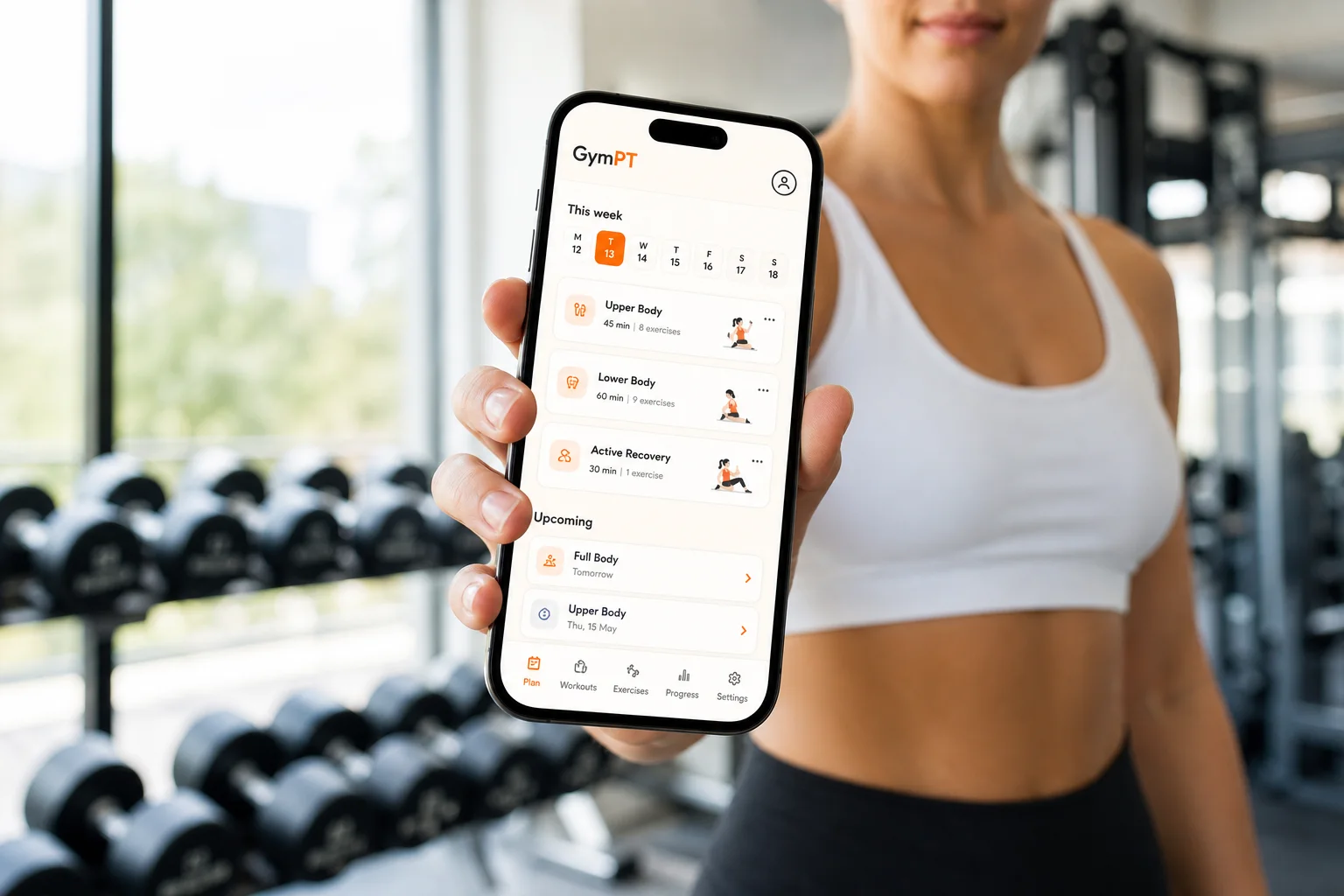
GymPT is one practical example of this approach. It combines personalized workout planning, AI coach chat, equipment-based training, body analysis, workout tracking, and progress insights in one experience. But before choosing any app, it helps to know which features actually matter.
What should a personal trainer app alternative do?
A digital trainer should reduce friction between your goal and your next workout. That means it should help answer questions such as:
- Which exercises should I do today?
- How many sets and repetitions make sense for my goal?
- What can I substitute if a machine or dumbbell is unavailable?
- How should I progress when a workout becomes easier?
- What should I change if my schedule or energy changes?
Research and current resistance-training guidance support a simple principle: consistency matters more than unnecessary complexity. A plan that fits your life and that you can repeat is usually more useful than an advanced routine you abandon after two weeks.
7 features to look for in a personal trainer app alternative
1. Goal-based workout planning
A useful app should begin with your objective rather than placing everyone into the same routine. Strength, muscle gain, general fitness, fat loss, mobility, and building a training habit may require different choices in exercise selection, weekly frequency, volume, and progression.
Look for an onboarding process that asks about your goal, experience level, preferred training days, session length, and limitations that affect exercise selection. The output should be a clear weekly structure, not just a random list of movements.
For example, someone training three days per week may benefit from a full-body structure, while someone training four or five days may prefer an upper-lower or body-part split. The important point is that the schedule should reflect the time you can realistically commit.
2. Personalization based on equipment
Equipment is one of the most common reasons a generic workout plan becomes impractical. A routine written for a fully equipped gym may not work in a small home setup, while a bodyweight-only plan may not suit someone who wants to use machines and free weights.
A strong personal trainer app alternative should let you select or scan the equipment you actually have and adapt the plan around it. That can include dumbbells, cables, resistance bands, benches, machines, barbells, or no equipment at all.
Exercise substitutions should also preserve the training purpose. If a cable row is unavailable, the replacement should still train the relevant pulling pattern—not simply become an unrelated movement.
For more on this topic, see Workout App With Equipment Scan: Build a Smarter Gym Routine.
3. Adjustable workouts instead of rigid prescriptions
Your training week will not always go exactly as planned. You may have less time, limited equipment, or lower energy than expected. A useful app should allow practical adjustments without making the entire plan feel broken.
Look for features such as:
- Shorter or longer session options
- Exercise substitutions
- Adjustable training frequency
- Changes to sets, repetitions, or rest periods
- Workout rescheduling when a session is missed
Flexibility does not mean removing structure. It means keeping the main training goal intact while adapting the route. This is especially helpful for people who want a sustainable routine rather than an all-or-nothing program.
4. Access to an AI coach that explains decisions
An AI coach can be useful when it behaves like a practical training assistant rather than a motivational quote generator. The most valuable conversations are specific: how to replace an exercise, how to organize a week, how to interpret a logged workout, or how to make a session more time-efficient.
When comparing an AI personal trainer app, ask whether the coach can use the context of your plan. Does it understand your selected equipment, training goal, recent workouts, and preferred schedule? Context-aware guidance is more useful than generic advice that could apply to anyone.
GymPT’s AI coach chat is designed to support these day-to-day decisions while keeping the user in control. It can help explain the plan, answer training questions, and make the app easier to use between sessions.
For a deeper look at program-building features, read Fitness Program Builder App: 9 Features That Make a Plan Usable.
5. Clear workout tracking
Tracking is not just about collecting numbers. It should make your next decision easier. At a minimum, an app should let you record the exercises completed, sets, repetitions, load, and relevant notes.
Good tracking helps you identify patterns:
- Are you completing the planned sessions?
- Are loads or repetitions gradually increasing?
- Which exercises feel consistently difficult?
- Are you skipping particular movements?
- Is your current schedule realistic?
Tracking also provides a more reliable view of progress than relying only on how you feel on a single day. Strength gains can be gradual, and consistency is easier to recognize when your completed sessions are recorded.
6. Progress insights that stay understandable
Progress dashboards should turn workout data into useful feedback. You do not need a wall of charts. You need clear answers to questions such as whether your training frequency is improving, whether performance is trending upward, and which muscle groups or movement patterns you are training regularly.
A personal trainer app alternative should present progress in a way that encourages realistic expectations. Short-term fluctuations are normal. One strong workout does not prove that a program is perfect, and one difficult workout does not mean it has failed.
Useful insights may include completed-workout streaks, volume trends, exercise performance, session frequency, and changes in body measurements or photos when you choose to record them. These should support reflection—not create pressure to chase unrealistic transformation claims.
7. A simple experience you will actually use
Ease of use is a training feature. If it takes too many taps to start a workout, log a set, or find a replacement exercise, the app creates friction at exactly the wrong moment.
Check whether the app makes these actions straightforward:
- Open today’s session.
- Understand the exercise instructions.
- Log the set without interrupting your workout.
- Move to the next exercise.
- Review what you completed afterward.
A clean design does not mean the app lacks depth. It means the important information is easy to find when you are between sets or training in a busy gym.
How to compare apps before you choose
Instead of comparing feature counts, compare the complete user journey. Start with the first workout and ask whether the app helps you move naturally from planning to execution to review.
Check the planning process
Does the app create a plan from your actual goals and availability, or does it simply assign a popular template? A template can be useful, but personalization should be visible in the final schedule.
Test the equipment flexibility
Try removing one piece of equipment from a sample workout. Can you quickly find a sensible alternative? If not, the plan may be difficult to use in real-world conditions.
Review the progression logic
Look for guidance on how to progress. This might involve adding repetitions within a target range, increasing load gradually, adding a set, or improving execution. The exact method can vary, but the app should make progression understandable.
Look for honest boundaries
A responsible fitness app should not present itself as a medical device or claim to diagnose injuries. It should encourage appropriate professional support when someone has a medical concern, significant pain, or a condition that requires individualized clinical advice.
Why GymPT can be a practical alternative
GymPT is built for people who want the structure of a personal trainer with the convenience of an app. It can create a personalized plan around your goals, available equipment, schedule, and training preferences.
The experience also connects the parts of training that are often separated across different tools:
- Personalized plans: Start with a routine shaped around your objectives and availability.
- AI coach chat: Ask practical questions while planning or completing workouts.
- Equipment-based training: Build sessions around what you can access.
- Body analysis: Use available information to make your training context more personal.
- Workout tracking: Record completed work and performance details.
- Progress insights: Review trends so you can make more informed adjustments.
This combination is useful because a plan only works when it can be followed, tracked, and updated. The goal is not to make every workout complicated. The goal is to make the next sensible workout easier to identify.
If you are building a weekly routine, Weekly Gym Schedule for Muscle Gain: A Practical 4-Day Plan offers another example of how structure can be organized around a specific goal. You can also explore Fitness Progress App: How to Track Workouts, Trends, and Consistency for a closer look at progress tracking.
Bottom line
The right personal trainer app alternative should help you train with more clarity, not overwhelm you with more information. Prioritize goal-based planning, equipment flexibility, adjustable workouts, useful coaching, simple tracking, understandable progress insights, and an experience you can use consistently.
GymPT brings these elements together in one AI-powered training app. Whether you are starting a routine, returning after a break, or looking for a more adaptable way to organize gym sessions, the best place to begin is with a plan that fits your real life—and a system that helps you keep showing up.