6 Day Home Workout Plan: Build Strength in Limited Space
This 6 day home workout plan helps you train every major movement pattern with bodyweight, bands or a loaded backpack—without needing a full gym.
In this article
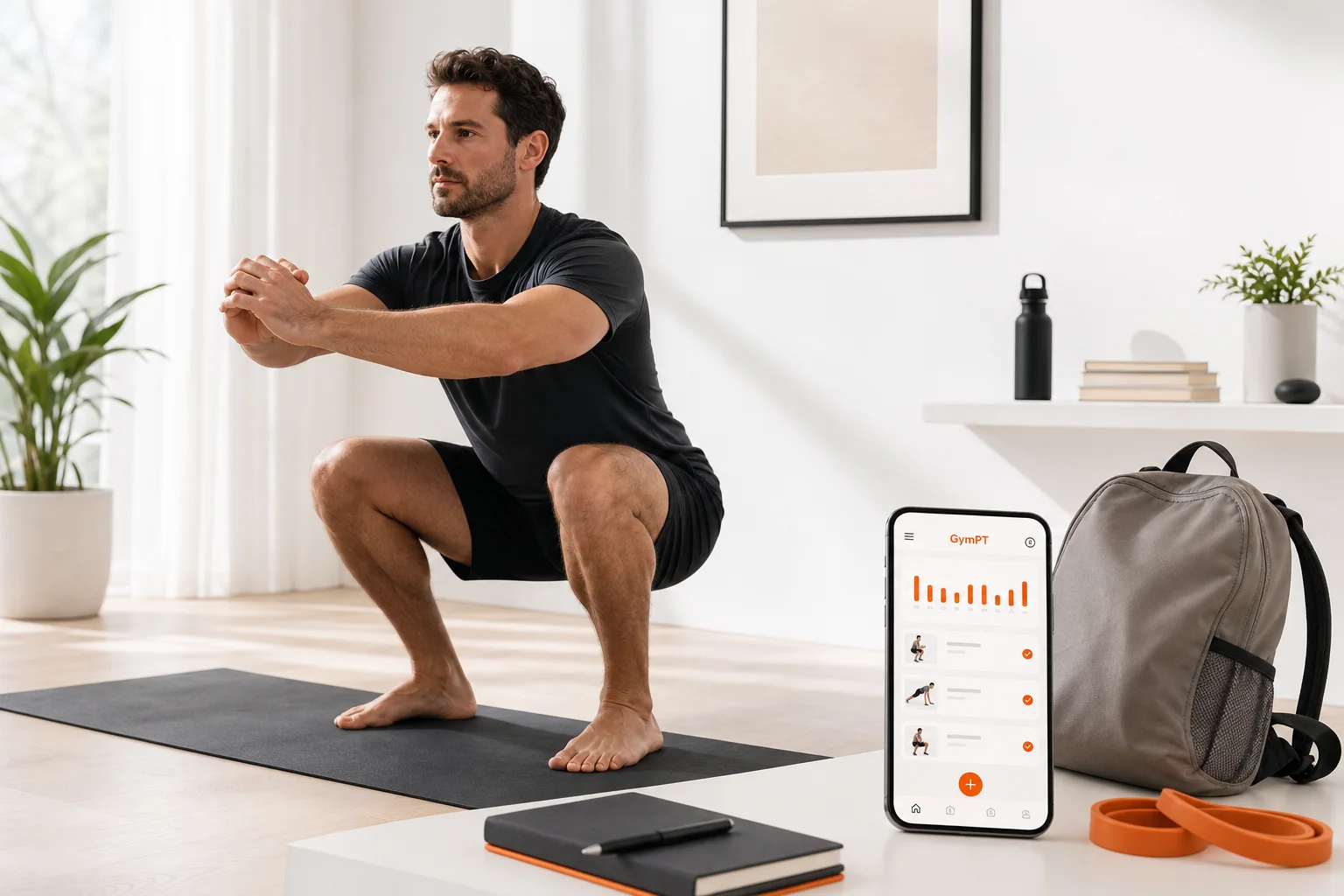
A 6 day home workout plan can work well when it is organized around movement patterns instead of trying to make every session exhausting. With limited space, a resistance band, a loaded backpack or a pair of dumbbells, you can train your legs, chest, back, shoulders, arms and core throughout the week.
The key is to spread stress intelligently. Six training days should not mean six maximum-effort workouts. This plan uses four focused strength sessions, one lighter conditioning session and one mobility or technique session. That gives you frequent practice while leaving room to recover.
How to use this 6 day home workout plan
Before starting, choose the equipment you actually have. The routine can be completed with bodyweight alone, but a resistance band, adjustable dumbbell or backpack makes progression easier. The goal is to finish most sets with good form and approximately one to three controlled repetitions left in reserve.
- Session length: about 25 to 45 minutes.
- Warm-up: 5 to 8 minutes of easy movement and practice sets.
- Rest: 60 to 120 seconds between challenging sets.
- Tempo: lower slowly, pause when useful and move smoothly.
- Progression: add repetitions, range of motion, resistance or a harder variation over time.
Adults are generally advised to perform muscle-strengthening activities for all major muscle groups on at least two days each week. A six-day schedule can exceed that minimum, but more training is only useful when the workload matches your experience and recovery. If you are new to training, begin with fewer sets or complete only four of the six sessions for the first two weeks.
Weekly schedule
- Day 1: Lower body strength
- Day 2: Upper body push and pull
- Day 3: Core and low-impact conditioning
- Day 4: Lower body single-leg training
- Day 5: Upper body volume and posture
- Day 6: Full-body technique and mobility
- Day 7: Rest, easy walking or relaxed mobility
Arrange the sessions around your life. For example, Day 3 and Day 6 are intentionally lighter so that the week does not become six consecutive hard workouts.
Day 1: Lower body strength
Use a slow lowering phase and keep your feet stable. If you have a backpack, add books or water bottles gradually rather than making a large jump in load.
- Squat or backpack squat: 3 sets of 8 to 15 repetitions
- Reverse lunge: 3 sets of 8 to 12 repetitions per side
- Glute bridge: 3 sets of 12 to 20 repetitions
- Standing calf raise: 2 to 4 sets of 12 to 20 repetitions
- Dead bug: 2 to 3 sets of 6 to 10 repetitions per side
When regular squats become easy, hold the backpack, pause near the bottom or use a split squat. Keep the movement controlled rather than chasing speed.
Day 2: Upper body push and pull
Home training often includes plenty of pushing but not enough pulling. If you use a band or sturdy table setup, include a rowing movement to balance the session. Do not use furniture that is unstable or not designed to support your bodyweight.
- Push-up: 3 sets of 6 to 15 repetitions
- Band row or backpack row: 3 sets of 8 to 15 repetitions
- Pike push-up: 2 to 3 sets of 6 to 12 repetitions
- Band pull-apart: 2 to 3 sets of 12 to 20 repetitions
- Side plank: 2 to 3 sets of 20 to 40 seconds per side
Use an incline push-up with your hands on a stable surface if floor push-ups are too difficult. To progress, lower the incline, add repetitions or use a slower three-second descent.
Day 3: Core and low-impact conditioning
This is a lighter day. Keep the effort moderate and focus on consistent breathing, trunk control and smooth transitions. You can complete the circuit for three to five rounds.
- March in place: 45 seconds
- Bear plank shoulder tap: 6 to 12 per side
- Bodyweight good morning: 12 to 15 repetitions
- Mountain climber at a controlled pace: 20 to 30 seconds
- Bird dog: 6 to 10 per side
- Easy step-ups or low-impact side steps: 45 seconds
Choose a pace that allows you to maintain technique. If jumping bothers your joints or makes the workout too noisy for your space, use marching, step-ups and controlled squats instead.
Day 4: Lower body single-leg training
Single-leg movements can make a simple home workout challenging without heavy equipment. Hold a wall or chair for balance when needed. Stability is part of the exercise, not a test of willpower.
- Split squat: 3 sets of 8 to 12 repetitions per side
- Single-leg glute bridge: 3 sets of 8 to 15 repetitions per side
- Supported single-leg Romanian deadlift: 3 sets of 8 to 12 per side
- Lateral lunge: 2 to 3 sets of 8 to 12 per side
- Front plank: 2 to 3 sets of 20 to 45 seconds
If balance limits the exercise, reduce the range of motion and use light support. Progress by increasing control first, then repetitions, then resistance.
Day 5: Upper body volume and posture
Day 5 uses moderate resistance and slightly higher repetitions. It is a good place to practice quality movement without taking every set to fatigue.
- Close-grip or standard push-up: 3 sets of 8 to 15 repetitions
- One-arm backpack row: 3 sets of 10 to 15 per side
- Band or dumbbell overhead press: 3 sets of 8 to 15 repetitions
- Band external rotation or reverse fly: 2 to 3 sets of 12 to 20 repetitions
- Suitcase hold with a backpack: 2 to 3 sets of 20 to 40 seconds per side
Keep your ribs stacked over your pelvis during pressing and holding exercises. If you cannot control the final repetitions, reduce the load or stop the set earlier.
Day 6: Full-body technique and mobility
Use Day 6 to reinforce the patterns from the week. This session should leave you feeling practiced, not depleted.
- Tempo squat: 2 to 3 sets of 8 to 12 repetitions
- Incline push-up: 2 to 3 sets of 8 to 15 repetitions
- Band row: 2 to 3 sets of 10 to 15 repetitions
- Hip hinge drill: 2 to 3 sets of 10 repetitions
- Dead bug or hollow-body regression: 2 sets of 6 to 10 per side
- Mobility flow: 5 to 10 minutes
For mobility, move through comfortable ranges for the hips, ankles, shoulders and upper back. Avoid forcing a stretch or turning this recovery-focused session into another high-effort workout.
Simple progression for the next four weeks
A home workout plan becomes more effective when you record what you do. You do not need complicated programming. Use this four-week progression:
- Week 1: Complete the lower end of each repetition range and learn the movements.
- Week 2: Add one or two repetitions to selected exercises while keeping form consistent.
- Week 3: Add a small amount of resistance or one extra set to the first two exercises of a session.
- Week 4: Keep the same exercises but use a slower lowering phase, a brief pause or a slightly harder variation.
After four weeks, review your training records. If repetitions increased while technique remained strong, continue. If fatigue accumulated, reduce sets for one week before progressing again. Consistency is more valuable than constantly changing exercises.
How GymPT can help you keep the plan organized
You can create this routine manually in GymPT without needing AI credits, record each workout and add notes about difficulty, equipment and exercise substitutions. A free account can save your records and connections, making it easier to see whether your weekly schedule is realistic.
If you want another perspective, you can request optional AI assistance or review a program proposal from a real personal trainer. The member decides whether to save and use a trainer proposal. A connected trainer only reviews the programs, workout records and notes you permit them to access, so your follow-up remains permission-based.
For related planning ideas, see the simple weekly gym plan, compare exercise selection in this barbell workout plan guide, or use the 2 day dumbbell workout plan when six training days do not fit your schedule. If you prefer shorter sessions, the 30 minute dumbbell workout plan offers another practical structure.
Final checklist
- Train in a clear, safe area with stable equipment.
- Use easier variations when form breaks down.
- Keep Day 3 and Day 6 genuinely lighter.
- Progress one variable at a time: repetitions, resistance, range or control.
- Record sessions so your next decision is based on what you actually completed.
- Take an extra rest day when normal recovery is not keeping pace.
This six-day schedule is a framework, not a requirement. The best plan is the one you can perform consistently, recover from and adjust as your home setup changes.