4 day upper lower workout plan
4 Day Upper Lower Workout Plan: Build Strength With Better Recovery
A well-designed 4 day upper lower workout plan trains every major muscle group twice weekly while leaving enough recovery between sessions. Here is how to structure it, choose exercises, and progress without turning every workout into a maximum-effort test.
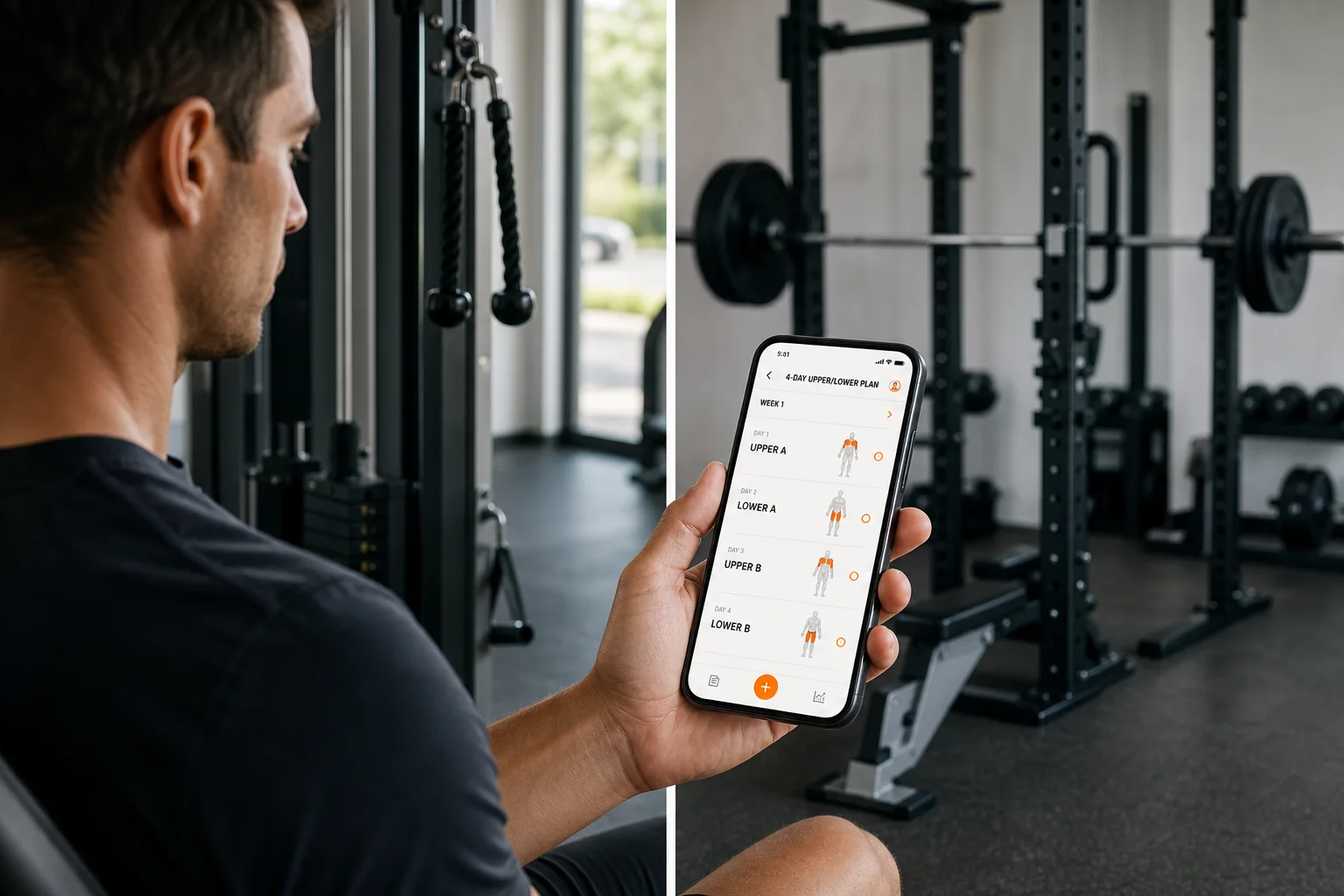
A 4 day upper lower workout plan is one of the most practical ways to organize strength and muscle-building training. You train your upper body twice, your lower body twice, and keep three days available for recovery, light activity, or life outside the gym.
The split works because it balances several important training decisions: weekly frequency, manageable session length, exercise variety, and recovery. It is not automatically better than a full-body or push-pull-legs routine, but it gives many people a clear structure without requiring five or six gym visits each week.
This guide explains how to build a flexible upper lower split for beginner-to-intermediate lifters, how to arrange your week, and how to progress safely over time.
What is a 4 day upper lower workout plan?
An upper lower split divides training into two categories:
- Upper-body sessions: chest, back, shoulders, biceps, and triceps.
- Lower-body sessions: quadriceps, hamstrings, glutes, calves, and core.
In a four-day routine, each category is usually trained twice per week. A simple schedule looks like this:
- Monday: Upper A
- Tuesday: Lower A
- Wednesday: Rest or easy activity
- Thursday: Upper B
- Friday: Lower B
- Saturday: Rest or optional low-intensity cardio
- Sunday: Rest
This arrangement gives most muscle groups roughly two training exposures per week. It also separates the two upper sessions and two lower sessions, helping you distribute training volume instead of cramming it into one long workout.
Who should use an upper lower split?
A four-day upper lower workout routine is often a good fit if you:
- Can consistently train four days per week.
- Want to build strength, muscle, or both.
- Prefer repeating key movement patterns throughout the week.
- Have enough training experience to perform compound exercises with controlled technique.
- Want more weekly volume than a two-day routine can comfortably provide.
Beginners can use this structure, but they may need fewer exercises and sets at first. If four weekly sessions are unrealistic, a two- or three-day plan that you complete consistently may be more effective for you. The best split is the one that fits your schedule, energy, equipment, and ability to recover.
For help comparing different weekly structures, see our guide to the 5 day upper lower workout plan.
How much training volume should you use?
Volume is one of the main variables to manage in a muscle-building program. A useful starting point is approximately 6 to 10 challenging working sets per major muscle group per week, then adjusting based on performance, soreness, recovery, and progress.
That does not mean every person should immediately perform 10 sets for every muscle. Compound exercises also train secondary muscles. For example, pressing works the chest, front shoulders, and triceps, while rows train the back and involve the biceps.
Start at the lower end if you are new to structured resistance training. Add sets only when your current workload is no longer producing progress and you are recovering well. More work is not automatically better if it reduces exercise quality or causes persistent fatigue.
A practical 4 day upper lower workout plan
The following template is designed for general strength and hypertrophy. Use a load that allows you to complete the target repetitions with good form and approximately one to three repetitions left in reserve on most working sets.
Upper A: horizontal push and pull emphasis
- Barbell or dumbbell bench press: 3 sets of 5–8 reps
- Chest-supported row: 3 sets of 6–10 reps
- Seated shoulder press: 2 sets of 8–10 reps
- Lat pulldown or assisted pull-up: 2–3 sets of 8–12 reps
- Lateral raise: 2 sets of 12–20 reps
- Triceps extension: 2 sets of 10–15 reps
- Dumbbell curl: 2 sets of 10–15 reps
Lower A: squat and bilateral strength emphasis
- Back squat, front squat, or leg press: 3 sets of 5–8 reps
- Romanian deadlift: 3 sets of 6–10 reps
- Walking lunge or split squat: 2 sets of 8–12 reps per side
- Leg curl: 2 sets of 10–15 reps
- Standing calf raise: 3 sets of 8–15 reps
- Plank or dead bug: 2–3 controlled sets
Upper B: vertical push and pull emphasis
- Overhead press: 3 sets of 5–8 reps
- Pull-up, assisted pull-up, or pulldown: 3 sets of 6–10 reps
- Incline dumbbell press: 3 sets of 8–12 reps
- One-arm cable or dumbbell row: 2–3 sets of 8–12 reps
- Rear-delt fly: 2 sets of 12–20 reps
- Incline curl: 2 sets of 10–15 reps
- Overhead triceps extension: 2 sets of 10–15 reps
Lower B: hip hinge and unilateral emphasis
- Deadlift variation or trap-bar deadlift: 2–3 sets of 3–6 reps
- Front squat, hack squat, or goblet squat: 3 sets of 8–12 reps
- Hip thrust or glute bridge: 2–3 sets of 8–12 reps
- Reverse lunge or step-up: 2 sets of 8–12 reps per side
- Seated leg curl: 2 sets of 10–15 reps
- Seated calf raise: 3 sets of 10–20 reps
- Cable crunch or reverse crunch: 2–3 sets of 10–15 reps
You do not need to use every exercise listed. Select one movement from each category, prioritize exercises you can perform comfortably, and adjust the routine to your available equipment. Machines, dumbbells, cables, resistance bands, and bodyweight movements can all be useful training tools.
How to choose exercises for your level
For beginners
Use one main movement and two to four assistance exercises per session. Choose stable exercises that make technique easier to learn, such as a leg press instead of a barbell squat or a chest-supported row instead of a demanding bent-over row.
Two working sets per exercise may be enough initially. Keep several repetitions in reserve and focus on consistent range of motion, controlled tempo, and repeatable technique.
For intermediate lifters
Use a heavier primary lift early in the session, followed by moderate-repetition exercises for specific muscles. You can vary the emphasis between sessions—for example, making Upper A more strength-focused and Upper B more hypertrophy-focused.
Intermediate lifters should also track performance. If you cannot identify whether your repetitions, load, or technique are improving, it becomes difficult to make informed adjustments.
How to progress week by week
A simple progression system is double progression:
- Choose a repetition range, such as 8–12 reps.
- Keep the same weight until you can reach the top of the range on every set with reliable form.
- Increase the load slightly at the next session.
- Return to the lower end of the range and build up again.
For example, if you perform three sets of dumbbell presses at 10, 10, and 9 reps, keep the same weight next time. When you can complete 12, 12, and 12 with good technique, increase the load by the smallest practical amount.
Progress is not limited to adding weight. You can also improve by completing more repetitions, using a steadier tempo, achieving better range of motion, or doing the same workload with less unnecessary fatigue. Avoid increasing load when technique breaks down or joint discomfort changes the movement.
Recovery guidelines for a four-day plan
The schedule matters, but recovery determines whether you can repeat quality sessions. Keep at least one rest or low-stress day between the second upper and second lower sessions when possible. If your lower body remains exhausted after Tuesday, reduce Tuesday’s volume or move Lower B later in the week.
- Sleep: Maintain a consistent sleep schedule and prioritize enough total sleep for your needs.
- Warm-up: Perform general movement followed by lighter sets of your first exercises.
- Effort: Most sets do not need to reach complete muscular failure.
- Cardio: Keep additional conditioning compatible with your leg recovery.
- Deloads: When performance, motivation, or recovery declines for several sessions, temporarily reduce sets or load.
Muscle soreness is not a reliable measure of workout quality. Look instead at performance trends, energy, technique, sleep, and whether you are ready to train the same muscle group again.
Common mistakes to avoid
- Doing too much too soon: Starting with maximum volume often makes the routine difficult to sustain.
- Changing exercises every week: Keep key movements long enough to learn them and evaluate progress.
- Ignoring the second session: Upper A and Upper B do not need to be identical, but both should contribute meaningful work.
- Training through sharp pain: Stop an exercise that causes concerning pain and seek qualified professional advice when needed.
- Forgetting the logbook: Without tracking, progression becomes guesswork.
How GymPT can personalize the plan
A template is a useful starting point, but the best version of a four-day split depends on your goal, training history, equipment, schedule, and recovery. GymPT can help turn those details into a more personalized workout plan, recommend exercises that match your available equipment, and keep your sessions organized.
You can also use AI coach chat to ask how to modify an exercise, review your weekly structure, or adjust training when your schedule changes. Workout tracking and progress insights make it easier to see whether your plan is working instead of relying only on motivation or soreness.
If you want to compare this structure with another four-day option, read our 4 day full body workout plan. For a broader approach to customizing training, explore our guide to a personalized gym app.
Bottom line
A well-planned 4 day upper lower workout plan gives each major muscle group two weekly training opportunities while preserving useful recovery time. Start with moderate volume, choose exercises you can perform consistently, leave room to progress, and adjust the routine when your performance or schedule changes.
Consistency, clear progression, and recovery will usually matter more than finding a perfect exercise list. Build the plan around the training you can repeat—and let the details evolve as you become stronger.