2 day push pull legs workout plan
2 Day Push Pull Legs Workout Plan: How to Make a Low-Frequency Split Work
A 2 day push pull legs workout plan can work well when you need a simple, repeatable structure. Here’s how to set it up, recover, and progress without guessing.
2 Day Push Pull Legs Workout Plan: How to Make a Low-Frequency Split Work
A 2 day push pull legs workout plan sounds unusual at first because the classic push-pull-legs split is often associated with three or more lifting days per week. But if you only have two training days, you can still use the same logic: organize your sessions around movement patterns, train the major muscle groups efficiently, and leave enough room for recovery. That approach fits the broader evidence that adults should do muscle-strengthening work at least two days per week, and that resistance training frequency should match your recovery capacity and schedule.
This guide shows you how to turn a low-frequency split into a practical plan. You’ll see who it works best for, how to structure the two sessions, how to progress week to week, and how to avoid the most common mistakes.
Who a 2 Day Push Pull Legs Workout Plan Is Best For
This setup is usually best for people who want a simple, sustainable routine rather than the highest possible training volume. It can work well for:
- Beginners who need a manageable schedule and more time to learn form.
- Busy lifters who can only commit to two gym sessions most weeks.
- People returning to training who want to rebuild consistency before increasing frequency.
- Anyone using a full-body or hybrid schedule who wants a clear push/pull structure without overcomplicating the week.
For beginners, training two or three days per week is a standard recommendation, and nonconsecutive sessions are commonly used to support recovery. More experienced lifters often benefit from higher frequency, but that does not mean lower-frequency training is useless; it just means you need to be more intentional with exercise selection and progression.
How to Think About the Split When You Only Train Twice
With only two lifting days, you are not really doing a full classic push-pull-legs rotation every week. Instead, you are using push and pull as the organizing framework for two efficient sessions, while still including lower-body work in both workouts. That is the smartest way to keep the plan balanced.
In practice, the split looks like this:
- Day 1: Push emphasis — chest, shoulders, triceps, plus a lower-body movement.
- Day 2: Pull emphasis — back, rear delts, biceps, plus a lower-body movement.
This keeps the plan realistic because your legs still need enough weekly work to progress. It also avoids the common mistake of trying to cram an entire leg day into one session and then leaving the upper body undertrained.
Sample 2 Day Push Pull Legs Workout Plan
Day 1: Push Emphasis
- Squat pattern — 3 sets of 5 to 8 reps
- Bench press or machine chest press — 3 sets of 6 to 10 reps
- Overhead press — 2 to 3 sets of 6 to 10 reps
- Incline dumbbell press or push-up variation — 2 sets of 8 to 12 reps
- Lateral raise — 2 sets of 12 to 15 reps
- Triceps pressdown or overhead extension — 2 sets of 10 to 15 reps
Day 2: Pull Emphasis
- Hinge pattern — 3 sets of 5 to 8 reps
- Lat pulldown or pull-up — 3 sets of 6 to 10 reps
- Row variation — 3 sets of 6 to 10 reps
- Rear delt fly or face pull — 2 sets of 12 to 15 reps
- Biceps curl — 2 to 3 sets of 8 to 12 reps
- Split squat or leg curl — 2 sets of 8 to 12 reps
If you train at home or in a limited gym, swap in equipment-based alternatives that match your setup. The key is not the exact exercise list; it is keeping the movement pattern, effort level, and weekly balance consistent.
How Much Volume Should You Use?
With only two sessions per week, volume matters more than fancy exercise variety. A good starting point is to aim for enough hard sets to stimulate progress without making each workout so long that recovery suffers.
For most people, a practical target is:
- 2 to 4 exercises per major movement pattern each week
- About 8 to 14 hard sets per muscle group per week if recovery is good
- 1 to 3 reps in reserve on most working sets, especially on compound lifts
That said, the right amount depends on your training age, sleep, stress, and how hard the sets actually are. If you are new, start lower. If you are experienced and recovering well, you can slowly add sets over time. The NSCA notes that frequency should be adjusted to the client’s status and overall stress, and that recovery between sessions matters just as much as the workout itself.
Recovery Rules That Make This Split Work
Because the plan is low-frequency, each session has to count. That also means you should protect recovery so the next workout is productive instead of a grind.
- Keep the two sessions nonconsecutive when possible, such as Monday and Thursday or Tuesday and Friday.
- Do not turn every set into a max effort set; save true all-out work for occasional top sets or final sets.
- Sleep and food matter because they influence how well you adapt between sessions.
- Use lighter accessories strategically so the workout is complete without becoming exhausting.
WHO guidance also supports muscle-strengthening activity on at least two days per week for adults, which makes this kind of schedule a sensible minimum for general fitness.
How to Progress Week by Week
The simplest progression model is to keep the exercises stable long enough to measure improvement. If you change the plan every week, you cannot tell whether you are actually getting stronger.
Use one of these progression methods:
- Double progression: stay in a rep range, add reps first, then add weight when you hit the top of the range.
- Load progression: add a small amount of weight when all sets feel controlled and technically solid.
- Set progression: add one set to a key lift if recovery is strong and progress has stalled.
A simple example: if your bench press is 3 sets of 6 to 10 reps, keep the same weight until you can do 10 reps on all three sets with good form. Then increase the load slightly and repeat.
That kind of gradual progression is consistent with strength-training guidance that emphasizes controlled increases rather than random jumps in workload.
Common Mistakes to Avoid
- Trying to fit a full three-day split into two days and making each workout too long.
- Skipping legs because the split feels upper-body focused.
- Using too many exercises and losing quality on the important lifts.
- Training hard but not tracking anything, which makes progression guesswork.
- Adding volume too quickly before you know how your body responds.
If you want the plan to work, keep it boring in the best way: repeatable exercises, clear rep targets, and consistent effort.
How GymPT Can Help You Run This Plan Better
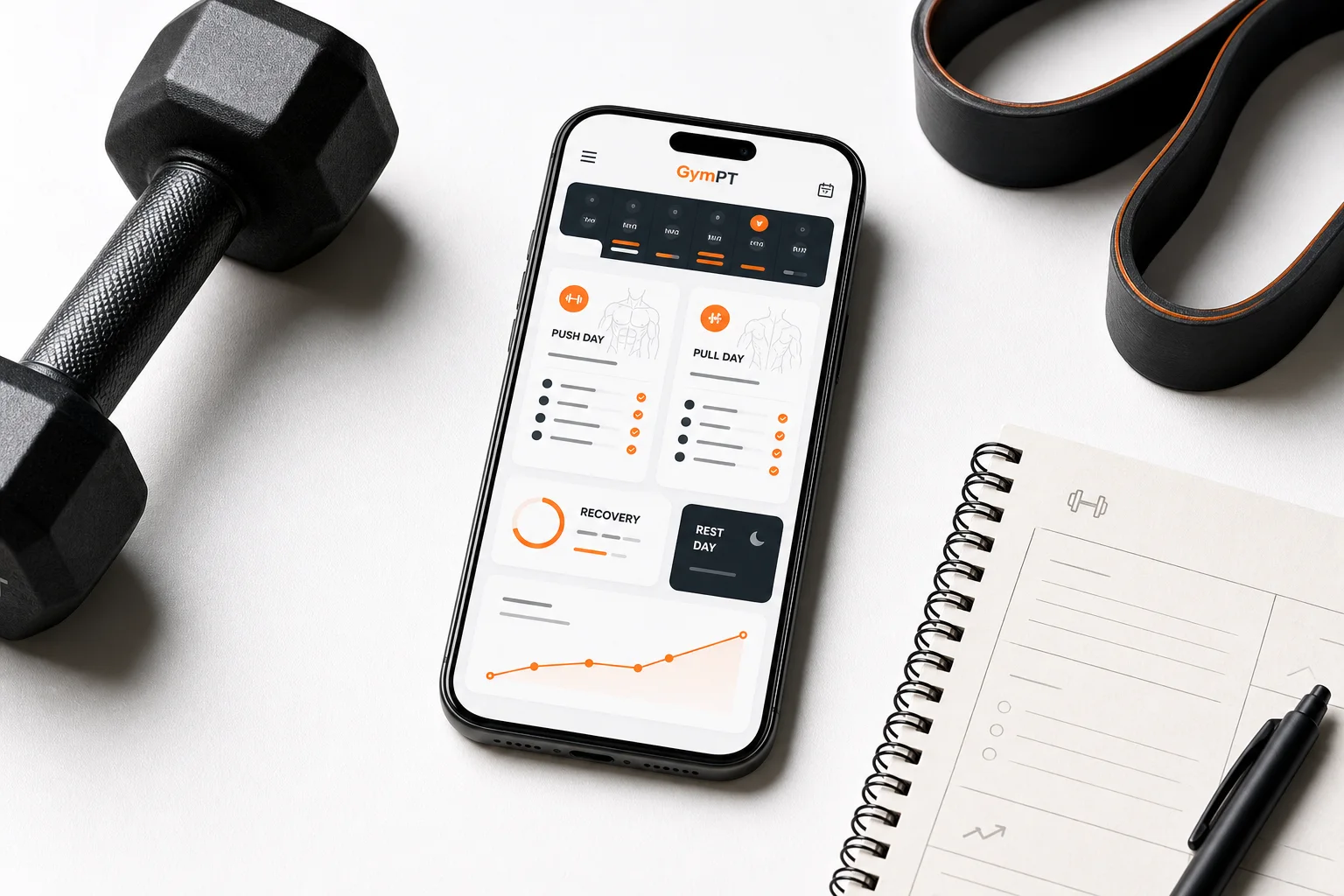
A low-frequency plan works best when you can see what is happening from week to week. GymPT can help by building a personalized workout plan, adjusting training around your equipment, tracking completed sessions, and showing progress insights so you know when to add reps, load, or recovery time. If you are unsure how to organize your week, the AI coach chat can also help you adapt the split to your schedule and experience level.
For more planning ideas, you may also like 3 Day Full Body Workout Plan: How to Train Smarter, Recover Better, and Progress Week by Week, 4 Day Full Body Workout Plan: A Practical Guide to Training, Recovery, and Progression, 5 Day Full Body Workout Plan: How to Train Hard, Recover Well, and Keep Progressing, and AI Workout Coach for Beginners: How to Start Safely, Stay Consistent, and Make Real Progress.
Bottom Line
A 2 day push pull legs workout plan is not about doing everything. It is about doing the right things often enough to improve. If you train the major movement patterns, keep sessions nonconsecutive, progress gradually, and track your work, two days per week can be a very effective starting point or maintenance plan. For many people, the best program is the one they can repeat consistently.