3 day workout plan for muscle gain
3 Day Workout Plan for Muscle Gain: A Practical Hypertrophy Split That Actually Works
A practical 3 day workout plan for muscle gain built around hypertrophy basics, progressive overload, and recovery—plus how to adjust it with GymPT.
If you want a 3 day workout plan for muscle gain, the goal is not to do everything in one session. The goal is to train each major muscle group with enough quality work, recover well, and repeat that stimulus week after week. That is what drives hypertrophy: a mix of hard sets, sensible volume, and gradual progression over time.
For most lifters, a 3-day split is one of the most practical ways to build muscle. It fits busy schedules, leaves room for recovery, and still gives you enough weekly training exposure to make progress. Public health guidance also supports regular muscle-strengthening activity across the week, and research suggests that training a muscle more than once per week can be effective when weekly volume is managed well.
What makes a 3-day plan good for muscle gain?
A good muscle-building plan is not just a list of exercises. It should help you do four things consistently:
- Train all major muscle groups each week.
- Use enough weekly volume to create a growth stimulus.
- Progress over time by adding reps, load, or sets.
- Recover between sessions so performance stays high.
That is why a 3-day plan works so well for many people. You can spread your work across the week, keep sessions focused, and avoid the fatigue that often comes from cramming too much into fewer workouts.
Hypertrophy basics: what actually builds muscle?
Muscle growth happens when training creates a signal your body adapts to over time. In practice, that means challenging the muscle with enough tension and enough total work to force adaptation. The exact “best” rep range is less important than whether the sets are hard, controlled, and repeated consistently.
For most lifters, the most useful hypertrophy principles are simple:
- Work close to failure on most sets, while keeping form solid.
- Use a mix of compound and isolation exercises so you can train efficiently and target lagging muscles.
- Accumulate weekly sets across the muscles you want to grow.
- Recover enough to repeat good performances next session.
That is why a 3-day split should feel challenging, but not crushing. If every workout leaves you unable to train well for days, the plan is probably too aggressive.
The best 3 day workout split for muscle gain
There are several good ways to structure a 3-day routine. For muscle gain, one of the most effective and beginner-friendly options is a full-body split performed three times per week. This gives each muscle repeated practice and enough weekly exposure without overcomplicating the plan.
Here is a practical example:
Day 1: Squat emphasis
- Back squat or leg press — 3 to 4 sets of 6 to 10 reps
- Bench press or machine chest press — 3 to 4 sets of 6 to 10 reps
- Row variation — 3 to 4 sets of 8 to 12 reps
- Romanian deadlift — 2 to 3 sets of 8 to 12 reps
- Lateral raise — 2 to 3 sets of 12 to 20 reps
- Optional curl or triceps pressdown — 2 sets of 10 to 15 reps
Day 2: Hinge emphasis
- Deadlift variation or hip hinge machine — 3 sets of 5 to 8 reps
- Overhead press or machine shoulder press — 3 to 4 sets of 6 to 10 reps
- Lat pulldown or assisted pull-up — 3 to 4 sets of 8 to 12 reps
- Split squat or lunge — 2 to 3 sets of 8 to 12 reps per leg
- Chest fly or incline press — 2 to 3 sets of 10 to 15 reps
- Core exercise — 2 to 3 sets
Day 3: Volume and balance
- Front squat, hack squat, or leg press — 3 to 4 sets of 8 to 12 reps
- Dumbbell bench press or push-up variation — 3 to 4 sets of 8 to 12 reps
- Seated row or cable row — 3 to 4 sets of 8 to 12 reps
- Leg curl — 2 to 3 sets of 10 to 15 reps
- Biceps curl — 2 to 3 sets of 10 to 15 reps
- Triceps extension — 2 to 3 sets of 10 to 15 reps
This structure works because it balances heavy work, moderate-volume work, and enough exercise variety to keep the plan sustainable.
How much volume do you need?
Volume matters because muscle growth is strongly influenced by the amount of quality work you do over time. A practical way to think about it is weekly hard sets per muscle group. If you are new, you may grow well on the lower end. If you are more advanced, you may need more work to keep progressing.
A simple starting point:
- Large muscle groups like quads, chest, back, and glutes: about 8 to 14 hard sets per week
- Smaller muscle groups like biceps, triceps, and side delts: about 6 to 10 hard sets per week
Start conservatively. If you are recovering well and performance is improving, add a set or two over time. If your lifts stall, sleep worsens, or soreness lingers too long, reduce volume slightly.
Progressive overload: the engine of long-term growth
Progressive overload means making training a little more demanding over time. That does not always mean adding weight every session. You can progress in several ways:
- Add 1 rep to a set while keeping the same load.
- Add a small amount of weight once you hit the top of a rep range.
- Add one extra set to a muscle that is recovering well.
- Improve exercise control, range of motion, or tempo.
Example: if you are doing dumbbell bench press for 3 sets of 8 to 12 reps, you might stay at the same weight until you can hit 12 reps on all sets with good form. Then you increase the load and repeat the process.
This is one of the biggest reasons a 3 day workout plan for muscle gain works: it is simple enough to track, which makes progression easier to measure.
Recovery is part of the plan, not an afterthought
Muscle is built between workouts, not during them. If recovery is poor, your next session suffers and your progress slows. The CDC recommends at least two days of muscle-strengthening activity each week for adults, and a 3-day plan fits comfortably within that framework while leaving room for recovery.
To recover well:
- Leave at least one rest day between lifting sessions when possible.
- Sleep consistently and aim for enough total sleep each night.
- Eat enough protein and calories to support growth.
- Do not max out every set; save true all-out efforts for selected sets.
If you are constantly sore, flat, or weaker from workout to workout, the issue is usually not motivation. It is usually recovery, volume, or exercise selection.
How to choose exercises for your goal
The best exercises are the ones you can perform well, progress over time, and recover from. For most people, that means building the plan around stable compound lifts and adding isolation work where needed.
- For legs: squat, leg press, split squat, leg curl, hip hinge
- For chest and triceps: bench press, machine press, incline press, fly, pressdown
- For back and biceps: row, pulldown, pull-up, curl
- For shoulders: overhead press, lateral raise, rear delt fly
If you train at a gym with machines, machines can be excellent for hypertrophy because they make it easier to keep tension on the target muscle and manage fatigue. If you train at home, dumbbells, bands, and bodyweight variations can still work very well.
How to know if your plan is working
You do not need to guess. A good muscle-gain plan usually shows progress in a few clear ways:
- You are adding reps or load over time.
- Your working sets feel more controlled at the same weight.
- Your measurements, photos, or body analysis trends improve gradually.
- You feel challenged, but not chronically drained.
If progress stalls for 2 to 4 weeks, adjust one variable at a time. Add a set, improve sleep, reduce junk volume, or swap an exercise that is hard to progress.
A simple weekly schedule you can follow
Here is a clean weekly layout:
- Monday: Full-body workout A
- Wednesday: Full-body workout B
- Friday: Full-body workout C
That spacing gives you recovery days between sessions and keeps the week easy to remember. If your schedule changes, the exact days matter less than keeping the sessions consistent.
How GymPT can help you stay on track
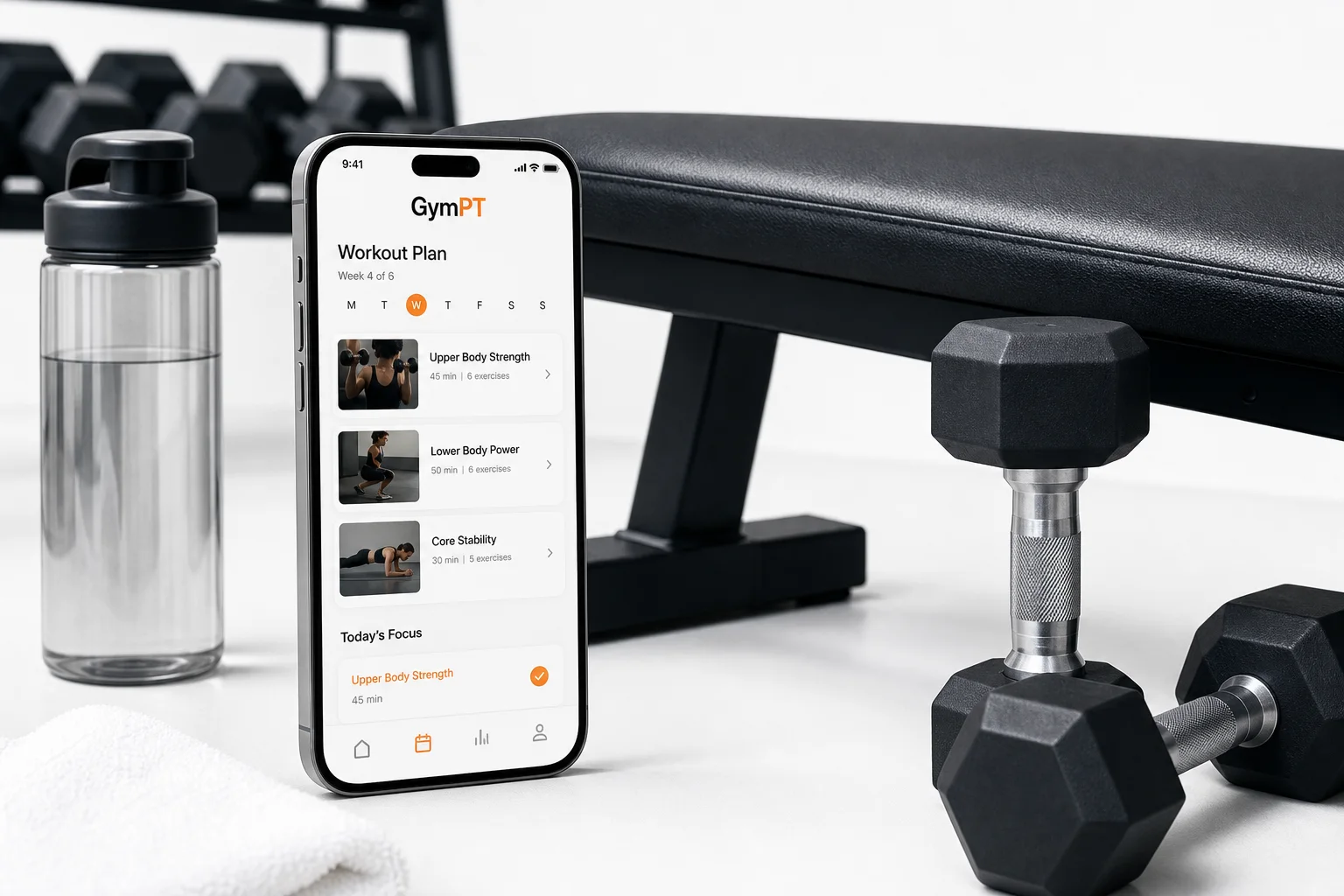
Planning is only half the battle. The harder part is adjusting when life, energy, or recovery changes. That is where GymPT can help. You can use it to build a personalized plan, track workouts, review progress insights, and adapt training based on the equipment you actually have.
If you want more structure, GymPT’s AI coach chat can help you refine exercise selection, volume, and progression without starting from scratch every time. That makes it easier to stay consistent long enough for the plan to work.
Sample 3 day workout plan for muscle gain
Use this as a starting template and adjust based on your experience level, equipment, and recovery.
Workout A
- Squat — 3 x 6 to 10
- Bench press — 3 x 6 to 10
- Row — 3 x 8 to 12
- Romanian deadlift — 2 x 8 to 12
- Lateral raise — 2 x 12 to 20
Workout B
- Deadlift variation — 3 x 5 to 8
- Overhead press — 3 x 6 to 10
- Lat pulldown — 3 x 8 to 12
- Split squat — 2 x 8 to 12 per leg
- Triceps pressdown — 2 x 10 to 15
Workout C
- Leg press — 3 x 8 to 12
- Incline dumbbell press — 3 x 8 to 12
- Seated cable row — 3 x 8 to 12
- Leg curl — 2 x 10 to 15
- Biceps curl — 2 x 10 to 15
Rest 1 to 3 minutes between most sets. Use longer rests for heavier compound lifts and shorter rests for isolation work.
Common mistakes to avoid
- Doing too much too soon. More is not always better if recovery collapses.
- Changing exercises every week. Progress is easier to track when movements stay stable.
- Training only the muscles you like. Balanced growth matters for performance and aesthetics.
- Ignoring progression. If nothing changes, your body has less reason to adapt.
- Skipping recovery. Sleep and nutrition are part of the program.
Final take
The best 3 day workout plan for muscle gain is the one you can repeat, recover from, and progress on. Keep the structure simple, train each major muscle group with enough weekly work, and make small improvements over time. That is how hypertrophy becomes predictable instead of random.
If you want help turning this into a plan that fits your schedule and equipment, GymPT can build it for you and keep it updated as you progress.
Train smart. Recover well. Add a little more over time.