
45-Minute Muscle Building Workout Plan: Two Full-Body Sessions
Build a repeatable muscle-building routine with two 45-minute full-body workouts, a simple weekly schedule, and a progression method you can track.
In this article
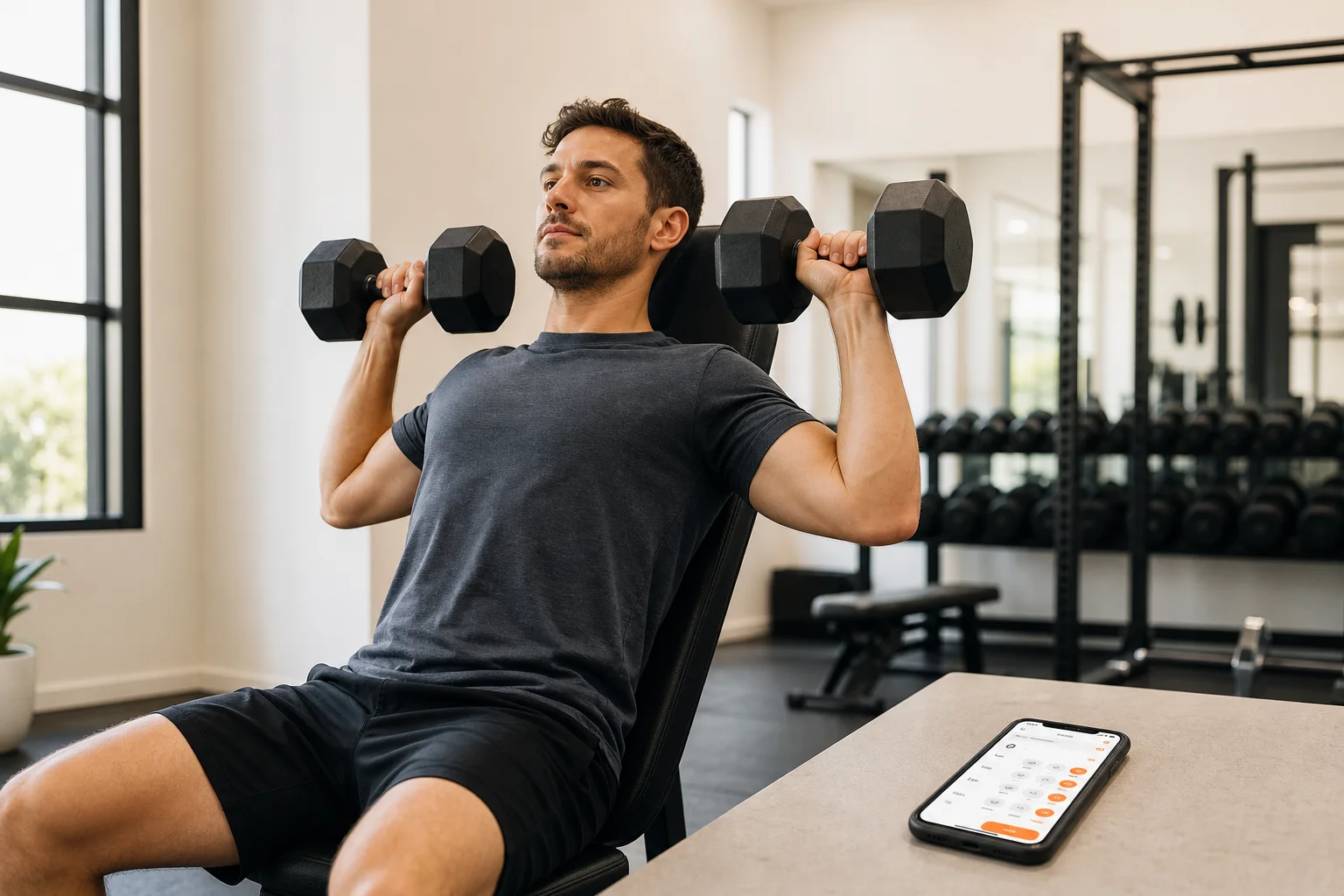
A 45 minute muscle building workout plan works best when you spend your time on a manageable number of challenging sets, not a long list of rushed exercises. This two-session routine trains the major muscle groups with straightforward equipment, planned rest, and a progression method you can follow from workout to workout.
Alternate Workout A and Workout B across the week. For example, train Monday, Wednesday, and Friday, switching sessions each time. The exact days can change; leave a rest day between lifting sessions when practical. The goal is a plan you can repeat, record, and gradually make more challenging while keeping your technique consistent.
What makes a 45-minute muscle-building workout effective?
Muscle growth, also called hypertrophy, comes from consistent resistance training over time. A useful session includes exercises that challenge different muscle groups, enough hard working sets to provide a training stimulus, and a way to progress. You do not need to take every set to the point where you cannot complete another repetition. Most sets can finish with about one to three good-form repetitions left in reserve.
Time limits are a reason to prioritize, not to skip rest on every exercise. Rest roughly two minutes after demanding compound lifts, and around 60–90 seconds after smaller accessory movements. If you pair exercises for opposing areas, such as a press and a row, you can alternate them while keeping useful recovery between sets.
There is no single set count that suits everyone. Start with the work below, pay attention to how your performance and recovery respond, and avoid adding volume just because a session feels short. More weekly training can help, but the benefit of added sets can diminish, and recoverability matters.
Your 45 minute muscle building workout plan
Use a clock as a gentle guide, not a reason to rush repetitions. The schedule below allows about five minutes to warm up, roughly 35–37 minutes for lifting, and a few minutes to note what you did. If you need extra rest to keep your form controlled, take it and let the session run slightly over.
Workout A: squat, press, row, and hinge
- 0–5 minutes — Warm-up: Move easily for a few minutes, then do a couple of lighter practice sets for your first lift. Warm up with movements that prepare you for the exercises you chose.
- 5–15 minutes — Squat or leg press: 3 sets of 6–10 repetitions. Rest about two minutes between working sets.
- 15–27 minutes — Bench press and seated row: 3 sets of 8–12 repetitions for each. Alternate a set of bench press with a set of rows; rest as needed between exercises.
- 27–36 minutes — Romanian deadlift: 3 sets of 8–12 repetitions. Use a controlled range of motion and keep the load appropriate for your technique.
- 36–41 minutes — Lateral raise: 2 sets of 12–20 repetitions, with about a minute of rest.
- 41–45 minutes — Record and reset: Note exercise variations, loads, repetitions, and anything you want to adjust next time.
Choose a squat or leg-press variation you can perform confidently. The bench press can be a dumbbell press or a suitable machine press; the row can be a cable, machine, or dumbbell variation. Keep the basic movement pattern consistent long enough to compare your sessions.
Workout B: single-leg work, vertical push and pull, and glutes
- 0–5 minutes — Warm-up: Start with easy movement and lighter practice repetitions for your first exercise.
- 5–14 minutes — Split squat or reverse lunge: 3 sets of 8–12 repetitions per side. Use a stable setup and choose a variation that fits your current ability.
- 14–26 minutes — Overhead press and lat pulldown: 3 sets of 8–12 repetitions for each. Alternate the exercises, resting enough to keep each set controlled.
- 26–35 minutes — Hip thrust or glute bridge: 3 sets of 8–12 repetitions.
- 35–41 minutes — Hamstring curl: 2 sets of 10–15 repetitions.
- 41–45 minutes — Record and reset: Log your work and note whether the selected loads felt appropriate.
If a machine or piece of equipment is unavailable, substitute a similar movement pattern rather than waiting through most of your session. For example, use a chest-supported row instead of a seated row, or a dumbbell press instead of a barbell press. See this gym equipment workout plan for more ideas about adapting to what is available.
How to schedule the workouts
Train two or three times per week, alternating A and B. Here is a sample three-day week:
- Week 1: Monday A, Wednesday B, Friday A.
- Week 2: Monday B, Wednesday A, Friday B.
If two sessions fit your week better, do A and B on separate days, then continue with the next workout the following week. A repeatable two-day schedule is more useful than a more ambitious plan you regularly miss. If you are new to lifting or returning after a long break, start with lighter loads and fewer working sets if needed, then build up as the sessions feel manageable. You can also use this simple restart plan after a break.
Progressive overload: a simple way to move forward
Progressive overload means gradually increasing the training challenge as your capacity improves. It does not mean adding weight at every workout. For this plan, use a double-progression approach:
- Choose a load that lets you reach the lower end of the repetition range with controlled form and a little effort left.
- Keep that load and try to add repetitions across later sessions, while staying within the listed range.
- When you can complete the top of the range on every set with good technique, increase the load by a small amount next time.
- Return toward the lower end of the range and build repetitions again.
For example, on a 3-by-8–12 exercise, you might record 10, 9, and 8 repetitions. Keep the load the same and aim to add a repetition where you can. Once you can perform 12 repetitions for all three sets with steady form, increase the weight modestly. If a new load makes you fall below the target range or changes your technique, reduce it and build back gradually.
Track the exercise variation as well as the weight. A dumbbell press and a barbell press are not identical entries, and changing equipment, range of motion, or setup can make comparisons less useful. For a deeper look at recording gradual progress, read this progressive overload workout plan guide.
Recovery and workout adjustments
Recovery is part of the program: it helps you return ready to train again. Leave time between full-body sessions, aim for regular sleep, and eat enough to support your usual activity and goals. If your repetitions or technique are slipping across several sessions, you feel unusually worn down, or soreness is affecting your next workout, consider reducing a set, easing the load, or taking more recovery time.
Do not try to make up missed training by cramming several sessions together. Resume with the next workout when your schedule allows. If an exercise causes pain, stop that movement and choose a comfortable alternative; seek qualified professional guidance when you need help adapting training to your circumstances.
Make the plan fit your week
A good muscle-building plan is one you can perform consistently and adjust thoughtfully. Keep the two sessions simple, use loads that allow controlled repetitions, and record each workout so you can see whether you are progressing. If you would rather begin with fewer sessions or a simpler split, compare this routine with a two-session muscle-building plan.
With GymPT, you can build a manual program and save workout records with a free account; core training does not require a paid subscription. You can also request optional AI support or review a program proposal from a personal trainer and decide whether to save and use it. AI features may have separate requirements shown before use. Whatever tool you use, let your training record and your judgment guide small, sustainable adjustments.